Samsung’s First AI Glasses Launch in November With No Display
Buyers will get a screen-free device that integrates with a Galaxy phone, no confirmed price, and a camera already drawing scrutiny from Korean privacy regulators before a single unit ships.

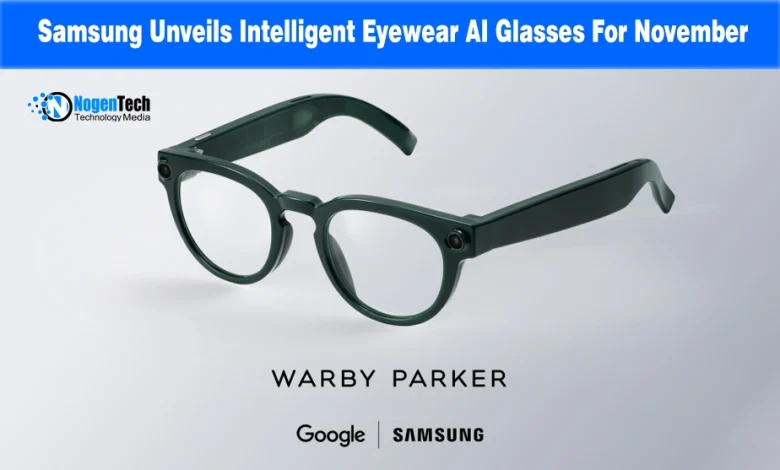
Samsung confirmed to The Korea Herald that its first AI glasses, Intelligent Eyewear, will launch in November following earlier previews at the Google I/O in May and Galaxy Unpacked in London in July.
The device runs on Android XR and was built in partnership with Google and eyewear brands Gentle Monster and Warby Parker, but Samsung has not announced pricing.
The glasses carry no visual display: a built-in camera and microphones capture what the wearer sees and hears, Google’s Gemini processes that input, and responses come back only through speakers built into the frame.
The Phone Dependency Nobody’s Framing as a Limitation
Intelligent Eyewear doesn’t process anything on its own. Every request routes through a connected smartphone.
While iPhones are supported for core audio and camera features, deep system integration requires a Galaxy device, a notable constraint given Apple’s market share.
Samsung is deliberately shipping without a display, opting for a screenless design until a basic grayscale panel for text and icons arrives between late 2027 and early 2028, as several industry reports indicate.
So, buyers in November are getting an audio-only, phone-dependent device as the opening move in a longer, multi-generation plan, not the finished product Samsung ultimately wants to sell.
Korean Regulators Are Already Involved Before Launch
Meta’s camera-equipped Ray-Ban glasses have already drawn criticism over covert recording, with incidents of people filmed without consent prompting some critics to label them “pervert glasses.”
As The Korean Herald details, South Korean privacy regulators met with the company in late July specifically to discuss how nearby people should be notified when a camera or microphone is active.
The Ministry of Science and ICT started drafting safer-use guidelines in September covering covert filming and exam-cheating concerns.
Samsung’s answer is LEDs inside and outside the frame that disable the camera if the external indicator gets covered, the same basic approach Meta uses, which hasn’t stopped the criticism aimed at Meta’s hardware.
A Launch Timed Right Behind Meta’s Own Pivot
Samsung enters an AI glasses market dominated by Meta, which held 94% of display-less shipments during H1 2026 as the segment grew 263% year-over-year, according to Counterpoint Research data cited by The Korea Herald.
Meta, notably, just introduced its own camera-free Ray-Ban Meta Audio glasses on September 23, explicitly responding to the same privacy pressure Samsung now faces before launch.
It reflects a stark reality: the camera that made smartglasses viral is also the feature people and regulators trust least.
While Samsung’s lighter design may attract early adopters, unannounced pricing, smartphone dependency, and strict regulatory oversight on bystander consent will determine if Intelligent Eyewear succeeds or becomes an expensive experiment.
Source: Samsung to launch first AI glasses in November, taking aim at Meta