
How Do Crypto Markets Work? A Beginner’s Guide to Trading and Trading Pairs
Crypto markets work by connecting buyers and sellers through centralized and decentralized exchanges, where trading pairs, market orders, limit orders, and supply and demand determine how digital assets are traded and priced.


Buying cryptocurrency may seem simple, but understanding how the market works is equally important. A cryptocurrency market connects buyers and sellers who trade digital assets such as Bitcoin and Ethereum through online platforms.
The term crypto market can refer to different activities:
- Bitcoin market: Demand and trading activity surrounding Bitcoin.
- Regional crypto market: Cryptocurrency activity within a specific country or region.
- Crypto exchanges: Platforms for buying, selling, and exchanging digital assets through centralized exchanges (CEXs) or decentralized exchanges (DEXs).
Like stock markets, crypto markets bring buyers and sellers together, but they operate 24/7, with prices changing based on trading activity. If you’re learning how to buy cryptocurrency, it’s also useful to understand exchange types, digital wallets, and trading pairs.
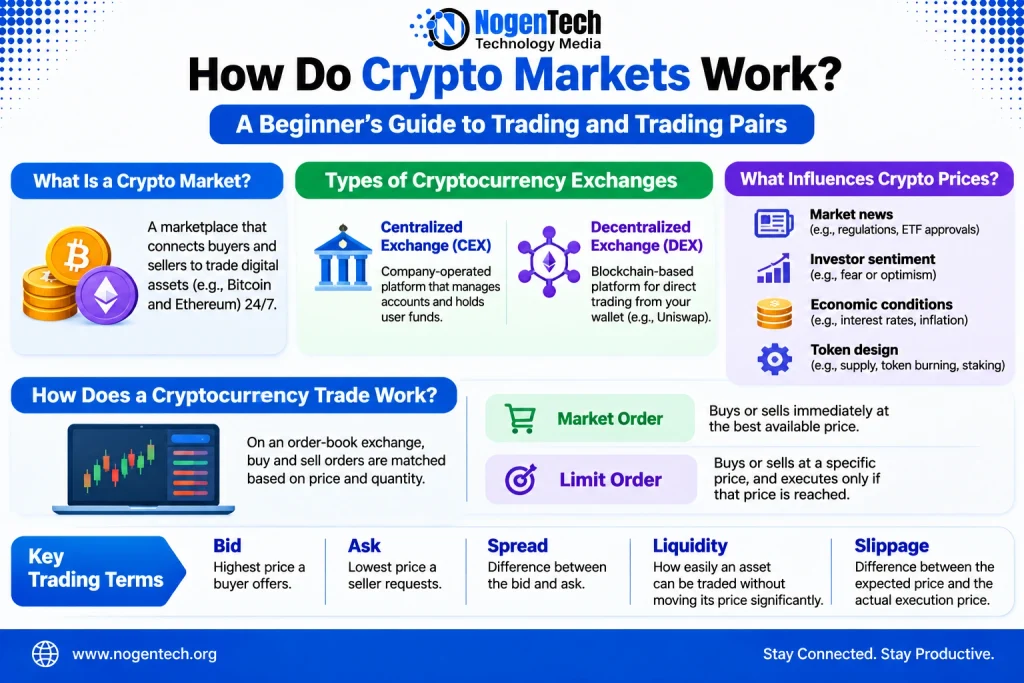
Types of Cryptocurrency Exchanges
Cryptocurrency exchanges allow users to trade digital assets, but they differ in how transactions are managed and who controls the funds.
1. Centralized Exchanges (CEXs)
Centralized exchanges are company-operated platforms that manage user accounts, trading services, and transactions.
They typically offer familiar interfaces where users can deposit funds, check prices, and place orders. Many also support traditional payment methods, making them accessible to beginners. Comparing the best crypto apps can help you find a platform that suits your trading needs.
However, using a CEX involves trusting its operator, particularly when the platform holds customer assets. Before choosing one, consider its security practices, trading fees, withdrawal policies, and regional availability.
2. Decentralized Exchanges (DEXs)
Decentralized exchanges use blockchain-based smart contracts to facilitate cryptocurrency trades directly from users’ wallets.
Unlike centralized platforms, DEXs typically allow users to maintain control of their assets without depositing them into an exchange-managed account. Uniswap is a well-known example.
These platforms require familiarity with crypto wallets, blockchain transactions, and network fees. Many primarily support crypto-to-crypto trading rather than direct purchases with traditional currencies.
However, decentralized trading still involves risks, including smart contract vulnerabilities, malicious tokens, and wallet-related mistakes. Hybrid exchanges also exist, combining selected features of centralized and decentralized trading.
What Influences Cryptocurrency Prices?
Cryptocurrency prices move according to buying and selling activity. When buyers accept higher asking prices, prices can rise. When sellers accept lower bids, prices can fall. Several factors influence these decisions:
- Market news: Regulatory developments, exchange-traded fund approvals, institutional adoption, and security incidents can affect demand.
- Investor sentiment: Fear and optimism influence trading decisions. Indicators such as the Crypto Fear & Greed Index help measure market sentiment but cannot reliably predict prices.
- Economic conditions: Interest rates, inflation reports, and geopolitical events can influence investors’ willingness to hold riskier assets.
- Token design: Maximum supply, token burning, staking rewards, and governance mechanisms affect how cryptocurrencies operate and how investors assess their value.
These factors often overlap, making short-term price movements difficult to predict. Understanding the key value drivers in crypto can help you evaluate market conditions, although limited token supply or positive news alone does not guarantee price increases.
How Does a Cryptocurrency Trade Work?
On an order-book exchange, buy and sell orders are organized in an order book, showing the prices and quantities participants are willing to trade. Two common order types determine how trades are executed.
Market Orders
A market order attempts to buy or sell cryptocurrency immediately against the best available offers. For example, when you place a market order to buy Bitcoin, the exchange matches it with available sellers. The execution price may differ from the displayed price, particularly during high volatility or low liquidity.
Limit Orders
A limit order lets you set the maximum price you’re willing to pay when buying or the minimum price you’ll accept when selling.
For example, if Bitcoin trades at $70,000, you could place a buy limit order at $68,000. It will execute only if suitable offers become available at $68,000 or lower. Unlike market orders, limit orders may remain unfilled.
Understanding Bid, Ask, Spread, and Liquidity
Several terms help explain how orders are matched:
- Bid: The highest price a buyer currently offers.
- Ask: The lowest price a seller currently requests.
- Spread: The difference between the highest bid and lowest ask.
- Liquidity: How easily an asset can be traded without significantly affecting its price.
- Slippage: The difference between the expected price and the actual execution price.
A narrow spread can indicate an active market, but liquidity also depends on available order quantities.
For example, a large market order may consume several sell offers at different prices, increasing the average purchase price. This is why order-book depth matters, especially for large trades or less popular cryptocurrencies. The Block’s guide to order-book depth explains this relationship in more detail.
Market makers help provide liquidity by regularly placing buy and sell quotes. Their activity supports order execution but cannot prevent sudden price movements.
What Are Cryptocurrency Trading Pairs?
A cryptocurrency trading pair identifies the two assets being exchanged. For example, BTC/USDT represents Bitcoin (BTC) and Tether (USDT), a stablecoin designed to track the US dollar.
Here’s how the pair works:
- BTC (base asset): The cryptocurrency being bought or sold.
- USDT (quote asset): The asset used to express Bitcoin’s price.
- Buying BTC/USDT: Spending USDT to acquire Bitcoin.
- Selling BTC/USDT: Exchanging Bitcoin for USDT.
If BTC/USDT trades at 70,000, one Bitcoin is quoted at 70,000 USDT. Other examples include ETH/USDT, BTC/ETH, and ETH/BTC.
Trading pairs allow users to exchange cryptocurrencies without converting their holdings into traditional currency after every transaction. Available pairs vary by exchange and region, so always confirm the assets and transaction direction before placing an order.
How Do Regulations Affect Crypto Markets?
Cryptocurrency trading operates globally, but regulations vary by country. Governments may impose licensing requirements, identity verification rules, trading restrictions, or tax obligations.
These regulations can determine:
- Which exchanges operate in a particular country.
- Whether identity verification is required.
- Which cryptocurrencies and trading products are available.
- How platforms handle compliance and customer information.
- What reporting and tax obligations apply.
Regulatory changes can also influence investor confidence and market participation. Before registering, check whether an exchange supports your region and what requirements apply to its services.
Who Participates in Cryptocurrency Markets?
Crypto markets involve participants with different objectives, resources, and strategies.
- Individual traders: Buy and sell cryptocurrencies using personal funds, either for long-term holding or short-term trading.
- Institutional investors: Investment funds, asset managers, and financial institutions that participate using larger pools of capital and professional strategies.
- Market makers: Provide liquidity by placing buy and sell quotes, helping other participants execute trades.
- Cryptocurrency developers: Build and maintain blockchain projects. Although they aren’t necessarily direct trading counterparties, their updates, development decisions, and project adoption can influence market expectations.
Each group contributes differently to trading activity, liquidity, or expectations about digital assets.
What Are Cryptocurrency Markets Used For Beyond Trading?
Although speculation attracts considerable attention, cryptocurrencies and blockchain networks support other applications.
Examples include:
- Cross-border transfers: Sending digital assets between people in different countries.
- Decentralized finance (DeFi): Using blockchain-based lending, borrowing, and token exchange services.
- Non-fungible tokens (NFTs): Creating and transferring unique blockchain tokens representing digital items or other assets.
- Blockchain gaming: Using tokens and digital assets within supported games.
- Supply chain records: Recording and verifying product-related information through blockchain systems.
These applications provide additional reasons to use blockchain networks. However, practical utility doesn’t automatically increase token prices. Its market impact depends on adoption, token design, and demand.
What Should Beginners Consider Before Trading Cryptocurrency?
Before entering the crypto market, understand the platform, transaction process, and potential risks. Following basic rules of investing in crypto can also help you make more informed decisions.
- Choose a suitable exchange: Compare security features, fees, supported assets, and regional availability.
- Check the trading pair: Confirm which asset you’re buying and what you’re using to pay.
- Understand order types: Know when market and limit orders are appropriate.
- Review liquidity and costs: Spreads, slippage, network fees, and trading charges can affect your transaction.
- Secure your assets: Use available account protections and understand whether you or the exchange controls your funds.
- Prepare for volatility: Cryptocurrency prices can change sharply, and financial losses are possible.
Understanding these factors can help you avoid common mistakes and make more informed trading decisions.