Oura Ring 5 Debuts at $399 as the World’s Smallest Smart Ring with Advanced Heart Tracking
Oura unveiled the Ring 5, 40% smaller than Ring 4, starting at $399 with pre-orders open now and shipping beginning June 4, alongside new Health Radar features including blood pressure signal detection and nighttime breathing analysis.

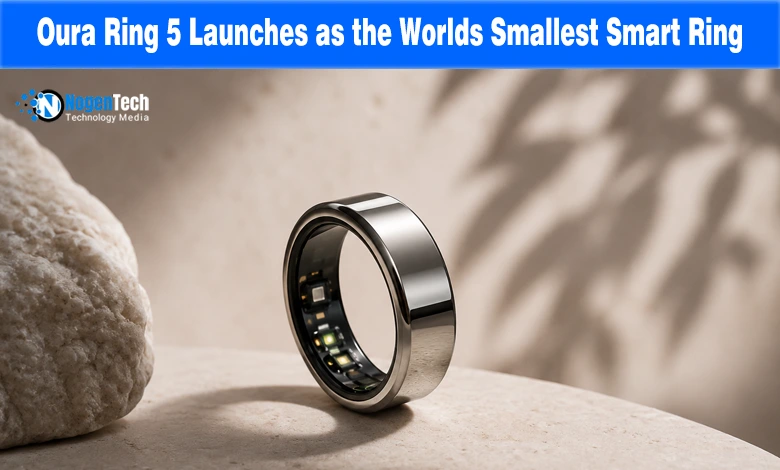
Oura unveiled the fifth generation of its popular smart ring on Thursday, May 28, 2026, starting at $399, arriving roughly 1.5 to 2 years after the Oura Ring 4.
The announcement came at CNBC’s Disruptor 50 Summit, where Oura CEO Tom Hale joined CNBC Anchor Andrew Ross Sorkin to introduce a ring that packs meaningfully more into considerably less space.
The Ring 5, which will be 40% smaller than the previous generation, is set to begin shipping June 4, with pre-orders open immediately.
This dramatic size reduction redefines what counts as the current best wearable tech, dropping the new ring into a health-tracking market that is more competitive than it has ever been as rival brands all vie for the same finger and wrist space.
Design, Sensors, and What 40% Smaller Actually Means
The Ring 5 is launching alongside software updates that add blood pressure signals, live activity tracking, on-demand care, and other features, also rolling out to the Oura Ring Gen3 and later.
Despite its smaller dimensions, Oura added larger sensors for more precise heart rate, blood oxygen saturation, and skin temperature measurements.
The Ring 5 launches in Silver and Matte Black at $399, while Brushed Silver, Gold, and Deep Rose, a new bronze-adjacent colorway, cost $499. A separate charging case will sell for $99 and is not included.
The size reduction matters practically: one of the most common complaints from Ring 4 users was that the hardware felt noticeable during some exercises and sleep positions.
At 40% smaller, the Ring 5 is designed to disappear into daily wear, the only form factor that makes 24/7 health monitoring viable. The approach reflects a broader wearable trend: the devices worn most consistently are the ones that keep getting smaller.
Health Radar, Blood Pressure Signals, and Clinical Monitoring
With Blood Pressure Signals, Oura tracks blood pressure patterns during sleep when the body’s cardiovascular patterns are most stable, since blood pressure should naturally dip overnight.
When it doesn’t, it can signal potential cardiovascular risk that daytime readings may miss. New capabilities include tracking blood pressure patterns during sleep, which Oura said can detect warning signs of cardiovascular risk, and nighttime breathing patterns and disturbances.
Members will also be able to log actual blood pressure readings from cuffs directly in the Oura app, creating a combined passive and active monitoring picture.
Leading among modern smart wearables, Oura is also partnering with on-demand care providers, giving members access to virtual health consultations directly through the app, a move that positions Oura not just as a data collector but as a starting point for clinical action.
The Preventative Care Pivot and the Fitbit Air Comparison
Oura’s evolution from a simple tracking device to a wearable focused on broader health and wellness, as well as preventative and predictive care, has helped the company grow its user base well beyond people just looking to track their sleep.
While Google’s screenless Fitbit Air band opts for a lightweight $99 entry point aimed at casual, day-to-day activity tracking, Oura positions its hardware as an investment in medical-grade oversight.
However, comparing the Ring 5 directly against the Fitbit Air, launched just weeks earlier, reveals two very different approaches to the same goal: Fitbit Air maximises simplicity, while Oura Ring 5 maximises clinical depth.