Moonshot Secured 20,000 Nvidia Chips Through Alibaba as Kimi K3 Scrutiny Grows
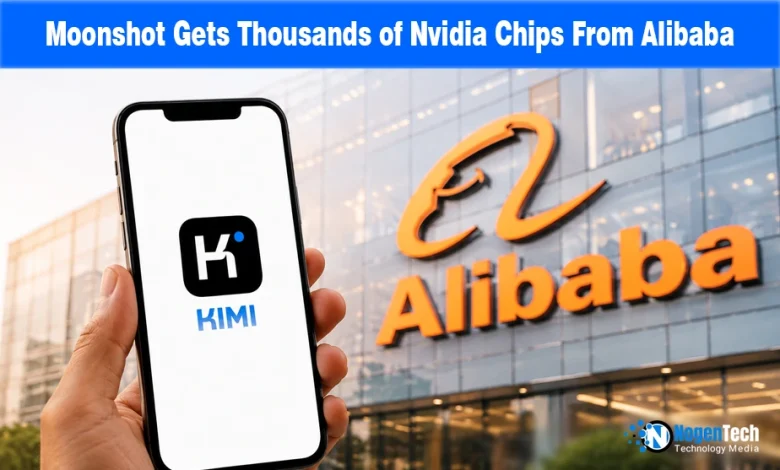
Chinese AI startup Moonshot accessed roughly 20,000 Nvidia chips through a computing agreement with major investor Alibaba, offering the clearest picture yet of how the company assembled enough raw compute to train Kimi K3, dubbed the world's largest open model.

Moonshot’s Kimi K3 became one of the AI industry’s biggest talking points this summer after launching as an open-weight model that appeared to match frontier models including Anthropic’s Fable 5 and OpenAI’s GPT-5.6 Sol, while remaining free to download.
That achievement immediately raised an obvious question given how tightly Washington has restricted advanced chip exports to China: where did Moonshot actually get the computing power to train a model of that scale? Friday’s report offers the most detailed answer yet, even as parts of it remain contested by the companies involved.
Alibaba Denies the Specifics While Confirming the Broader Deal
Reuters reported that Alibaba, when asked directly about the chip supply, told the outlet in a statement that the alleged supply of H200 chips to Moonshot was completely groundless.
Notably, that denial focused narrowly on the H200 chip model specifically, and Alibaba’s spokesperson did not dispute the broader existence of a roughly 20,000-chip computing agreement itself.
Bloomberg’s own sourcing described an Alibaba spokesperson who declined to comment on which specific Nvidia chip models were involved, even while not denying that the underlying compute partnership exists.
This distinction leaves real ambiguity about exactly which hardware generation is doing the heavy lifting inside Moonshot’s training runs, while adding more scrutiny to Alibaba, which is currently in a rift with the Claude maker.
A Portfolio Company Outperforming Its Own Backer
Bloomberg also highlighted an awkward situation at Alibaba.
Even though its Qwen engineering teams use similar Alibaba computing resources, Kimi K3 has outperformed Alibaba’s flagship AI model in benchmark tests, reportedly frustrating some teams inside the company.
That tension underscores the strategic bet Alibaba made by backing Moonshot in the first place, betting on outside AI talent even at the risk of that talent’s output eclipsing its own internal research division.
Reuters reported that Moonshot could not be reached for comment, while the White House, the U.S. Commerce Department, and Nvidia did not respond to requests about the arrangement.
Blackwell Access Remains the Bigger Flashpoint
Beyond the H200 cluster, the report detailed the more politically charged side of Moonshot’s compute story.
Sources familiar with Moonshot’s procurement said the company has a channel for accessing Nvidia’s more powerful Blackwell processors through Southeast Asia
However, it remains unclear whether that access comes through a legal rental arrangement or a purchase that would violate U.S. export rules.
That detail reinforces Michael Kratsios’ claim last week that Moonshot obtained restricted Blackwell chips through a third party in Thailand to train Kimi K3, alongside separate U.S. government findings that it distilled Anthropic’s Claude Fable 5 during development.
This adds to earlier distillation claims on Alibaba by Anthropic, calling it the largest distillation attack.
With Moonshot reportedly seeking more Blackwell chips to train Kimi K4, questions over how Chinese AI labs access advanced U.S. processors are likely to remain under regulatory scrutiny.
Source: Moonshot’s Kimi Uses 20,000 Nvidia Chip Cluster From Alibaba