US Officials Sound Alarm Over Potential ASML Chip Tool Leak to China
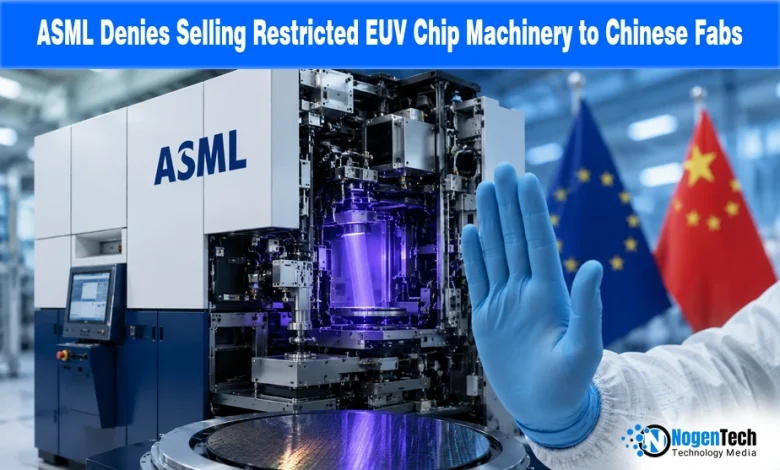
The U.S. has raised concerns that advanced semiconductor equipment from ASML may have reached China through illicit channels, but ASML denies any unauthorized transfer of its EUV systems.

The technology sector is locking into an intense trade standoff over who controls the hardware behind next-generation silicon, placing Dutch lithography giant ASML directly in the geopolitical crosshairs.
Washington is moving aggressively to block Beijing from acquiring the company’s precise machinery needed to build advanced microchips, keeping a tight lid on Western supply chains.
This pressure directly shapes regional manufacturing milestones, drawing immediate attention to how Chinese firms are advancing chip production, forcing US regulators to constantly re-evaluate their export blacklists.
Washington Raises Leak Suspicions
The latest friction stems from a report by Bloomberg, which reveals that U.S. officials have formally approached ASML with intelligence indicating that proprietary, high-end chip-making tools might now be operating within Chinese borders.
Washington’s export enforcement units are deeply concerned that components, or potentially entire legacy deep ultraviolet (DUV) or newer machinery, have bypassed traditional customs checks via third-party intermediaries or secondary markets.
This concern has grown even deeper after White House claims that Chinese firms are conducting large-scale “model distillation” through proxy networks, raising regulatory fears about efforts to close the AI gap.
The U.S. Department of Commerce has spent years expanding its regulatory perimeter, pressuring the Dutch government to restrict ASML from exporting its premier hardware to Chinese state-backed foundries like SMIC.
This structural oversight aims to block China from independently mastering advanced sub-7-nanometer processes.
However, U.S. intelligence suggests that gray-market supply networks have become increasingly sophisticated, prompting fresh demands for ASML to conduct a rigorous audit of its global machinery deployments.
ASML Defends Its Supply Chain Controls
ASML moved quickly to counter the narrative. In a public statement detailed by TechCrunch, the Veldhoven-based company clarified that it has not found any evidence to substantiate the U.S. claims.
The corporation emphasized that its most advanced systems, specifically its multi-hundred-million-dollar EUV lithography machines, are tracked under a strict, closed-loop custody protocol that prevents untraceable re-selling or unapproved relocations.
Such tight controls are critical at a time when an unprecedented chip business boom is driving market valuations sky-high, as seen with SK Hynix sitting just $52 billion won away from a historic 2,000 trillion won market cap.
The company noted in its defense that it has never sold or shipped EUV lithography systems to China, reiterating its strict adherence to both Dutch and U.S. cross-border trade mandates.
ASML explained that its high-end tools require highly specialized, ongoing maintenance from its own field engineers to remain operational.
This continuous physical servicing makes it structurally impossible for a fabrication plant to run a modern ASML machine in complete secrecy.
The Broader Semiconductor Cold War
This technological tug-of-war occurs just as Western economies make aggressive moves to bring critical silicon infrastructure back home.
Major structural shifts are being enforced to insulate domestic production, highlighted by events such as the Apple-Intel chip manufacturing partnership, an initiative specifically designed to reduce reliance on overseas foundries.
Concurrently, Chinese enterprises are actively building workarounds to bypass Western equipment entirely.
Cut off from formal ASML channels, Chinese firms are rethinking architecture altogether, as demonstrated by Huawei, which unveiled its Tau Scaling Law to build 1.4nm chips without relying on standard EUV lithography systems.
As Washington investigates how deeply Western tools have penetrated Chinese fabs, the international chip sector is rapidly dividing into two distinct, incompatible ecosystems.
Source: US Tells ASML It’s Concerned China May Have Top Chip Tool