
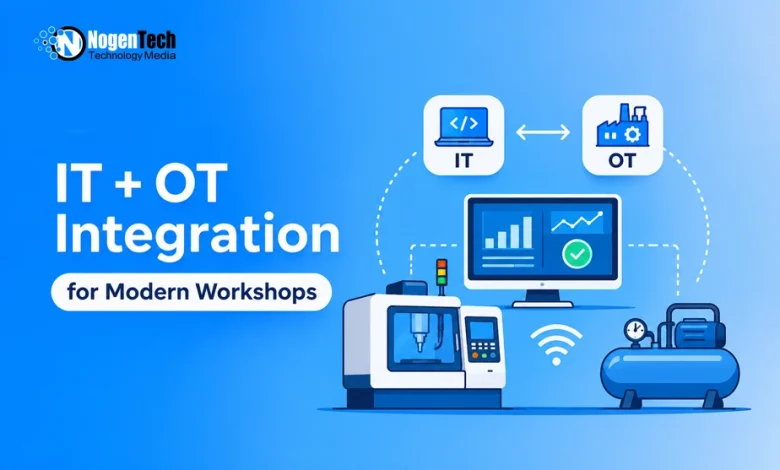
Modern workshops rely on more than mechanical tools. CNC machines, IoT sensors, industrial networks, and cloud-based software now help businesses monitor equipment, automate processes, and improve operational efficiency.
Connecting these technologies requires Information Technology (IT) and Operational Technology (OT) integration. IT manages data, networks, and software, while OT controls physical equipment such as compressors, CNC machines, and vacuum systems.
Together, they enable real-time monitoring, automated alerts, data-driven maintenance, and better equipment management.
Building the IT Infrastructure of a Smart Workshop
A connected workshop needs reliable infrastructure to transmit, process, and store operational data. Key components include:
- Industrial IoT Sensors: Collect pressure, temperature, vibration, and airflow measurements.
- Industrial Gateways: Connect machines and sensors with monitoring networks.
- Ethernet Networks: Support communication between compatible industrial devices.
- Cloud Platforms: Provide remote access to equipment data and dashboards.
- Edge Computing: Processes selected data locally to reduce latency and dependence on cloud connectivity.
- Monitoring Software: Displays performance trends, equipment status, and alerts.
Industrial communication protocols such as Modbus TCP and OPC UA help compatible devices exchange information.
Connecting IT Networks With Physical Equipment
Digital systems depend on reliable machinery and utilities. For example, compressed air systems power pneumatic equipment, while vacuum systems support CNC clamping and automated material handling.
IoT monitoring can detect pressure fluctuations or unusual consumption, but correcting these problems requires properly designed physical infrastructure.
Industrial suppliers such as Unipipe Solutions offer piping infrastructure options that workshops can evaluate alongside their digital monitoring requirements.
The objective is to connect operational data with equipment performance without compromising reliability.
How IoT Improves Equipment Monitoring
The Industrial Internet of Things (IIoT) connects physical machines with sensors, networks, and software applications.
In workshops, connected devices can track:
- Air Pressure: Detects pressure changes affecting pneumatic equipment.
- Airflow: Identifies consumption patterns and possible leakage.
- Temperature: Monitors equipment operating conditions.
- Vibration: Helps identify abnormal machinery behavior.
- Operating Hours: Supports maintenance scheduling.
- Energy Consumption: Provides data for evaluating equipment efficiency.
Cloud-Based Monitoring and Automated Alerts
Connected monitoring platforms can display operational data through centralized dashboards. Depending on the installed equipment, these systems may provide:
- Real-time equipment status
- Historical performance reports
- Configurable pressure and temperature alerts
- Compressor operating trends
- Remote access for authorized personnel
For example, if airflow remains high after production equipment stops, a monitoring system can flag unexpected consumption. Technicians can then investigate possible leaks or equipment issues.
Cloud connectivity is optional. Workshops can also use local monitoring software when remote access is unnecessary.
Using Data Analytics to Reduce Operational Costs
Industrial data analytics helps workshops identify inefficiencies by analyzing equipment performance over time.
Compressed air is a useful example because compressor operation consumes electricity, and leaks can increase unnecessary runtime. By comparing airflow, pressure, energy use, and production activity, businesses can investigate unusual operating patterns.
Important applications include:
- Energy Analysis: Compares compressor electricity consumption with production demand.
- Leak Detection: Identifies unexpected airflow during idle periods.
- Performance Monitoring: Tracks pressure fluctuations across workstations.
- Capacity Planning: Helps evaluate whether existing equipment can support additional demand.
- Maintenance Analysis: Identifies recurring problems through historical records.
Small businesses can start with spreadsheets, while larger facilities may use industrial analytics platforms or Manufacturing Execution Systems (MES). The value comes from using collected data to support decisions rather than simply generating reports.
Integrating Smart Infrastructure With CNC Automation
Computer Numerical Control (CNC) machines use programmed instructions to perform precise manufacturing operations.
Depending on their design, these machines may also rely on pneumatic components, vacuum clamping, and automated material-handling systems.
IT/OT integration allows compatible sensors and controllers to monitor these supporting processes.
Compressed Air Monitoring in Automated Workshops
Pneumatic equipment requires suitable pressure and airflow for consistent operation. Undersized piping, excessive restrictions, or leaks can affect performance. Digital monitoring can help by:
- Tracking pressure at selected distribution points
- Measuring airflow during production
- Identifying unusual consumption patterns
- Recording compressor operating trends
- Generating alerts when readings exceed configured limits
However, sensors cannot correct physical distribution problems. Properly engineered compressed air lines remain essential for supplying pneumatic equipment.
Modular piping systems may also simplify physical expansion when workshops add compatible automated machines or rearrange production areas.
Vacuum Monitoring in CNC and Robotics
Vacuum technology supports CNC workholding, robotic gripping, and automated material handling. For example, a CNC router may use vacuum clamping to hold a workpiece during machining. Connected vacuum sensors can help controllers determine whether the required holding condition has been achieved.
Common applications include:
- CNC Workholding: Monitors vacuum conditions during machining.
- Robotic Grippers: Confirms suitable vacuum before moving components.
- Automated Handling: Supports monitoring of vacuum-operated equipment.
- Fault Detection: Identifies unexpected vacuum losses.
Workshops evaluating vacuum distribution can review compatible systems alongside equipment manufacturer specifications. Reliable piping, properly selected sensors, and suitable controllers are all necessary for effective monitoring.
Cybersecurity in IT and OT Environments
Connecting industrial machinery to digital networks introduces cybersecurity risks. Unsecured gateways, outdated software, or poorly configured remote access can expose operational systems to unauthorized activity.
Workshops should implement security controls appropriate to their equipment and risk levels, following established guidance such as the NIST Guide to Operational Technology (OT) Security.
Essential practices include:
- Network Segmentation: Separate industrial devices from office and guest networks.
- Access Control: Limit equipment access to authorized users.
- Multi-Factor Authentication: Protect supported remote access systems.
- Firmware Updates: Apply manufacturer-approved updates through planned maintenance procedures.
- Device Inventory: Maintain records of connected sensors, gateways, and controllers.
- Data Backups: Preserve critical configurations and operational records.
- Network Monitoring: Identify suspicious activity and unexpected connections.
Industrial cybersecurity frameworks such as IEC 62443 provide guidance for securing industrial automation and control systems. Because OT systems may have safety and availability requirements, security changes should be assessed before deployment.
Predictive Maintenance With Industrial IoT
Predictive maintenance uses data analytics techniques to identify developing equipment problems before they cause unexpected failures.
Instead of depending exclusively on fixed maintenance schedules, workshops can analyze condition-monitoring information.
Examples include:
- Increasing Compressor Runtime: May indicate leaks or changing air demand.
- Repeated Pressure Drops: May suggest restrictions or insufficient distribution capacity.
- Unusual Vibration: Can indicate developing mechanical problems.
- Temperature Changes: May reveal abnormal equipment operating conditions.
- Recurring Alerts: Help identify issues that require further investigation.
Connected systems can record these patterns and notify maintenance teams when configured thresholds are exceeded.
Digital Maintenance Management
A Computerized Maintenance Management System (CMMS) helps businesses organize servicing and equipment records, while artificial intelligence in asset management can support equipment performance analysis and maintenance planning.
Typical features include:
- Maintenance schedules
- Equipment service histories
- Work orders
- Filter replacement records
- Inspection logs
- Maintenance notifications
Small workshops can use basic software or shared spreadsheets before investing in a dedicated platform. Predictive monitoring complements physical inspections; it does not replace manufacturer-recommended maintenance or safety checks.
Preparing Small Workshops for Industry 4.0
Industry 4.0 combines industrial automation, connected equipment, analytics, and digital communication. Small workshops can adopt these technologies incrementally instead of replacing existing systems.
A practical implementation strategy includes:
- Assess Existing Equipment: Identify machines that support digital monitoring or compatible communication interfaces.
- Establish Network Connectivity: Install appropriate networking equipment and industrial gateways.
- Introduce IoT Monitoring: Start with measurable requirements such as compressor pressure or energy consumption.
- Centralize Operational Data: Use dashboards or management software to organize equipment information.
- Implement Security Controls: Protect connected machinery and data.
- Expand Automation: Integrate additional CNC equipment, sensors, or monitoring applications when justified.
Why Scalable Infrastructure Matters
A technology-ready workshop needs systems that accommodate future requirements. Priorities include:
- Network Scalability: Support additional connected devices.
- Software Compatibility: Select systems with suitable integration capabilities.
- Physical Expansion: Plan utility connections for realistic equipment growth.
- Documentation: Maintain updated network diagrams and equipment layouts.
- Employee Training: Ensure operators understand monitoring and safety procedures.
Planning these requirements early reduces unnecessary complexity when introducing new technologies.
Final Thoughts
IT and OT integration helps workshops connect industrial machinery with digital monitoring, analytics, and management systems.
Technologies such as Industrial IoT, edge computing, cloud dashboards, and predictive maintenance software provide greater visibility into equipment performance and operational efficiency.
Compressed air and vacuum systems illustrate how this works in practice. Reliable physical infrastructure supports automated machinery, while connected sensors provide information about operating conditions.
For small workshops, a practical starting point is to identify a measurable operational problem, introduce suitable monitoring technology, secure the connected systems, and expand based on actual requirements.
This approach creates a scalable foundation for automation without adding unnecessary technology or infrastructure costs.