Nearly 55.5% of students say they struggle to stay focused and complete assignments in online or hybrid classes, and in 2026, that number is still climbing.
If you’re staring at your screen with deadlines piling up, dozens of tabs open, and zero motivation left, you’re not alone, and you’re not failing. You’re navigating a learning system that’s faster, more digital, and more demanding than ever before.
Between AI-assisted coursework, virtual classrooms, recorded lectures, and nonstop distractions, students today don’t need to study harder; they need smarter learning tools. That’s exactly why this guide covers the EdTech tools for students that are handpicked platforms designed to help struggling students.
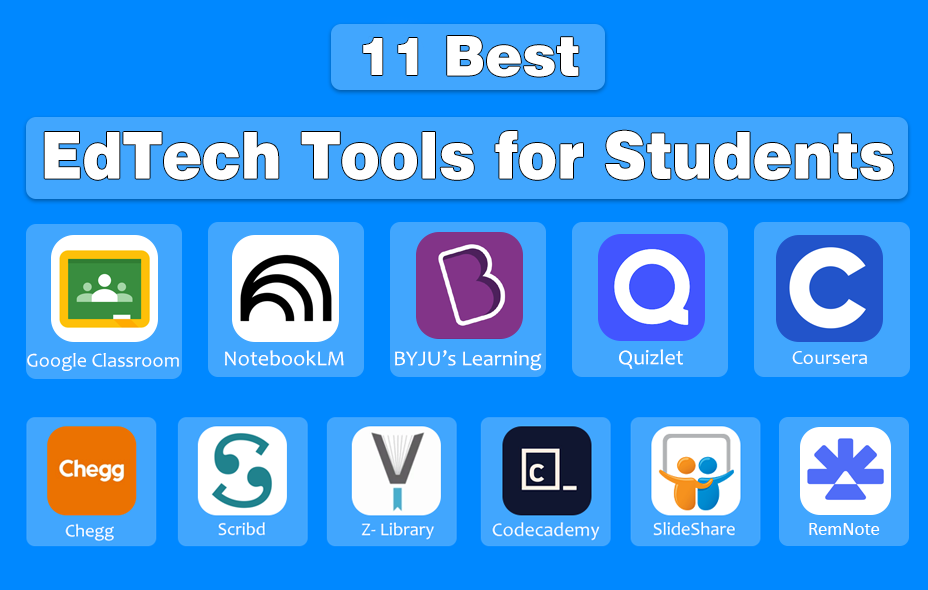
11 Best EdTech Tools for Students for a Hybrid System
Here are the most useful EdTech tools for students that help them improve their studies with the assistance of advanced technology.
Google Classroom helps students manage online and hybrid learning without feeling overwhelmed. It centralizes assignments, announcements, and deadlines into one organized space. Students avoid missing tasks scattered across emails and messaging apps.
The platform integrates smoothly with Google Docs, Drive, and Meet. Teachers provide feedback quickly, improving understanding and accountability because of their consistent study routines and better time management. Notifications keep students informed without constant checking.
NotebookLM assists students with understanding complex topics using AI-powered note analysis. It transforms uploaded documents into organized study insights. Students can ask questions directly from their own materials. Long readings become clear summaries within seconds.
The tool reduces time spent rereading dense content. NotebookLM encourages deeper comprehension instead of memorization. It supports research-heavy subjects effectively. Students stay focused without switching between sources.
BYJU’s Learning explains difficult concepts through engaging visual lessons, as it uses animations to simplify abstract topics. Students learn at their own learning curve without the pressure of studies and being left out. Lessons feel interactive rather than passive.
The platform adapts content based on student progress. Practice questions strengthen understanding gradually, and students can replay lessons whenever needed. BYJU’s supports exam-focused preparation, and it encourages structured learning habits.

Quizlet helps students memorize information using active recall techniques while converting notes into interactive flashcards quickly. Students can study alone or collaborate with peers, as the platform supports fast revision sessions with ready-to-go flashcards.
Moreover, students have different study modes that prevent boredom in the process of learning new concepts with short sessions. It works well for languages and definitions, which is also good for students who are learning new languages.

Coursera offers students access to global university-level courses with just a single registration and practice. It helps learners build practical skills alongside academics with the help of videos, quizzes, and hands-on projects.
These certificates add credibility to student profiles and encourage them for career-oriented learning. Further, they can track their progress to keep themselves motivated for bigger goals. That’s why learning feels structured and purposeful.
Chegg helps students when homework feels confusing or overwhelming with clear, step-by-step explanations for complex academic problems. Students learn how answers work instead of memorizing solutions of subjects and difficulty levels.
Textbook solutions save time during intense study sessions, as it is especially useful during late-night studying or tight deadlines. It encourages independent problem-solving skills with an interesting and simple interface that keeps students engaged in learning.
Scribd gives students access to a massive digital library, including books, notes, audiobooks, and documents. Students can research topics without buying textbooks, which makes it the best tool for students who want a cost-effective solution for their studies.
Further, it offers offline access that supports flexible study schedules. Scribd helps with assignments and exam preparation. Search tools locate relevant materials quickly, and it allows downloads, and you can also use Scribd Downloader to save documents for sharing purposes.
Z-Library provides access to a wide range of educational books for students in accordance with their research and reference purposes. It helps find rare or hard-to-access materials on the Internet. The platform supports multiple academic datasets.
It provides students with multiple search filters that improve the discovery speed of relevant datasets. Further, it allows downloads that streamlines the offline study and supports self-directed learning, which helps it work like a supplementary resource.
Codecademy teaches coding through hands-on practice, which is a perfect EdTech tool for students who are willing to learn how to code. The platform emphasizes that students must write real code to learn the basics and advanced forms of coding.
It provides students with interactive lessons that reduce the fear of programming and failing, which enhances their focus on learning. The platform supports beginners and advanced learners to start their career paths with long-term goals.
Lastly, I’ve added the SlideShare EdTech tool to the list of the best EdTech tools for students because of its learn through visual presentations approach. It hosts slides created by educators and professionals to help students grasp summarized concepts quickly.
The platform supports fast revisions with the assistance of ready-to-go presentations that cover academic and professional topics. It suits visual learners who want to learn without watching too many videos that are too long on YouTube or any other platform.
RemNote improves learning by combining note-taking, flashcards, and spaced repetition in one tool. Unlike other learning tools for students, you do not have to switch between different apps for your notes, for your flashcards, and for reviewing by means of active recall.
RemNote is particularly effective for subjects that require lots of repetition and revision, such as Medicine, Law, Languages and Computer Science.
RemNote’s interlinked notes, customizable flashcards, and review schedule ensure that you have all the tools you need to revise effectively, helping you store knowledge for the long term rather than just studying at the last minute.
Final Thoughts on EdTech Tools
EdTech tools are no longer optional for students navigating online and hybrid learning in 2026. They solve real problems like poor focus, time mismanagement, and information overload, which make them the right tools for students to study smarter instead of long study hours.
They transform confusion into clarity and stress into structure, which is really a necessity for young students. EdTech platforms support different learning styles and personal study speeds that set them apart from other tech tools that promise effective learning.