Office space is one of the largest expenses for modern organizations, yet many businesses have little visibility into how their workplaces are actually being used.
Empty meeting rooms, underutilized desks, and inefficient layouts can quietly drain resources and increase operational costs.Workplace occupancy sensors solve this challenge by turning real-time space usage data into actionable workplace insights.
By providing real-time insights into space usage, these smart solutions help organizations optimize office layouts, improve employee experiences, reduce energy consumption, and make smarter real estate decisions.
But with multiple sensing technologies, privacy considerations, and deployment models on the market, choosing the right platform can be challenging.
In this guide, I’ll compare the best workplace occupancy sensor platforms and help you identify the right solution for your space optimization goals.
What Are Occupancy Sensors?
Occupancy sensors are smart devices designed to detect the presence, movement, or number of people within a physical space.
They collect real-time data about how rooms, desks, meeting spaces, and entire buildings are being utilized.
Modern workplace occupancy sensors go beyond simple motion detection. Advanced solutions can measure:
- Real-time occupancy levels
- Space utilization rates
- Headcount and traffic flow
- Dwell time and activity patterns
- Meeting room usage
- Desk and workstation occupancy
- Building traffic trends
Organizations use this data to make informed decisions about workplace design, staffing, cleaning schedules, energy management, and real estate investments.
Why Workplace Occupancy Sensors Matter in Modern Workplaces
Organizations are increasingly using occupancy intelligence to:
- Reduce underutilized office space
- Support hybrid workplace strategies
- Improve employee experience
- Optimize meeting room availability
- Lower HVAC and lighting costs
- Support sustainability initiatives
- Improve cleaning schedules based on actual usage
- Generate data-driven workplace insights
According to industry research, many organizations discover that a significant parts of their office space remains unused on a typical workday, making occupancy analytics an essential component of workplace optimization.
Workplace Occupancy Sensor Platforms
Butlr
Most occupancy sensor platforms rely on cameras and computer vision, which works in some spaces but creates legal, privacy, and stakeholder approval friction in many others.
Butlr takes a different approach by reading thermal signatures instead of capturing images, which removes PII concerns at the hardware level and opens up deployment in spaces that camera-based systems cannot enter at all.

Key Features
- Thermal-only sensors detect heat patterns rather than images, so no personally identifiable information is ever captured—a hardware-level constraint, not a policy setting that can be misconfigured
- 95% accuracy on real-time headcount, with coordinate-level positioning, dwell time, and movement pattern data
- API-first architecture feeds occupancy data directly into workplace platforms, BMS systems, energy tools, cleaning orchestration software, BI dashboards, and digital twins
- Heatic 2+ sensors use peel-and-stick mounting with no electrician or complex wiring required, enabling building deployments in weeks rather than months
- Wired, wireless, or cellular connectivity options support multi-building rollouts across regions
- Two operating modes: Presence (activity and pathing within a defined space) and Traffic (entrance and exit counting)
- Deploys in spaces other systems cannot reach, including restrooms, healthcare facilities, labs, and other privacy-sensitive areas
- TLS 1.2 encryption, AES-256 data encryption, and SOC 2 Type II compliance support enterprise procurement
What’s Missing
- Teams looking for a single tool that bundles deep built-in analytics dashboards as the primary interface may prefer a vendor with a heavier reporting layer, though Butlr’s API-first approach is generally a better fit for teams already running workplace and BI software
Pricing
Custom pricing available upon request. Butlr’s lightweight hardware, lack of installation labor, and flexible connectivity contribute to a lower total cost of ownership at scale than platforms requiring electricians, cabling, or structured installation phases.
Best For
Organizations that need accurate, privacy-safe occupancy data across the full enterprise footprint, including spaces where cameras cannot go.
Particularly strong for workplace teams that want real-time data flowing into existing systems rather than locked behind a proprietary dashboard, and for enterprises rolling out occupancy intelligence at scale without the deployment friction of camera-based platforms.
VergeSense
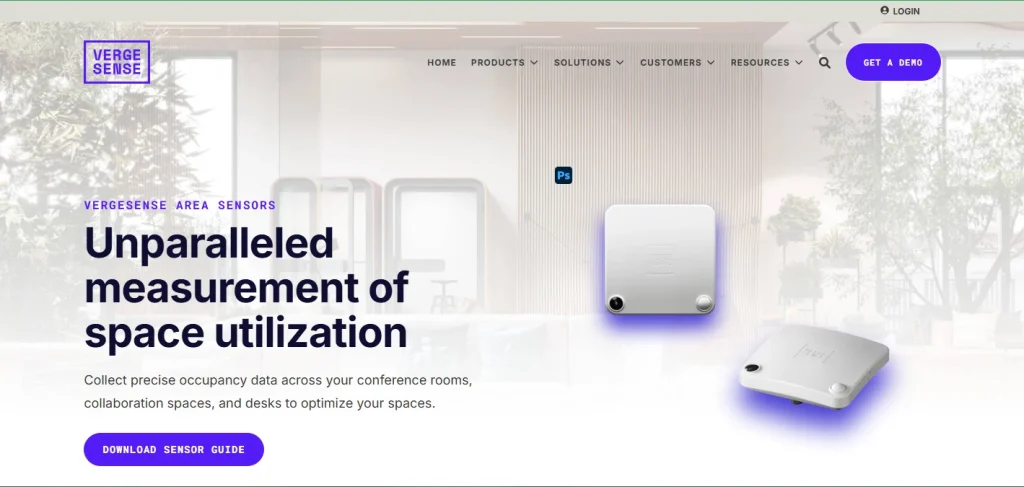
VergeSense is an AI-powered workplace planning platform built around camera-based sensors and computer vision.
Rather than positioning itself for wall-to-wall portfolio sensing, the platform is geared toward selective high-value spaces such as conference rooms, collaboration zones, and open office areas, and layers analytics, benchmarks, and planning models on top of the underlying sensor data.
Key Features
- Camera-based sensors with computer vision detect and analyze workplace activity
- Built-in analytics, benchmarks, and planning models provide a single platform for real estate and portfolio decisions
- Magnetic snap-on mounts simplify physical sensor installation
- Battery-powered, wireless connectivity reduces cabling and electrical requirements
- API access included on the standard pricing tier, allowing teams to pull data into their own tools without paying for a higher subscription
- Advisory and managed services available for teams that want hands-on support beyond data collection and analysis
- TLS 1.2 encryption, AES-256 data encryption, SOC 2 Type II and ISO 27001 certifications
What’s Missing
- Camera-based sensing can trigger legal, IT, and employee privacy reviews, particularly for deployments outside the US in regions with stricter workplace surveillance regulations
- Designed for selective high-value spaces rather than wall-to-wall coverage, which can limit full-portfolio visibility
- Phased rollouts and the need to position and configure each sensor extend time to value compared to simpler install methods
Pricing
Custom pricing available upon request.
Best For
Enterprises focused on monitoring selective high-value spaces like conference rooms and collaboration zones rather than full-building coverage.
Best suited for organizations comfortable with camera-based sensing and prepared to navigate the legal, IT, and stakeholder reviews that often come with those deployments.
Also a strong fit for teams that want integrated analytics and portfolio planning models bundled into the same platform as the sensors.
PointGrab
PointGrab is a workplace intelligence platform that combines optical and PIR sensing in a single hardware package, designed to handle multiple use cases per sensor.
Deployments are typically selective rather than portfolio-wide, and the cloud management platform handles sensor configuration, detection area definition, and data export.
Key Features
- Combined optical and PIR sensing in a single sensor unit
- A single sensor covers multiple use cases: occupancy count, motion tracking, object detection, and virtual traffic line monitoring
- Wired and wireless connectivity options
- Visualization and reporting tools for facility teams focused on space utilization
- Cloud management platform for sensor configuration and detection area definition
- API available for data export and third-party integration
- ISO 27001 certified
What’s Missing
- Camera-based sensing typically requires privacy reviews and stakeholder sign-off before deployment, particularly in regulated regions
- More involved installation requirements and sensor calibration needs make large-scale rollouts more complex
- Integrations run primarily through PointGrab’s own platform, limiting how easily data flows into external tools
- No SOC 2 Type II certification listed, which can slow procurement at security-focused enterprises
Pricing
Custom pricing available upon request.
Best For
Facility teams that want a multi-purpose sensor combining occupancy, motion, object detection, and traffic counting in one device, and that can absorb the calibration and installation overhead in exchange for the coverage flexibility.
Best fit for organizations comfortable with camera-based sensing and selective rather than portfolio-wide deployments.
XY Sense
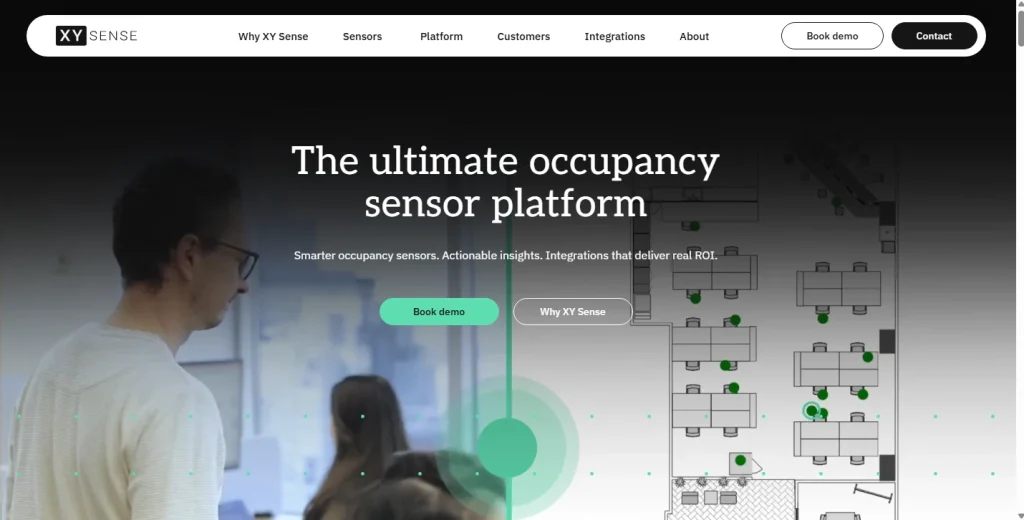
XY Sense uses ceiling-mounted sensors that capture XY coordinate data without recording images or personal information.
The platform offers several sensor types tuned to specific space categories, including area sensors, entry and exit counters, and presence detectors, and feeds the resulting data into its own analytics layer for utilization reporting, hybrid work planning, and portfolio optimization.
Key Features
- Ceiling-mounted sensors capture XY coordinate data without images or PII
- Multiple sensor types let teams match hardware to space type (area sensing, entry and exit counting, presence detection)
- Built-in air quality monitoring integrations layer environmental data alongside occupancy
- API and webhooks available for data access
- Wired and wireless connectivity options
- Coordinate-level data without cameras simplifies privacy conversations relative to camera-based platforms
- TLS 1.2 encryption, AES-256 data encryption, ISO 27001 certified
What’s Missing
- Commonly deployed in partial or sampled coverage models rather than wall-to-wall, which can leave gaps in full-building visibility
- Separate sensor types for different spaces add complexity to deployment planning and procurement
- Platform is primarily designed around its own analytics and dashboards rather than open data flow into other systems
- Privacy governance steps are still required, which can extend approval timelines despite the no-image design
Pricing
Custom pricing available upon request.
Best For
Workplace teams that want coordinate-level utilization data without the legal and stakeholder friction of camera-based platforms, and that are comfortable with partial or sampled coverage rather than wall-to-wall sensing.
Strong fit for organizations that value the built-in environmental monitoring layer alongside occupancy data, particularly for ESG reporting or building health programs.
Density
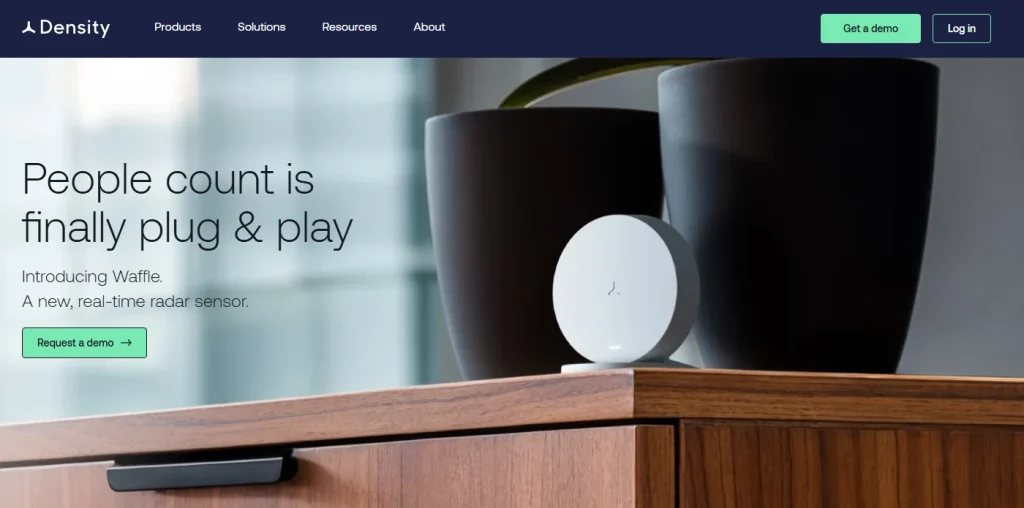
Density is a people analytics platform that combines depth sensors and 60 GHz radar to measure space usage in real time.
It offers different sensor formats for different space types, including open area sensors, doorway counters, and smaller-space radar units, with a self-installable radar option for desks and phone booths that reduces deployment effort for some use cases.
Key Features
- Depth sensing and 60 GHz radar combination avoids video capture entirely
- Sensors available for open areas, doorways, meeting rooms, phone booths, and desks
- Self-installable radar option reduces setup effort for smaller spaces
- Larger coverage area per sensor in open spaces reduces total hardware needed
- Modes include open area headcount, entry and exit counting, and room-level people count
- Advisory services available, including professional site planning and workplace strategy support
- TLS 1.2 encryption and AES-256 data encryption
What’s Missing
- Open area and entry sensors require professional installation with power and network infrastructure, expect to coordinate electricians, network cabling, and ceiling access for each location across multi-floor deployments
- Radar-based sensing can face scrutiny in regions sensitive to RF-based detection, particularly in the EU and healthcare settings
- The analytics platform is the primary interface for data; while an API exists, integrations are not a core focus of the product
- No SOC 2 Type II or ISO 27001 certification listed
Pricing
Sensors start at $149 per unit. Software starts at $8 per unit per month for rooms and phone booths and $2.50 per unit per month for desks, billed annually.
Best For
Organizations with smaller-space monitoring priorities such as phone booths, individual rooms, and desks, where the self-installable radar option can shorten deployment.
Best suited for teams that can absorb the professional installation overhead for open-area and entry sensors, and that don’t need deep API-based integration into external workplace systems.
Workplace Occupancy Sensor Platform Comparison
| Platform | Detection Method | Privacy Friendly | API Access | Best For |
| Butlr | Thermal Sensing | Excellent | Extensive | Enterprise-wide deployments |
| VergeSense | Camera + AI | Moderate | Yes | Conference rooms & collaboration spaces |
| PointGrab | Optical + PIR | Moderate | Yes | Multi-purpose occupancy monitoring |
| XY Sense | Coordinate Tracking | High | Yes | Utilization analytics |
| Density | Radar + Depth Sensors | High | Yes | Room and desk monitoring |
Choosing the Right Workplace Occupancy Sensor Platform
When selecting a workplace occupancy sensor solution, focus on the factors that matter most to your organization:
- Privacy Requirements: Choose privacy-friendly technologies like thermal or radar sensing if employee privacy and regulatory compliance are priorities.
- Deployment Complexity: Consider whether the platform requires professional installation or supports quick, wireless deployment.
- Coverage Needs: Determine whether you need full-building visibility or monitoring for specific spaces like meeting rooms and collaboration areas.
- Integration Capabilities: Look for API-first platforms that connect with workplace management, energy, cleaning, and business intelligence systems.
- Analytics & Reporting: Decide whether you need built-in dashboards or prefer sending data to existing software tools.
- Scalability: Ensure the solution can support future growth across multiple floors, buildings, or regions.
- Security & Compliance: Verify certifications such as SOC 2 Type II and ISO 27001 for enterprise-grade security.
- Total Cost of Ownership: Evaluate hardware, software, installation, maintenance, and support costs, not just the sensor price.
The best platform is the one that aligns with your organization’s operational goals, privacy requirements, budget, and workplace technology ecosystem.
<strong>Occupancy Sensors Improve Space Optimization</strong>
Workplace occupancy sensors have become essential tools for organizations seeking to optimize office space, improve employee experiences, and make data-driven real estate decisions.
From privacy-focused thermal sensors to advanced AI-powered analytics platforms, today’s solutions offer a wide range of capabilities to meet different workplace needs.
The right choice ultimately depends on your deployment scale, privacy expectations, integration requirements, and long-term business objectives.
By carefully evaluating these factors, organizations can invest in an occupancy sensing platform that delivers actionable insights, reduces operational costs, and supports a smarter, more efficient workplace for years to come.
FAQs
What is a workplace occupancy sensor?
A workplace occupancy sensor detects the presence, movement, or number of people within a space to help organizations understand and optimize workplace utilization.
How do occupancy sensors improve space optimization?
They provide real-time usage data that helps organizations identify underutilized areas, improve room scheduling, and make informed workplace planning decisions.
Are occupancy sensors privacy compliant?
Many modern solutions use thermal, radar, or coordinate-based technologies that avoid capturing personally identifiable information, making them more privacy-friendly than camera-based systems.
What industries benefit most from occupancy sensors?
Corporate offices, healthcare facilities, educational institutions, coworking spaces, government buildings, and commercial real estate organizations can all benefit from occupancy analytics.
Can occupancy sensors integrate with smart building systems?
Yes. Many platforms integrate with HVAC, lighting, workplace management software, CAFM systems, IWMS platforms, and business intelligence tools.
What should I look for when choosing an occupancy sensor platform?
Consider privacy compliance, deployment requirements, integration capabilities, data accuracy, scalability, security certifications, and total cost of ownership.