Best Data Science Courses in 2026: Essential Skills & High-Paying Career Opportunities

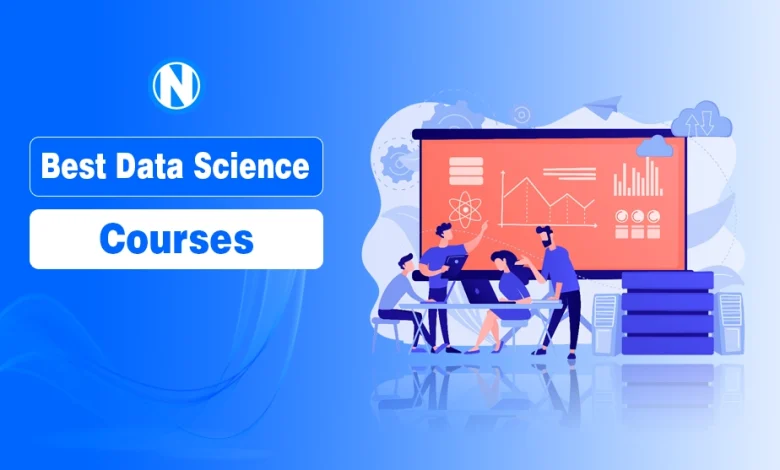
Data science is transforming how businesses make decisions, improve customer experiences, and scale operations. From predictive analytics in healthcare to AI-powered automation in finance and retail, companies now depend on data professionals to uncover patterns and deliver measurable business outcomes.
Because of this growing demand, data science courses have become one of the most searched educational pathways for students, IT professionals, analysts, and career changers in 2026.
Modern data science is no longer limited to spreadsheets and dashboards. It combines artificial intelligence, statistical analysis, cloud computing, machine learning, and business intelligence to solve complex problems using real-world data.
In this guide, you will learn about the essential skills, industry tools, best data science courses, certifications, and career opportunities shaping the future of data science.

What Is Data Science and Why Does It Matter?
Data science is the process of collecting, organizing, analyzing, and interpreting structured and unstructured data to support business decisions.
Companies use data science for:
- Customer behavior analysis
- Fraud detection
- Sales forecasting
- Personalized recommendations
- Supply chain optimization
- Predictive maintenance
- Risk management
Industries such as healthcare, banking, eCommerce, logistics, cybersecurity, and manufacturing rely heavily on data-driven strategies to stay competitive.
Unlike traditional reporting, modern data science integrates technologies like machine learning, automation, and big data analytics to produce scalable insights.
Core Skills Required in Data Science
Successful data scientists combine technical expertise with analytical thinking and communication skills.
Programming and Data Analysis
Python remains the most widely used programming language in the industry because of its flexibility and strong ecosystem. Libraries commonly used include:
- NumPy
- Pandas
- Matplotlib
- Seaborn
- scikit-learn
These tools support data cleaning, visualization, predictive modeling, and automation.
For beginners, enrolling in a data science with python course helps build practical coding experience while learning statistical analysis and machine learning fundamentals.
SQL is equally important because data scientists regularly work with relational databases, perform data extraction, and analyze structured datasets.
Statistics and Machine Learning
Statistics remains the foundation of accurate data analysis. Professionals must understand:
- Probability distributions
- Hypothesis testing
- Regression analysis
- Confidence intervals
- Correlation and variance
- Predictive analytics metrics
Machine learning expands these capabilities by allowing systems to learn from historical data. Common algorithms include:
- Random Forest
- Decision Trees
- Gradient Boosting
- Clustering Algorithms
- Neural Networks
Popular frameworks used by modern AI teams include:
- TensorFlow
- PyTorch
- XGBoost
- LightGBM
These technologies power recommendation systems, fraud detection tools, AI chatbots, and intelligent automation platforms.
5 Best Data Science Courses and Learning Platforms
Choosing the right learning path depends on career goals, technical background, and industry focus.
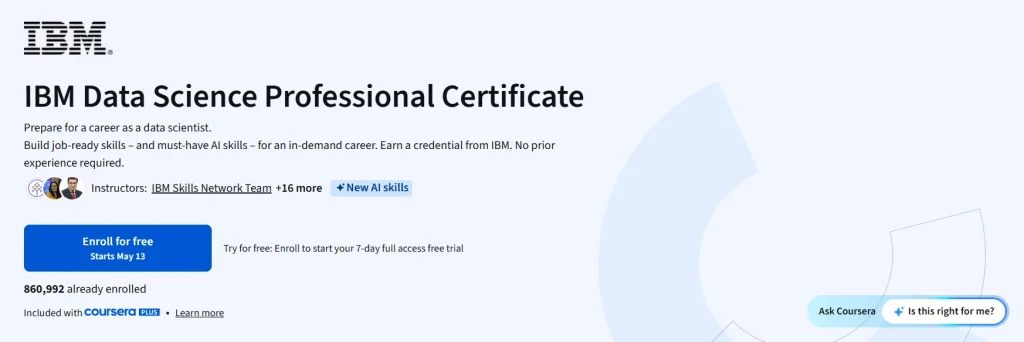
1. IBM Data Science Professional Certificate
This certification covers Python, SQL, machine learning, data visualization, and capstone projects designed around real business use cases.
Key Highlights
- Beginner-friendly structure
- Covers Python, SQL, and machine learning
- Includes hands-on projects
- Focuses on real-world business use cases
- Helps learners build a professional portfolio
- Strong focus on cloud-based workflows
Best For
- Beginners entering data science
- Career changers
- Students wanting practical project experience
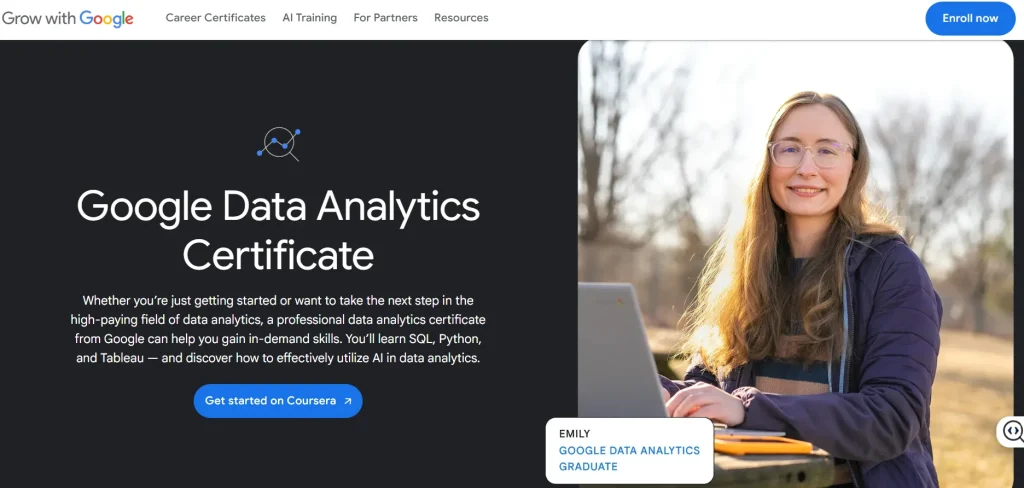
2. Google Data Analytics Certificate
Ideal for beginners, this program focuses on data analysis, spreadsheets, SQL, and business reporting skills.
Key Highlights
- No prior experience required
- Beginner-focused learning path
- Includes AI and analytics fundamentals
- Covers spreadsheets, SQL, and visualization
- Flexible self-paced learning
- Industry-recognized certification
Best For
- Absolute beginners
- Non-technical learners
- Professionals transitioning into analytics
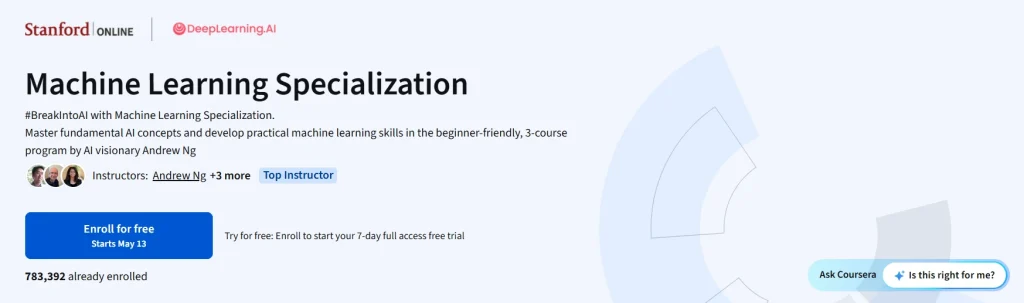
3. Andrew Ng Machine Learning Specialization
One of the most respected machine learning programs, this specialization explains AI concepts using practical applications and mathematical foundations.
Key Highlights
- Intermediate-level curriculum
- Focus on statistical analysis
- Covers predictive modeling
- Includes machine learning fundamentals
- Uses real-world datasets and projects
- Strong analytical and business focus
Best For
- Learners with basic analytics knowledge
- Junior analysts upgrading skills
- Professionals moving toward AI and ML roles
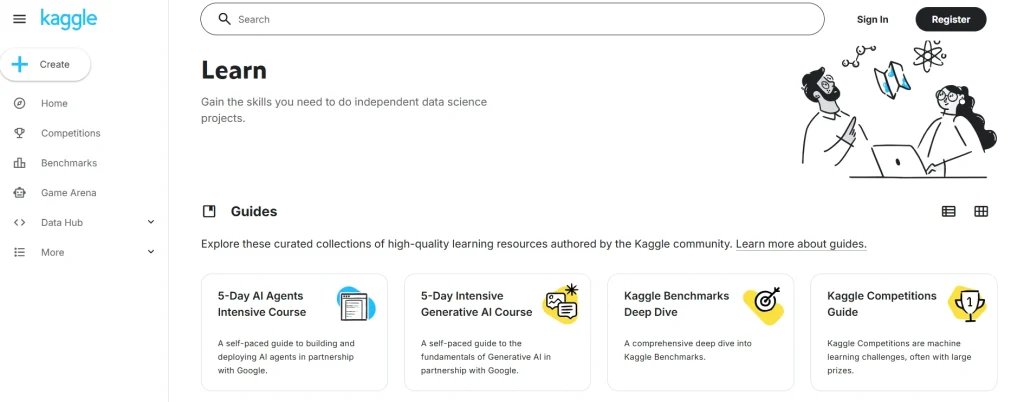
4. Kaggle Learning Platform
Kaggle provides free hands-on learning resources, datasets, coding exercises, and machine learning competitions that help learners build professional portfolios.
Key Highlights
- Completely free learning platform
- Hands-on coding exercises
- Access to real-world datasets
- Machine learning competitions
- Strong community support
- Portfolio-building opportunities
Best For
- Self-paced learners
- Beginners practicing coding
- Learners building real-world projects
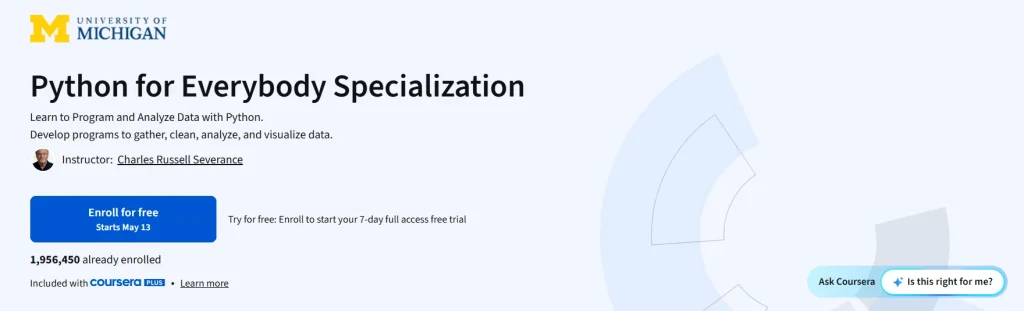
5. Python for Everybody
Created by the University of Michigan, this beginner-friendly course introduces programming concepts and Python fundamentals for data analysis.
Key Highlights
- Strong Python-focused curriculum
- Covers NumPy and Pandas extensively
- Teaches data cleaning and preprocessing
- Includes inferential statistics
- Practical data analysis workflows
- Suitable for technical learners
Best For
- Python learners
- Aspiring data analysts
- Students wanting deeper technical skills
Data Engineering and Cloud Technologies
Modern organizations process massive amounts of data daily. This has increased demand for professionals who understand both analytics and infrastructure.
Key technologies in the modern data stack include:
- Apache Spark
- Apache Airflow
- dbt
- Snowflake
- Google BigQuery
- Amazon Redshift
Cloud platforms such as AWS, Microsoft Azure, and Google Cloud Platform are now essential parts of enterprise data operations.
Professionals with knowledge of both data engineering and machine learning often gain better career opportunities because they can manage end-to-end data pipelines.
Career Opportunities in Data Science
The global demand for data professionals continues to rise as businesses adopt AI-driven technologies.
Popular career roles include:
- Data Scientist
- Machine Learning Engineer
- Data Analyst
- Business Intelligence Analyst
- AI Engineer
- Data Engineer
- NLP Specialist
- Computer Vision Engineer
Companies hiring data science professionals include technology firms, financial institutions, healthcare providers, consulting companies, and eCommerce brands.
Remote work opportunities have also expanded significantly, allowing professionals to work with global teams from anywhere.
Salary Trends and Industry Growth
Data science remains one of the highest-paying technology careers.
United States
- Entry-level data scientists: $95,000+
- Mid-level professionals: $120,000–$150,000
- Senior AI specialists and ML engineers: $200,000+
India
- Mid-level professionals: 8–20 LPA
- Senior product-company specialists: 25–40 LPA
Professionals specializing in artificial intelligence, deep learning, natural language processing, and cloud analytics often receive higher compensation packages.
Common Challenges Beginners Face
Many aspiring data scientists struggle because they focus only on theory without building practical experience.
Common Problems
- Learning too many tools at once
- Ignoring statistics fundamentals
- Lack of portfolio projects
- Limited real-world dataset experience
- Weak communication skills
Practical Solutions
- Start with Python and SQL first
- Practice on Kaggle datasets
- Build real-world projects
- Learn visualization and storytelling
- Focus on solving business problems instead of memorizing algorithms
Employers value practical problem-solving skills more than certifications alone.
Why Communication Skills Are Essential
Modern data scientists must communicate insights clearly to executives, managers, and non-technical teams.
Strong communication helps professionals:
- Explain analytical findings
- Present business recommendations
- Support strategic decisions
- Collaborate across departments
- Increase project impact
Technical knowledge combined with business communication often leads to faster career growth and leadership opportunities.
Final Thoughts
Data science continues to be one of the fastest-growing and most valuable career paths in the global technology industry. Businesses need professionals who can analyze data, build predictive models, and transform information into strategic decisions.
If you are starting out, begin with Python, SQL, and data analysis. If you are already comfortable with the basics, move into machine learning, deep learning, and cloud-based workflows.
The right path depends on your current skill level, but the long-term opportunity is clear: data professionals who can analyze, explain, and apply insights are in strong demand.
People Also Ask
What are the best data science courses for beginners in 2026?
IBM Data Science Professional Certificate and Google Data Analytics Professional Certificate are two of the best beginner-friendly options because they teach practical skills and require no advanced background.
Which skills should I learn first for data science?
Start with Python, SQL, and basic statistics. After that, move into data visualization, machine learning, and communication skills.
Is data science still a good career in 2026?
Yes. BLS projects 34% growth for data scientists and 20% growth for computer and information research scientists from 2024 to 2034, which is much faster than average.
Do I need a degree to start learning data science?
No degree is required to begin learning. For example, Google’s Data Analytics Professional Certificate is beginner level and requires no degree or prior experience, though some jobs in the field do prefer a bachelor’s or higher degree.
What is the best free platform to practice data science?
Kaggle Learn is one of the best free options because it offers short, practical lessons in Python, Pandas, and machine learning.
Are machine learning and deep learning part of data science?
Yes. Data science commonly includes machine learning, and deeper AI paths may include deep learning depending on the role and specialization.