Security teams today face a difficult challenge. Modern businesses generate thousands of security alerts daily across cloud environments, endpoints, networks, SaaS applications, and identity systems. Meanwhile, cybercriminals are using automation and AI to launch more sophisticated attacks at unprecedented speed.
Traditional security operations often struggle to keep up. Analysts spend valuable time sorting through alerts, investigating incidents manually, and responding to threats after damage has already begun.
This is where AI agent security solutions are making a difference.
While exploring different AI-driven security platforms, I’ve seen a major shift toward AI agent-based solutions that don’t just detect threats but actively investigate, correlate data, and respond in real time.
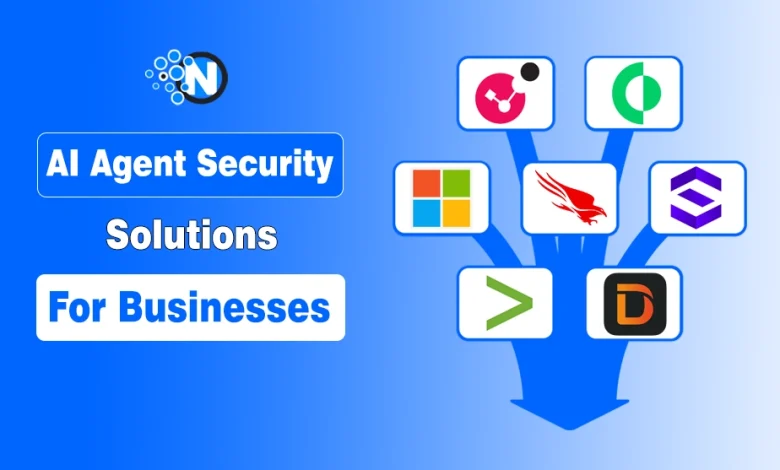
Comparing the Best 8 AI Agent Security Solutions
| Solution | Core Strength | AI Agent Focus | Best For | Deployment Focus |
| Check Point | Prevention-first security across network, cloud, endpoint | Threat prevention + policy automation | Enterprises prioritizing early threat blocking | Hybrid environments |
| Palo Alto Networks (Cortex XSIAM/XDR) | Unified SOC automation and correlation | Automated investigation + response workflows | SOC teams needing faster triage at scale | Large, data-heavy security operations |
| Microsoft Security Copilot + Defender | Integrated Microsoft ecosystem security | AI-assisted investigation and summarization | Microsoft-heavy organizations | Cloud + identity-centered environments |
| CrowdStrike Falcon (Charlotte AI) | Endpoint detection and rapid response | AI-assisted threat hunting and analysis | Endpoint-first security strategies | Distributed workforces |
| SentinelOne (Purple AI) | Autonomous endpoint protection | Natural language investigation + auto response | Lean security teams | Endpoint + automated response |
| Splunk (Enterprise Security + SOAR) | Powerful log analysis and customization | Detection + playbook automation | Mature SOCs with complex data needs | Large-scale log environments |
| Darktrace | Behavioral anomaly detection | Autonomous anomaly-based threat detection | Insider risk and stealth attacks | Network + behavior monitoring |
| Zscaler | Zero Trust access control | AI-driven access insights | Remote/hybrid workforces | Cloud-based secure access (SASE) |
What Are AI Agent Security Solutions?
AI agent security solutions are cybersecurity platforms that use artificial intelligence, machine learning, and automation to detect, investigate, and respond to security threats with minimal human intervention.
Unlike traditional security tools that rely heavily on predefined rules and manual analysis, AI-powered security agents, often custom-engineered by agentic AI development companies, can continuously monitor systems, correlate data from multiple sources, identify suspicious behavior, and take action based on real-time risk assessments.
Best AI Agent Security Solutions for Businesses
Security teams in 2026 have several AI-driven security platform options to choose from, each with a slightly different focus and strength. Below are some of the most widely used AI agent security solutions for businesses:
1) Check Point
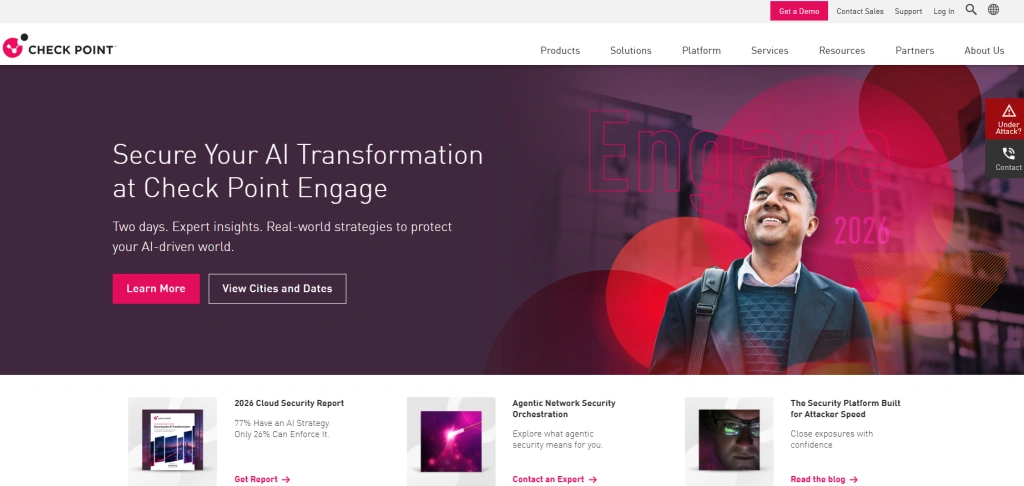
Check Point is a prevention-first security vendor that covers network, cloud, endpoint, and email layers. It focuses on stopping threats early through automated threat prevention and consistent policy management.
For organizations that want AI-driven protection without dealing with constant alert overload, Check Point is a practical option, especially as environments grow and manual management becomes harder to maintain.
This is also why it comes up in conversations around agentic AI security: businesses want AI that doesn’t just “spot something weird” but helps stop threats earlier and reduces the number of late-night escalations.
Check Point’s focus on prevention, threat intelligence, and centralized management meets the cybersecurity needs well, especially for teams that want automation but still demand control, explainability, and governance.
Key Features
- AI-powered threat prevention
- Unified security management console
- ThreatCloud AI intelligence platform
- Automated policy enforcement
- Zero Trust Network Access (ZTNA)
- Cloud-native application protection
- Ransomware prevention
- Real-time risk analysis
Best for:
- Businesses that prioritize stopping threats early (not just reporting them)
- Hybrid environments that need consistent policy enforcement
- Teams trying to reduce alert overload without losing visibility
2) Palo Alto Networks Cortex XSIAM (and Cortex XDR)
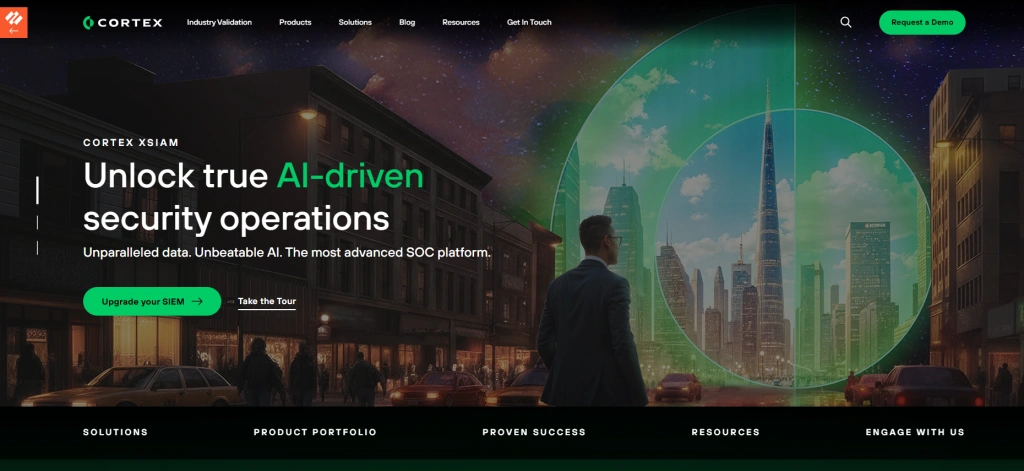
Cortex XSIAM is built around the idea that the SOC shouldn’t have to manually glue everything together.
It pulls in signals, correlates activity across sources, and helps automate investigation and response workflows. In day-to-day terms, it’s designed to cut down the time between “we got an alert” and “we know what’s actually happening.”
For organizations already using Palo Alto’s ecosystem, Cortex is a logical next step, especially if they want more automation in detection and response without building everything in-house.
Key Features
- AI-driven SOC automation
- Cross-domain data correlation
- Automated incident investigation
- Security orchestration and response
- Machine learning threat detection
- Attack surface management
- Threat hunting capabilities
- Unified analyst workflows
Best for:
- SOC teams that need faster triage and investigation
- Organizations with lots of telemetry but limited analyst time
- Businesses aiming for response playbooks and automation at scale
3) Microsoft Security Copilot + Defender (XDR)
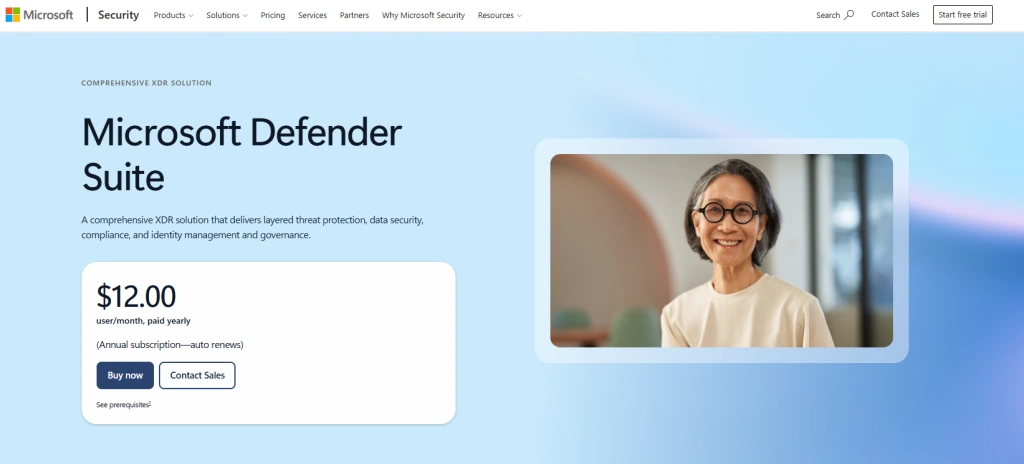
Microsoft’s approach is attractive because many companies already live inside Microsoft 365, Entra ID (Azure AD), and Azure. Defender provides the detection and response backbone, and Security Copilot helps teams summarize incidents, investigate faster, and make sense of sprawling alert timelines.
In practice, it’s helpful for the “tell me what matters” problem: what happened, what’s impacted, what should we do next, and what evidence supports that decision.
Key Features
- Generative AI-powered investigations
- Natural language security queries
- Microsoft ecosystem integration
- Automated incident summaries
- Identity-based threat detection
- Endpoint and cloud protection
- Threat intelligence insights
- Compliance reporting support
Best for:
- Microsoft-heavy environments
- Teams looking to speed up investigation and reporting
- Businesses that need better security visibility tied to identity and endpoints
4) CrowdStrike Falcon (Charlotte AI + Falcon Platform)
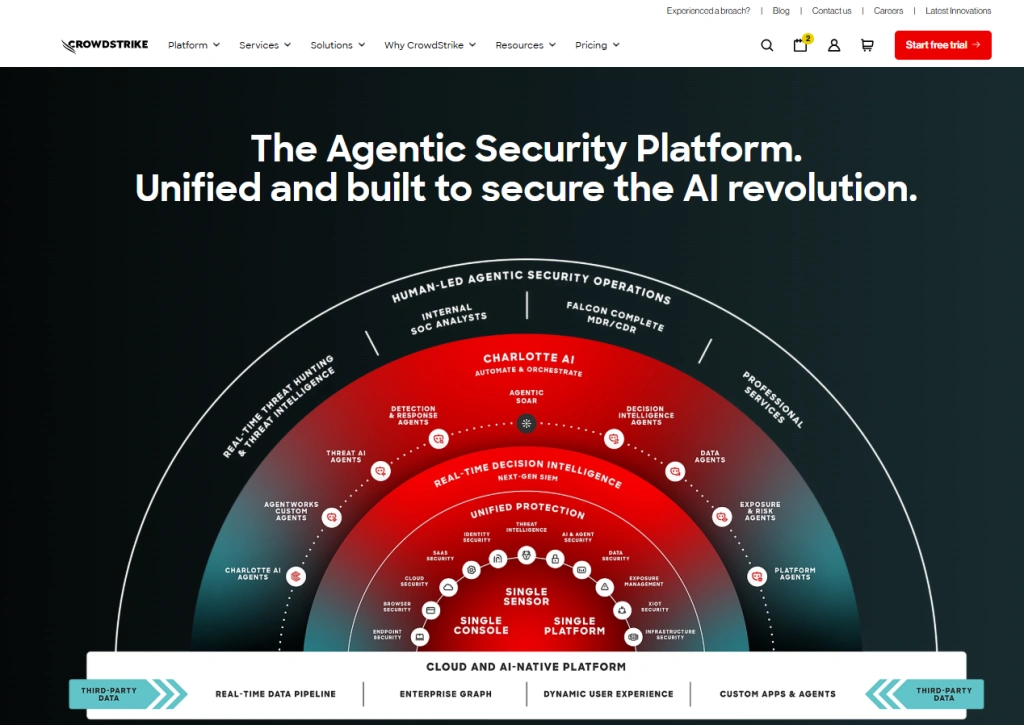
CrowdStrike has always been strong on endpoint visibility and fast response. The Falcon platform, combined with Charlotte AI, makes threat hunting and investigation more efficient, particularly when attackers are using methods that do not trigger standard malware detection.
If your main risk comes from endpoints like laptops, servers, or a remote workforce, CrowdStrike is a solid option.
If your risk is endpoint-driven laptops, servers, or a remote workforce, CrowdStrike remains a serious contender, particularly for companies that want strong telemetry and fast containment workflows.
Key Features
- AI-assisted threat hunting
- Advanced endpoint detection and response (EDR)
- Behavioral analytics
- Real-time attack visibility
- Cloud-native architecture
- Automated investigation workflows
- Rapid threat containment
- Managed threat hunting services
Best for:
- Endpoint-first security strategies
- Organizations needing rapid containment and a strong threat context
- Teams that do active threat hunting (or want to)
5) SentinelOne (Purple AI + Singularity Platform)
SentinelOne focuses on autonomous response and streamlined operations. Its AI layer is meant to reduce the friction of investigation by asking questions in plain language, summarizing incidents, and helping analysts move quickly from detection to action.
Where SentinelOne tends to land well is in teams that want high protection coverage but are not staffed to manually investigate everything.
Key Features
- Autonomous endpoint protection
- Conversational AI investigations
- Automated threat remediation
- Behavioral AI detection
- Ransomware protection
- Threat intelligence enrichment
- Cloud and identity security
- Simplified security operations
Best for:
- Lean security teams needing automation support
- Endpoint protection plus response workflows
- Organizations that want quicker incident interpretation and action
6) Splunk (Enterprise Security) + SOAR
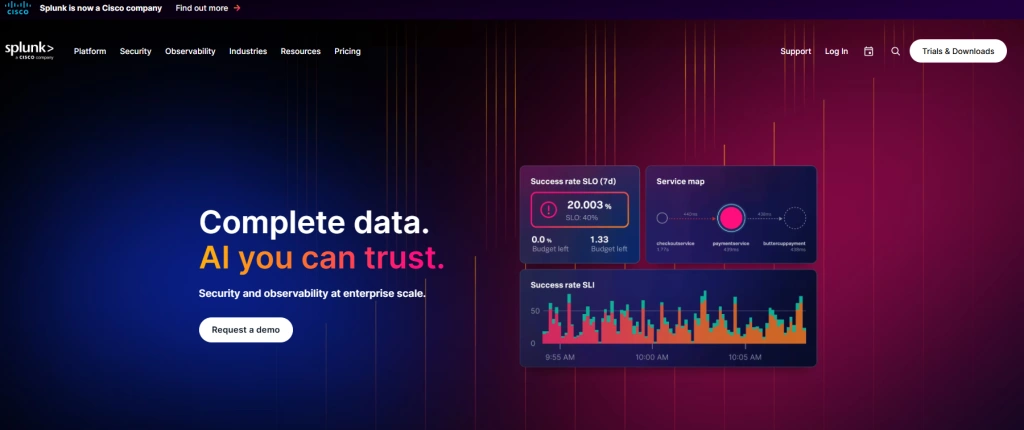
Splunk remains a major player for organizations that treat security operations as a data problem: collect everything, query anything, and build strong detection logic. Add SOAR capabilities, and you have a platform that can automate response steps once detections fire.
Splunk isn’t always the “simplest” option, but it’s powerful, especially when you need custom detections, profound investigations, and broad integrations.
Key Features
- Enterprise-grade SIEM capabilities
- Automated response playbooks
- Large-scale log analytics
- Custom detection engineering
- Security orchestration
- Threat intelligence integration
- Advanced reporting dashboards
- Extensive third-party integrations
Best for:
- Mature SOCs with strong processes
- High-volume log environments
- Businesses that want customizable detections and automated playbooks
7) Darktrace
Darktrace learns what normal activity looks like inside a company and flags anything that does not fit. This is useful when the threat is not obvious malware but something slower, like a compromised account quietly gaining more access over time.
In automated security setups, this kind of behavior-based detection gives the system a clear reason to investigate further, even when no known threat signature is matched.
Key Features
- Self-learning artificial intelligence
- Behavioral analytics
- Anomaly detection
- Insider threat monitoring
- Autonomous threat investigation
- Email security protection
- Network visibility
- Cloud and SaaS monitoring
Best for:
- Catching stealthy, low-and-slow attacks
- Environments where insider risk is a concern
- Teams that want anomaly-driven detection as an additional layer
8) Zscaler (Zero Trust + AI-driven insights)
As businesses run more SaaS and support more remote work, access control becomes security. Zscaler’s zero-trust approach helps reduce exposure by controlling connections to apps and resources, while analytics help spot suspicious access patterns.
It’s not a “SOC agent” in the same way as XDR platforms, but it plays an important role in preventing the kinds of access-based incidents that AI-powered attackers increasingly rely on.
Key Features
- Zero Trust security architecture
- Secure Access Service Edge (SASE)
- AI-powered access analytics
- Cloud-native web security
- Secure remote access
- Data Loss Prevention (DLP)
- Application visibility
- Continuous risk assessment
Best for:
- Remote/hybrid workforces
- Companies moving away from traditional perimeter security
- Organizations focusing on reducing the attack surface through access controls
How to Choose the Right AI Security Platform
Before selecting a solution, consider:
- Existing Technology Stack: Organizations already invested in Microsoft, Palo Alto, or CrowdStrike ecosystems may benefit from tighter integrations.
- Security Team Size: Smaller teams often benefit from autonomous platforms such as SentinelOne or Microsoft Security Copilot.
- Infrastructure Complexity: Large enterprises typically require platforms that can handle extensive telemetry and automated investigations.
- Compliance Requirements: Evaluate how each platform supports industry-specific compliance standards and reporting needs.
- Automation Goals: Some organizations prefer human oversight, while others prioritize autonomous detection and response.
People Also Ask
Are AI agent security solutions suitable for small businesses?
Yes, many solutions are scalable and can work for smaller teams. However, simpler setups are usually more cost-effective for small businesses.
Do AI agent security tools replace human security teams?
No, they are designed to support security teams, not replace them. Humans are still needed to review critical decisions and handle complex incidents.
Do these tools automatically fix security threats?
Some tools can automatically respond to certain threats, but this depends on configuration. Most organizations still keep humans in the loop for important actions.
Can AI security platforms reduce false alerts?
Yes, many of them use AI to filter noise and prioritize real threats. This helps security teams focus on more important issues.
Is cloud integration important for these solutions?
Yes, most modern AI security tools rely on cloud and SaaS integrations. Good integration helps improve visibility and response speed across systems.
Can AI security solutions reduce alert fatigue?
Yes. Most platforms use machine learning to prioritize threats, eliminate duplicate alerts, and reduce false positives.
Why is Zero Trust important for modern cybersecurity?
Zero Trust continuously verifies users and devices before granting access, reducing the risk of unauthorized access and lateral movement within networks.
Final Thoughts on AI Agent Security Solutions
AI agent security solutions are reshaping how modern security teams detect, investigate, and respond to threats. While each platform offers different strengths, the right choice depends on your environment, risk priorities, and level of automation comfort.
As these tools become more advanced, the focus is shifting toward balancing speed with control.
The most successful cybersecurity programs in 2026 will combine AI-driven automation with skilled human analysts, creating a security strategy that is both efficient and resilient against evolving threats.