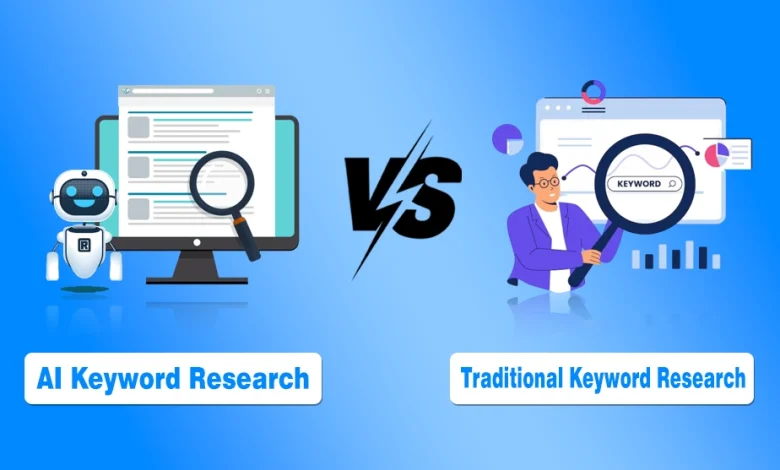
Google search does not work the way it did even one year ago, and keyword research has changed with it. After over 14 years in SEO, I have witnessed ranking strategies rise, peak, and then quietly disappear from the search engines.
What once required hours of manual keyword digging now takes minutes with AI, but speed alone does not guarantee rankings.
At NogenTech, where we actively test SEO frameworks across high-competition tech and AI topics, one question keeps arising: Does AI-powered keyword research actually outperform traditional methods, or are we risking strategy by relying too heavily on automation?
In this article, I’ll try to cut through the hype. Instead of theory, I’ll compare AI vs traditional keyword research based on real SEO execution, which shifts search intent, and how Google’s AI-driven results now interpret content.
What is Traditional Keyword Research?
Traditional keyword research is coupled with manual and semi-manual search to discover the keywords in terms of the relevancy, volume of the search, competition, and intent-based search, predominantly guided by human judgment.
The traditional method of keyword research operates in the following way. Any typical conventional process of carrying out keyword research entails:
- Seed Keyword Brainstorming: Setting product, service, or content theme cores.
- Keyword Expansion: The differences can be identified with the assistance of such tools as Google Keyword Planner or Google Trends.
- SERP Analysis: Browse through search results individually to understand:
- Competitor Research: Analysing the keywords that are ranked effectively by competitors and their layout.
- Keyword Selection: Choosing appropriate keywords, prioritising, and business goals.

Common Tools Used for Traditional Keyword Research
Some Potential Drawbacks of Traditional Keyword Research
- Very time-intensive
- Difficult to scale small websites.
- SEO expertise and experience needed.
What is AI Keyword Research?
AI keyword research relies on AI, which is grounded in the concepts of machine learning, natural language processing (NLP), and big data to make the key discovery of keywords and analysis automatic.
Rather than manually processing the numbers only, AI tools are utilized to analyze millions of pieces of data in order to identify patterns, trends, and opportunities.
👉 Pro Tip: Use AI for discovery and scale, not final decisions. Let AI uncover trends, clusters, and long-tail opportunities quickly, then apply traditional keyword research to validate intent, relevance, and business value before targeting.
The Keyword Analysis with the Rise of AI
AI has deeply penetrated search engine optimization and fundamentally changed how keyword research is performed. What once took days of manual analysis can now be completed in seconds with the help of artificial intelligence.
AI-powered tools analyze massive search datasets, detect emerging trends early, and go far beyond simple keyword matching by understanding user intent. Instead of focusing only on words, AI uncovers hidden semantic relationships between topics.
It automatically generates long-tail keywords, saving a significant amount of time. When comparing AI keyword research with traditional methods, the most visible advantages are speed, scale, and data depth. AI can process and connect far more information than a human ever could.

The Core Strengths of AI-Driven Keyword Research
AI introduces capabilities that human analysis alone often misses. It evaluates both historical and real-time search behavior, which allows SEO professionals to identify trends as they happen. Modern AI SEO tools also support multilingual and semantic search.
That’s what makes it easier to understand context, related concepts, and topic relevance.
This contextual understanding plays a key role in topic clustering and content planning. One of AI’s most powerful advantages is predictive analysis. It can forecast future keyword demand, which enables proactive content strategies.
This predictive power is something traditional keyword research tools simply do not offer.
How AI is Applied in Keyword Research
AI-driven keyword research can:
- Analyze historical and real-time search data
- Identify keyword clusters and semantic relationships
- Predict keyword performance
- Categorize keywords by search intent
Common AI Keyword Research Features
- Topic mapping and keyword clustering
- Automated intent classification
- Traffic and performance forecasting
- Content gap and opportunity analysis
- Trend prediction
Drawbacks of AI-Powered Keyword Research
- Can misunderstand the meaning or purpose of the user.
- Weaker in strongly specific niches.
- Training data are necessary to determine quality.
- Potential of blindly taking tool outputs.
AI vs Traditional Keyword Research: Quick Comparison
| Factor | AI Keyword Research | Traditional Keyword Research |
|---|---|---|
| Speed | Generates thousands of keyword ideas in minutes using automation and data models | Takes days due to manual research, filtering, and analysis |
| Accuracy | Processes large datasets efficiently and identifies patterns at scale | Better at interpreting nuance, context, and subtle intent |
| Scalability | Highly scalable and ideal for large websites and enterprise-level SEO | Limited scalability and becomes inefficient as site size grows |
| Search Intent Understanding | Good at classifying basic and commercial intent | Stronger at interpreting complex, emotional, or mixed intent |
| Learning Curve | Easier to adopt with user-friendly dashboards and automation | Requires deeper SEO knowledge, experience, and manual effort |
Cost Considerations: Time vs Money
Traditional keyword research is usually free in terms of tools, but it demands significant time, focus, and effort. This makes it suitable for beginners and small teams. AI tools, on the other hand, typically require paid subscriptions but offer automation and speed.
Large-scale projects often find this trade-off worthwhile. However, both approaches carry hidden costs: traditional research consumes time, while AI requires training, trust, and validation. The right choice depends on budget, team size, and business goals.
Effect of Google Algorithms on Keyword Research
Google’s algorithm updates consistently reshape how keyword research works, and their impact is felt differently across AI-driven and traditional research methods.
Impact on Traditional Keyword Research
Traditional keyword research relies heavily on human observation and experience. When Google releases an update, experienced SEOs often notice ranking shifts, SERP layout changes, or intent realignments quickly.
This allows them to adjust strategies in real time by re-evaluating content quality, intent match, and competitor behavior. Because it is human-led, traditional research adapts faster during sudden or major algorithm updates.
Especially when Google introduces changes related to helpful content, E-E-A-T, or intent interpretation. However, this approach is slower at scale and depends heavily on expertise.
Impact on AI-Driven Keyword Research
AI-based keyword research tools depend on data models and historical datasets. When Google updates its algorithm, AI tools need time to ingest new data, retrain models, and reflect changes accurately. During this adjustment period, AI insights may lag behind real-world SERP behavior.
That said, once sufficient data is available, AI excels. It quickly identifies new patterns, emerging trends, and shifting intent signals across thousands of keywords, something manual analysis cannot achieve efficiently.
👉 Pro Tip: During Google algorithm updates, trust human judgment first. AI tools may lag until new data stabilizes, so use traditional analysis to adjust strategy early and bring AI back in once patterns become clear.
Key Difference in Adaptability
- Traditional research reacts faster in the early phase of algorithm updates
- AI research adapts better over time once new data stabilizes
- Humans interpret why changes happen
- AI identifies how broadly those changes affect search behavior
The Smart Approach of Combining Both
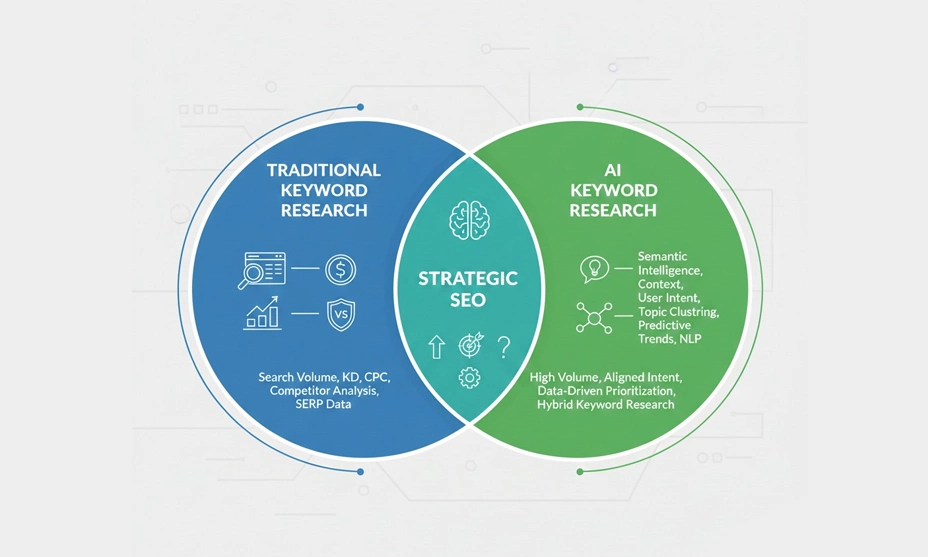
Google’s algorithm changes highlight why relying on only one method is risky. Traditional research provides agility and judgment during volatility, while AI delivers scale and long-term pattern recognition once updates settle.
The strongest SEO strategies combine both and use human insight to respond immediately to updates and AI-driven analysis to refine and scale the strategy afterward.
Final Thoughts on AI vs Traditional Keyword Research
The debate around AI vs traditional keyword research is not about choosing one over the other. But to understand that traditional methods provide structure and understanding while AI delivers speed, scale, and predictive insights.
The most successful SEOs combine both into their strategies. They let AI handle data processing while applying human expertise to strategy and decision-making. This balanced approach drives sustainable search growth, authority, and long-term visibility.
People Also Ask
Will AI supplant the conventional keyword research?
No, AI will not replace it. AI will augment the process. Strategy is still dependent on human intuition.
Which one is more economical for novices?
A great number of free tools work with conventional data. More often, AI advanced tools are more expensive.
Is AI accurate with the intent of search?
Artificial Intelligence perceives intent more with time. It is yet to be human-verified on complicated subjects.
How does the way that AI identify long-tail keywords?
AI examines patterns of conversations and queries. It creates expressions that are in real life in normal speech.