3 Types of AI Tools That Help You Make Better Decisions
From quick comparisons to guided reflection, discover how three types of AI tools can help you make more informed decisions without taking control of the final choice.

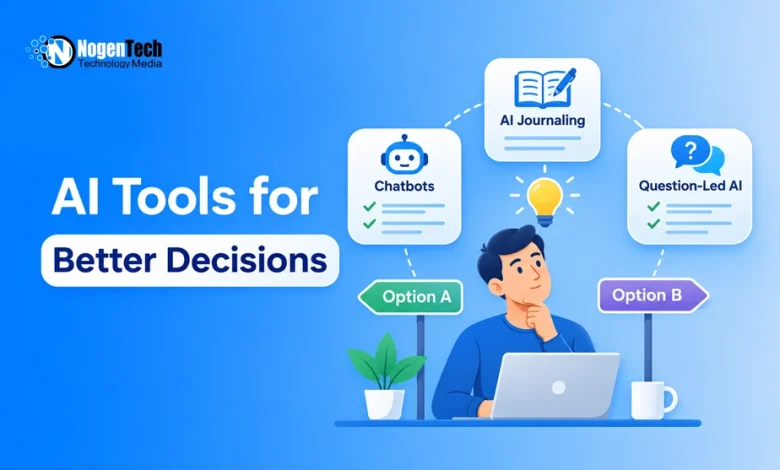
Ask an AI chatbot whether to accept a new job, and it may give you an answer within seconds. But what if you need help understanding your options rather than someone deciding for you?
A 2026 study published in Scientific Reports involving 295 participants highlights the risks of relying too heavily on AI advice, especially without questioning its recommendations.
Three types of AI tools approach decisions differently: standard chatbots compare options, AI journaling apps help you reflect, and question-led tools like Vesela help clarify your priorities. Here’s how each works and which might suit your needs.
A Real-Life Example: Should You Accept a New Job?
Imagine you’ve spent four years at a company where you like your manager, understand your responsibilities, and have a stable position. Then another company offers you:
- A bigger job title
- A 15% salary increase
- Less job security
- A team you’ve only met twice
- A Friday deadline to accept
You’ve compared both jobs in a spreadsheet, but neither option looks clearly better. Different AI tools can help you approach this decision in different ways.
How Different AI Tools Help With Decisions
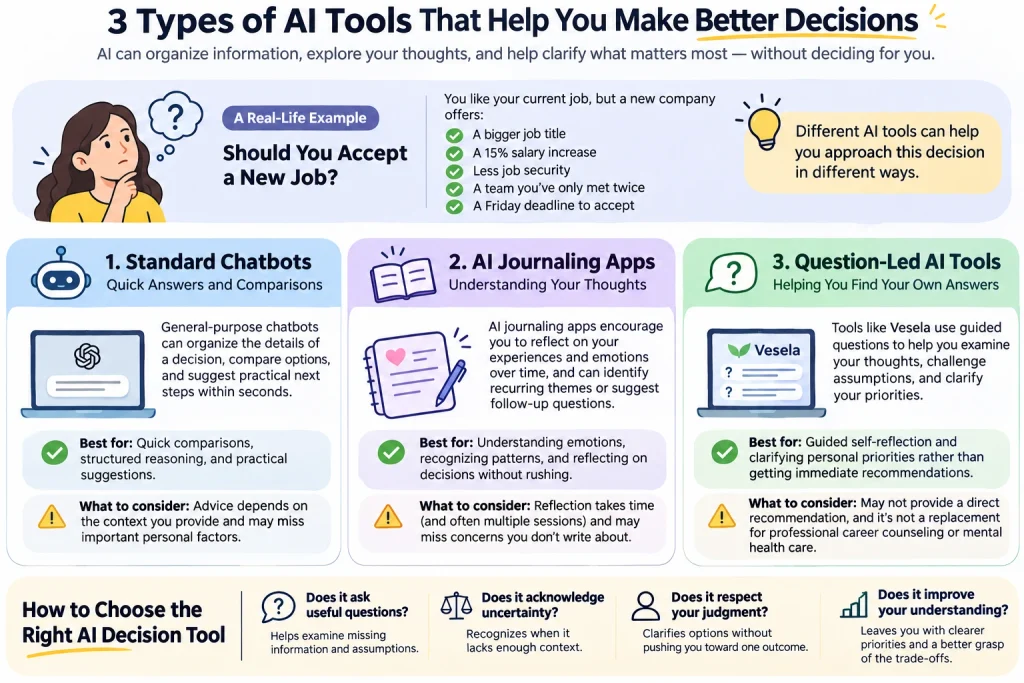
1. Standard Chatbots: Quick Answers and Comparisons
General-purpose chatbots can organize the details of a decision within seconds.
For the job offer, a chatbot might weigh the 15% salary increase and bigger title against the uncertainty of joining a smaller company.
This helps identify trade-offs, but its recommendation depends on what you share, which is one of the limitations of large language models. It may not know whether you’re saving for a house, supporting family members, or recovering from a difficult career change.
A 2025 Microsoft Research and Carnegie Mellon study surveyed 319 knowledge workers and found that greater confidence in generative AI was associated with less critical thinking during AI-assisted tasks.
Still, chatbots can be useful when you ask them to challenge assumptions, identify missing information, or question you before offering advice.
Best for: Quick comparisons, structured reasoning, and practical suggestions.
2. AI Journaling Apps: Understanding Your Thoughts
AI journaling apps encourage you to reflect on experiences and emotions over time. For example, you might feel excited about the new job on Monday but worried about leaving your current manager on Wednesday.
Some apps identify recurring themes or suggest follow-up questions based on your entries, helping you recognize concerns that a pros-and-cons list might miss.
However, journaling depends on what you write, and reflection can take several sessions. If you have only two days to accept an offer, it may not provide the immediate structure you need.
Best for: Understanding emotions, recognizing patterns, and reflecting on decisions without rushing.
3. Question-Led AI: Helping You Find Your Own Answers
Question-led AI tools use guided reflection instead of immediately recommending a decision. One example is Vesela, which helps users examine their thoughts and clarify priorities through questions. For the same job offer, a question-led conversation might explore:
- What would the bigger title actually change for you?
- How important is job security right now?
- Are you staying because you’re satisfied or uncomfortable with change?
- Which decision would you regret more, and why?
These questions can reveal concerns you might otherwise overlook. For example, you may realize your preference for job security comes from family expectations rather than your current financial situation.
Vesela offers a free plan with up to 20 daily messages using Vesela Mini. Its paid plan includes unlimited conversations, persistent memory, and access to a more advanced model.
While Vesela can help you reflect on your reasoning, it doesn’t guarantee better decisions or replace professional career counseling or mental health care.
Best for: Guided self-reflection and clarifying personal priorities rather than getting immediate recommendations.
Why AI Should Support Your Judgment, Not Replace It
AI can organize information and highlight trade-offs, but it doesn’t automatically understand your circumstances. A chatbot may know your salary and job title without knowing how much uncertainty you can handle. Even tools with memory rely on the information you’ve shared.
Overreliance is another concern.
A 2026 study involving 342 undergraduate students found that participants accepted incorrect ChatGPT advice 62.4% of the time under the study’s conditions. A brief reflection prompt reduced that rate to 39.7%.
The takeaway is to evaluate AI suggestions rather than accept them automatically, using AI to improve critical thinking instead of replacing your judgment.
How to Choose an AI Decision-Support Tool
Before using an AI app for an important decision, consider four questions:
- Does it ask useful questions? It should help examine missing information and assumptions, not just provide answers.
- Does it acknowledge uncertainty? Look for tools that recognize when they lack enough context.
- Does it respect your judgment? Suggestions should clarify options without pushing you toward one outcome.
- Does it improve your understanding? You should leave with clearer priorities and a better grasp of the trade-offs.
You can also test the same dilemma across different tools to see which approach works best for you.
Final Thoughts on Making Better Decisions Using Chatbots
Standard chatbots help with quick comparisons, AI journaling apps support emotional reflection, and question-led tools like Vesela help clarify personal priorities.
The right choice depends on whether you need information, reflection, or help questioning your assumptions. For important decisions, use AI to understand your options while keeping the final choice in your hands.