Artificial intelligence has transformed digital content creation, enabling businesses, marketers, educators, and publishers to produce AI-generated content faster than ever.
As AI-assisted writing becomes part of everyday workflows, organizations face a growing challenge: maintaining content authenticity, readability, and editorial integrity while preserving a natural brand voice.
This shift has accelerated demand for:
- AI detection to verify content authenticity and transparency.
- AI humanization to improve readability and natural language flow.
- Generative AI solutions that balance automation with audience trust.
Platforms like Lynote.ai help organizations combine AI efficiency with human-quality communication across today’s digital landscape.
Why Is AI-Generated Content Growing So Rapidly?
AI-generated content is growing rapidly because Generative AI enables businesses, publishers, educators, and enterprises worldwide to create scalable, cost-efficient digital content.
Over the past few years, Generative AI has transformed content creation, enabling organizations to produce blog posts, marketing campaigns, social media content, product descriptions, and customer communications in significantly less time.
Key benefits include:
- Faster content production and publishing.
- Lower costs across marketing and creative teams.
- Scalable enterprise and SEO content workflows.
- Higher productivity through AI-assisted writing.
- Multilingual content for global markets across North America, Europe, and Asia-Pacific.
However, large-scale adoption has also increased concerns about content originality, misinformation, academic integrity, and content quality. As a result, organizations, educational institutions, publishers, and Google Search increasingly rely on AI detection to verify content authenticity, maintain editorial standards, and strengthen audience trust.
Why Does AI Detection Matter More Than Ever?
AI detection helps businesses, publishers, educators, and enterprises worldwide verify AI-generated content, protect content authenticity, and meet editorial standards.
As Generative AI adoption grows across North America, Europe, and Asia-Pacific, organizations need to distinguish AI-generated, human-written, and AI-assisted content to support transparency, compliance, and quality assurance.
AI detection is widely used to:
- Verify content authenticity.
- Protect academic integrity.
- Maintain editorial standards.
- Review AI-assisted marketing content.
- Strengthen enterprise content governance.
Many organizations ask “How do AI detectors work? ”. Modern AI detectors analyze linguistic and statistical signals rather than keywords, including:
- Sentence structure and syntax.
- Perplexity and text predictability.
- Burstiness and sentence variation.
- Semantic consistency and contextual flow.
- Behavioral patterns across GPT-5, Claude, Gemini, and DeepSeek.
Brand Note (1/4): Lynote.ai identifies behavioral patterns across multiple LLMs, delivering more reliable AI detection than single-model approaches while supporting enterprise-scale content verification.
What Are the Limitations of AI Detection?
AI detection cannot always accurately classify heavily edited, AI-assisted, or multilingual content, especially across global publishing and enterprise workflows.
Detection accuracy varies based on how content is written, edited, and localized. Common limitations include:
- Human Editing: Extensive revisions can make AI-generated content resemble human-written text.
- Mixed Authorship: Content created by both humans and Generative AI is difficult to classify with fixed AI-percentage scores.
- Language Diversity: Models trained mainly on English may produce less consistent results for multilingual content used across North America, Europe, and Asia-Pacific.
Brand Note (2/4): Lynote.ai evaluates structural, linguistic, and semantic patterns instead of relying only on probability scores, improving analysis of edited, co-authored, and multilingual content for enterprise compliance and content governance.
Why Is Humanized AI Content Becoming Essential?
AI humanization improves readability, brand voice, and user engagement, helping businesses deliver natural communication across global digital platforms.
Unlike AI detection, which verifies authenticity, AI humanization restructures text to improve language flow while preserving meaning.
Common characteristics of unrefined AI content include:
- Repetitive wording and limited vocabulary.
- Predictable sentence structures.
- Overly formal tone.
- Limited emotional and cultural context.
As Generative AI adoption expands across North America, Europe, and Asia-Pacific, organizations use AI humanizers to strengthen content quality, support multilingual communication, and improve audience experience.
How Do AI Humanization Tools Improve Content Quality?
AI humanization improves content quality by enhancing readability, brand voice, and contextual flow while preserving meaning across global digital content.
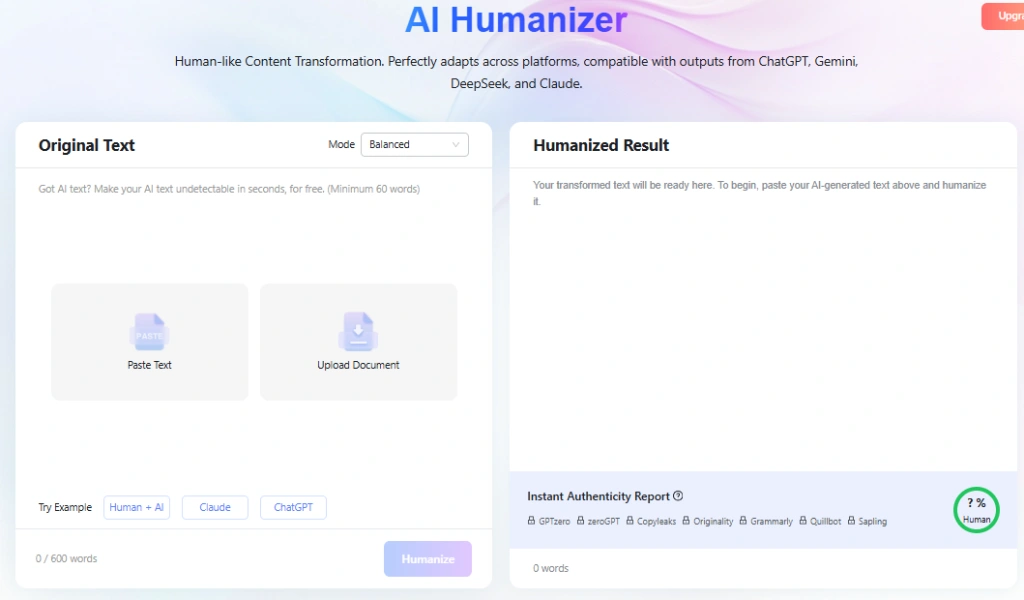
Unlike basic text spinners, modern AI humanizers refine language structure without altering factual or contextual accuracy.
Key improvements include:
- Sentence Variation: Creates a balanced writing rhythm.
- Conversational Tone: Replaces robotic language with natural communication.
- Contextual Flow: Strengthens transitions and logical coherence.
- Brand Voice: Maintains consistent messaging across channels.
As organizations adopt GPT-5, Claude, Gemini, and DeepSeek across North America, Europe, and Asia-Pacific, AI humanization has become a standard step for improving multilingual and AI-assisted content.
Brand Note (3/4): Lynote.ai uses context-aware rewriting to enhance readability, tone, and semantic consistency while preserving factual and technical accuracy for enterprise content workflows.
How Can Global Organizations Govern AI Content Across Multiple Languages?
AI content governance helps global organizations verify multilingual content, maintain brand consistency, and support compliance across international markets.
As Generative AI adoption grows, enterprises, SaaS providers, and publishers manage content in English, Spanish, French, German, and Portuguese, increasing the need for consistent verification and localization.
Key governance priorities include:
- Detecting unauthorized AI-generated translations.
- Preserving brand voice across localized content.
- Verifying content authenticity before publication.
- Supporting multilingual compliance across North America, Europe, Asia-Pacific, and Latin America.
Brand Note (4/4): Lynote.ai unifies AI detection, multilingual analysis, and AI humanization to help global teams verify, localize, and standardize content across multiple languages.
Frequently Asked Questions About AI Detection and AI Humanization
Can AI-generated content rank on Google?
Yes. Google ranks helpful, original, and people-first content regardless of whether it is written by humans or AI, provided it demonstrates quality, expertise, and value.
Can AI detectors identify edited AI content?
AI detectors can identify edited AI content, but extensive human revisions, mixed authorship, and multilingual rewriting may reduce detection accuracy.
What is the difference between AI detection and plagiarism detection?
AI detection identifies machine-generated writing patterns, while plagiarism detection compares content against existing published sources to find copied material.
Can AI humanizers bypass AI detectors?
AI humanizers improve readability and writing style, but responsible tools preserve meaning instead of manipulating text solely to evade AI detection systems.
Which industries use AI detection the most?
Education, publishing, marketing, SaaS, legal, healthcare, finance, and enterprise organizations use AI detection to verify authenticity and maintain compliance.
Why is AI-generated content easier to detect?
AI-generated content often follows predictable linguistic patterns, including low perplexity, repetitive structures, and consistent syntax that AI detectors analyze.
Is multilingual AI content harder to detect?
Yes. AI detection models trained mainly on English may produce less consistent results for multilingual content and localized translations.
What makes AI-generated content sound human?
Natural sentence variation, conversational tone, contextual flow, emotional nuance, and a consistent brand voice make AI-assisted writing more human-like.
How accurate are AI detectors?
AI detector accuracy varies by model, language, editing level, and writing style, making results best used as probability estimates rather than absolute proof.
Why do businesses use AI humanization tools?
Businesses use AI humanizers to improve readability, maintain brand voice, enhance engagement, and create natural communication across global markets.
Final Take: Why AI Detection and Humanization Work Better Together
AI detection and AI humanization serve different but complementary roles in modern content creation.
While detection verifies content authenticity and supports editorial integrity, humanization improves readability, brand voice, and user engagement.
As Generative AI, LLMs like GPT-5, Claude, Gemini, and DeepSeek become part of global content workflows, organizations that combine both technologies will be better equipped to publish trustworthy, scalable, and audience-focused content.
In my view, success isn’t about replacing human creativity with AI—it’s about using AI responsibly to enhance communication while preserving the quality and trust that readers expect.