Mobile advertising is more competitive than ever, and businesses are spending more to reach the right people. But many of those campaigns are quietly losing conversions after the ad is clicked.
The problem is not always the targeting or the creative. Most of the time, it is what happens next. How users get from a social media ad into an app makes a huge difference in whether they convert or leave.
This article covers why standard links create that problem and what you can do about it.
What is the Hidden Problem with Standard URLs?
The hidden problem with standard URLs is that they open inside social in-app browsers, breaking logins, autofill, carts, payments, and attribution while adding conversion-killing friction after clicks.
Most social platforms open external links inside their own embedded browsers rather than launching a user’s preferred mobile browser or app. While this may seem convenient, it often creates a disconnected experience. Common issues include:
- Lost login sessions
- Missing saved payment details
- Broken autofill functionality
- Incomplete shopping carts
- Additional authentication steps
A customer who was ready to purchase may suddenly find themselves entering credentials, searching for payment information, or waiting for a two-factor authentication text before they can continue.
Every additional step increases the likelihood of abandonment.
Why Mobile Conversion Paths Matter?
Mobile conversion paths matter because post-click friction quickly weakens user intent, causing abandonment, lower conversions, poor attribution, and wasted ad spend.
User intent is often strongest immediately after an ad click. The longer it takes users to reach the intended destination, the greater the chance that they will leave the process entirely.
For app-based businesses, this challenge can significantly impact:
- Conversion rates
- Customer acquisition performance
- Return on ad spend
- Revenue attribution
- Campaign optimization
Companies frequently spend substantial acquisition costs driving traffic to campaigns, only to lose users because the post-click experience creates unnecessary friction.
The Cost of Mobile Friction
Studies from Baymard Institute consistently show that unnecessary checkout friction remains one of the leading causes of abandonment during online purchases. When users encounter extra login requirements, broken sessions, or unexpected redirects after clicking an ad, many choose not to complete the process.
For app-first businesses, reducing these friction points can have a direct impact on conversion rates, customer acquisition costs, and return on advertising spend.
Why Standard Links Hurt Mobile App Conversions?
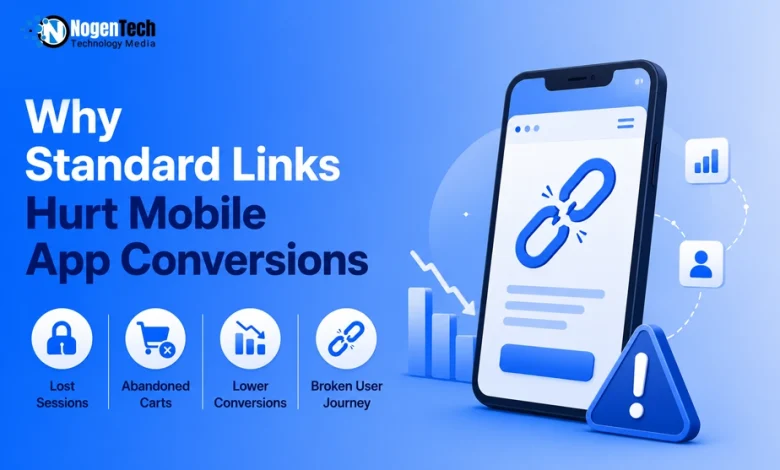
Standard links hurt mobile app conversions by opening in isolated in-app browsers, disrupting sessions, increasing friction, weakening attribution, and causing abandonment.
Standard links, typically plain URLs shared in social media ads, are one of the leading causes of mobile conversion loss.
They may look harmless, but the way they behave on mobile devices creates a chain of friction that pushes users away before they ever complete a purchase or sign-up.
They Open Inside In-App Browsers, Not Your App
When a user taps a link inside Facebook, Instagram, or TikTok, the platform does not open your app or even the user’s default browser. Instead, it loads the page inside its own built-in browser, completely separate from your app environment.
This means users land in an isolated session where:
- Saved passwords and autofill do not work
- Shopping carts from previous sessions are missing
- Login states are not carried over
- Payment details stored in the browser are unavailable
A user who was ready to buy now faces multiple steps just to get back to where they were.
They Break the Momentum After an Ad Click
User intent is at its peak the moment someone taps your ad. Standard links waste that intent by adding unnecessary steps between the click and the conversion.
Instead of landing directly on the product page, offer, or checkout screen shown in the ad, users often end up on:
- A generic homepage
- A desktop-formatted landing page
- A login screen with no context
- An error page if the URL is not mobile-optimized
Each of these outcomes increases the chance of abandonment significantly.
They Make Attribution Unreliable
Standard links do not carry reliable tracking data through the full user journey. When a user drops off inside an in-app browser and later returns through the app directly, the original ad click is no longer connected to that conversion.
This creates blind spots in your reporting, including:
- Which ad creative drove the install or purchase
- Which audience segment converted
- Which platform deserves credit for the sale
- Which campaigns should receive more budget
Without this data, marketing decisions are based on incomplete information, making it harder to scale what works.
They Are Not Built for App-First Experiences
Standard URLs were designed for the web. They do not understand app architecture, cannot route users to specific in-app screens, and have no mechanism to preserve user intent across an install.
For businesses where the app is the primary conversion environment, relying on standard links means accepting a gap between ad performance and actual revenue, one that deep linking and mobile measurement platforms are specifically built to close.
What are the Attribution Challenges in Social Media Campaigns?
Attribution challenges arise when users leave in-app browsers and return directly through the app, breaking tracking visibility and making campaigns, creatives, audiences, and channels harder to measure accurately.
The problem extends beyond user experience. When users abandon a social media browser and later return directly through an app, attribution systems may lose visibility into the original marketing source.
This creates gaps in reporting.
Marketing teams may struggle to determine:
- Which campaigns drive installs
- Which creatives generate purchases
- Which audiences convert best
- Which channels deserve additional budget
Without reliable attribution, optimization decisions become far more difficult. But there is a bigger picture here. Social media remains one of the most powerful channels for driving sales, and learning effective ways to drive more sales through social media is only possible when your attribution data is accurate.
Knowing which content, format, and audience combination actually leads to purchases allows businesses to double down on what works and stop wasting budget on what does not. When attribution is broken, that learning process stalls completely, and teams are left guessing instead of growing.
Why Deep Linking Has Become Essential?
Deep linking has become essential because it sends users directly to relevant in-app destinations, reducing friction, preserving intent, improving conversions, and supporting accurate attribution.
Deep linking technology helps connect users directly to specific destinations inside an app. Rather than sending traffic to generic landing pages, deep links guide users toward the exact content associated with the advertisement.
Examples include:
- Product pages
- Promotional offers
- Account screens
- Checkout flows
- Subscription pages
This creates a smoother customer experience while reducing unnecessary navigation.
Challenges with Social Media Platforms
Social platforms operate within their own ecosystems and often prioritize keeping users engaged within those environments.
As a result, traditional Facebook deep links and standard URLs may not always provide the seamless experience advertisers expect.
Similarly, brands using standard Instagram links often encounter limitations when attempting to move users from social content directly into app experiences.
These restrictions can create additional complexity for marketers focused on driving app installs and in-app purchases.
How Mobile Measurement Platforms Help?
Mobile Measurement Platforms help by tracking user journeys, measuring campaign performance, supporting deep linking, improving attribution accuracy, and connecting ad interactions with conversions.
Mobile Measurement Platforms (MMPs) were developed to solve these challenges. These platforms help marketers:
- Track user journeys
- Measure campaign performance
- Support deep linking
- Improve attribution accuracy
- Connect ad interactions with conversions
By combining attribution data with intelligent routing systems, MMPs help businesses maintain continuity throughout the customer journey.
What is Deferred Deep Linking?
Deferred deep linking preserves a user’s intended destination through the app installation process, so after installing, the app opens directly to the relevant in-app screen.
One of the most valuable capabilities offered by modern attribution platforms is deferred deep linking. This technology allows marketers to preserve user intent even when the app is not yet installed.
A typical workflow looks like this:
- A user clicks an advertisement.
- The system records attribution information.
- The user is directed to the appropriate app store.
- After installation, the app automatically opens to the intended destination.
Without deferred deep linking, users often land on a generic home screen after installation and may never complete the intended action.
Benefits of Better App Routing
Organizations that improve mobile routing often see benefits such as:
- Higher conversion rates: Users land exactly where the ad promised, making them far more likely to complete the intended action.
- Lower abandonment rates: A smoother path means fewer users drop off due to extra steps, missing login sessions, or irrelevant landing pages.
- More accurate attribution: Reliable routing keeps the connection between ad clicks and conversions intact, giving teams cleaner data to work with.
- Better customer experiences: Users who move seamlessly from an ad into the right in-app screen are less frustrated and more likely to return.
- Improved return on advertising spend: The same budget generates more completed actions when fewer conversions are lost to avoidable friction.
These improvements help marketing teams make more informed decisions about budget allocation and campaign performance.
Best Practices for Mobile Marketers
Improving social-to-app conversion performance does not require rebuilding campaigns from scratch. It requires a focused look at what happens after the click and a commitment to fixing the gaps that are quietly costing conversions.
Audit Existing User Journeys
Start by mapping the full path a user takes from tapping a social media ad to completing a conversion.
Open your own ads on a mobile device and follow each step manually. Pay attention to where the experience slows down and where extra steps appear. Many businesses discover significant friction points during this process that were never previously identified.
Implement Deep Linking
Deep linking sends users directly to the specific in-app screen associated with the ad they clicked. Instead of landing on a homepage and navigating independently, users arrive at the exact product, promotion, or content that motivated the click.
For users without the app installed, deferred deep linking preserves that intent through the installation process so the first in-app experience still matches the original ad.
Improve Attribution Visibility
Work with a Mobile Measurement Platform to ensure every ad interaction, install, and in-app conversion is tracked correctly. Review your attribution windows and identify any gaps where conversions are being lost or misattributed. When attribution is reliable, budget allocation becomes far more strategic.
Optimize for Mobile Experiences
Test your ads specifically within mobile environments, including in-app browsers used by platforms like Instagram and Facebook. Check whether landing pages load quickly, display correctly on smaller screens, and guide users toward the intended action without unnecessary distractions.
Monitor Conversion Drop-Off Points
Use analytics tools to identify the exact steps where users are abandoning the conversion process.
Whether drop-off is happening at the app store page, during onboarding, or at checkout, understanding where users leave gives you a clear target for optimization. Prioritize the highest drop-off points first for the most immediate impact.
People Also Ask About
What is the difference between a standard link and a deep link?
A standard link opens a generic webpage inside an in-app browser. A deep link takes the user directly to a specific screen inside the app.
Why do social media platforms use in-app browsers?
They use built-in browsers to keep users within their ecosystem. This creates friction for advertisers trying to drive users into their own app.
What is deferred deep linking?
It preserves a user’s intended destination through the app installation process. After installing, the app opens to the correct screen automatically.
How does poor routing affect attribution?
It breaks the connection between the ad click and the conversion. This makes it difficult to know which campaigns are actually driving results.
Do all mobile apps need deep linking?
Any app running paid social campaigns will benefit from it. It matters most when conversions happen inside the app rather than on a webpage.
Final Thoughts on Why Standard Links Hurt Mobile App Conversions
Mobile conversions are won or lost in the moments after an ad is clicked. Businesses that focus only on targeting and creative while ignoring the post-click journey are leaving a measurable portion of their ad spend on the table.
Deep linking, reliable attribution, and optimized mobile routing are no longer optional for serious mobile marketers.
Addressing these fundamentals helps protect acquisition budgets, improve campaign performance, and create the kind of seamless app experiences that turn ad clicks into lasting customers.