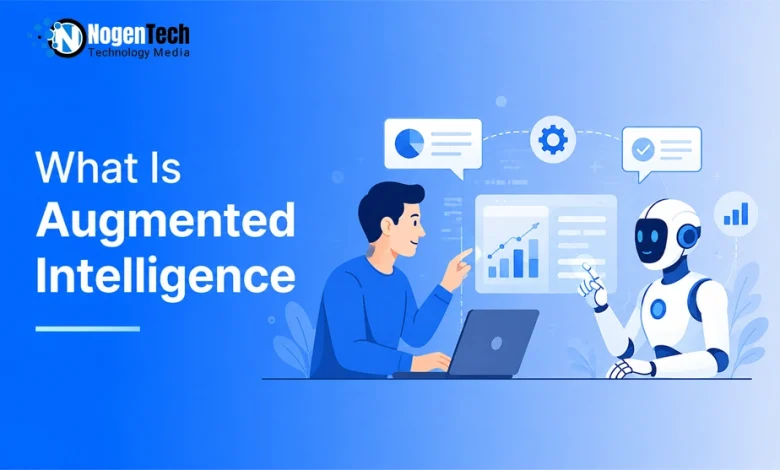
Augmented Intelligence is another modern-day technology that combines the speed and processing power of AI with the expertise and oversight of humans.
It has transformed how firms handle repetitive tasks, data processing, documentation, and decision-making. Many technologies have automated labor-heavy jobs.
However, full automation may not be desirable when the work involves judgment, context, interpretation, or knowledge that can affect important decisions. This scenario is where enhanced intelligence becomes more useful.
Scribe-X blends human and AI scribing to document healthcare while speeding up processes and maintaining human analysis and interpretation. Augmented intelligence helps humans improve their work by enhancing human judgment.
How AI Keeps People Informed
Traditional automation has focused on removing humans from the process. Augmented intelligence is technology that assists individuals.
AI can quickly analyze large volumes of data, detect trends, filter data, and perform repetitive tasks. Humans can then review the output, notice anything weird, and apply knowledge that is hard to codify. This combination is very effective in areas that require precision and context.
The Practical Limitations of Automation
Robots function best with predictable jobs and when information is adequately specified. Problems may arise for the system with partial, confusing, or varied inputs.
A computer algorithm could give a plausible answer and miss a crucial point. These kinds of errors can go unnoticed in the pipeline without human intervention. Augmented systems help users recognize misleading information before accepting or using it.
Context Is Hard to Automate
Context is difficult to automate because individuals see information in relation to a wider context. They can read tone, analyze unexpected situations, and connect unrelated material. Artificial intelligence systems can now comprehend language and recognize patterns, but they still cannot understand meaning that depends on context.
Human engagement provides a context-aware person to review the output and determine whether it accurately reflects what occurred.
Healthcare Shows the Importance of Oversight
Augmented intelligence could be better than full automation in therapy. Medical records require accurate documentation of words, patient history, medications, diagnoses, and treatment decisions.
AI can quickly collect and organize data, freeing clinicians from administrative work. Human review can identify missing details, resolve ambiguities, and update the record to reflect clinical practice.
Together, they make documentation easier and improve quality control. This balance is especially critical in heavily regulated environments, such as implementing Artificial intelligence validation in Medicare Advantage workflows, where automated outputs must strictly align with compliance standards
Prioritizing Higher-Value Work
Thus, augmented intelligence might lessen the monotonous work, not to get rid of it, but to focus on more important things. If people were doing data input, transcribing, sorting, or retrieval, they might be spending more time evaluating, discussing, problem-solving, and choosing. This improves productivity and lets workers move on to more complex jobs.
Increased Adaptability of Systems
Workflows are constantly changing. Job obligations might change with new legislation, consumer expectations, technologies, and internal processes.
If conditions change, a purely automated system may need major revisions. Augmented intelligence lets users step into new scenarios and provide feedback that improves performance. This flexibility makes the paradigm useful in exception-driven and dynamic contexts.
The Correct Speed-Judgment Balance
Automation is attractive because it’s quick and dependable. Success is not simply about speed. Organizations need knowledge, judgment, and the ability to spot issues.
Augmented intelligence is a partnership between people and technology that leverages their strengths. As AI capabilities continue to increase, this type of collaboration may continue to boost productivity without losing the human understanding that demanding jobs require.