Structured Light vs. iToF Depth Cameras in Factory Automation
Structured light offers finer detail and precision at fixed distances, while iToF provides more consistent depth measurements across variable distances and wider areas. The better choice depends on the factory application.

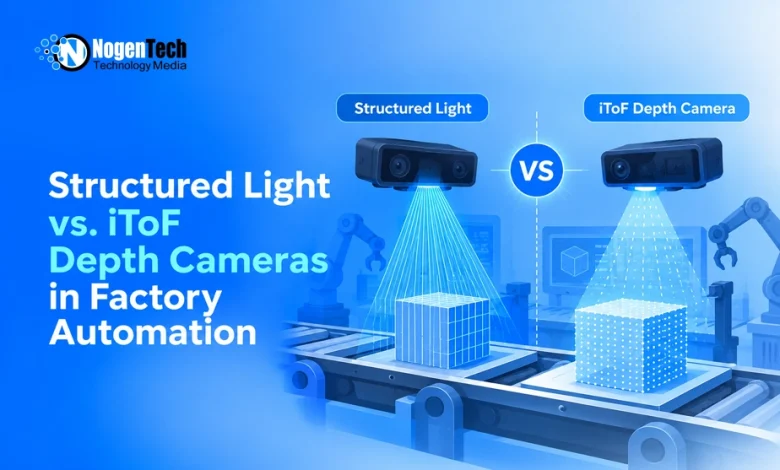
The right depth camera for factory automation depends on accuracy, distance, and factory conditions. Quality inspection needs precise measurements at a fixed distance, while bin-pick systems must detect parts at different depths.
Structured light and indirect time-of-flight (iToF) both use infrared light to measure depth, but differ in accuracy, field of view, and motion response.
Manufacturers such as Orbbec offer both technologies through cameras like the Astra 2 (structured light) and Femto Bolt (iToF). Here’s how they compare in specifications, limitations, and practical factory use.
| Factor | Structured Light | iToF |
| Depth measurement | Infrared pattern and triangulation | Modulated infrared light and phase measurement |
| Accuracy | Fine detail at a fixed distance | More consistent error across different distances |
| Field of view | Narrower on the Astra 2 | Wider on the Femto Bolt |
| Motion response | Pattern blur can cause depth gaps | Fast edges can produce flying pixels |
| Ambient light | Sensitive to reduced pattern contrast | Better tolerance, but affected by strong sunlight |
| Main limitation | Depth error increases with distance | Multipath interference |
| Best suited for | Fixed-distance inspection and part measurement | Bin picking, pallet measurement, and cell monitoring |
How Structured Light and iToF Cameras Measure Depth
Structured Light
Structured light cameras project a known infrared pattern onto an object and compare the captured pattern with a calibrated reference. Depth is calculated through triangulation between the projector and sensor.
This method provides fine detail and low noise near the calibrated working distance. However, depth error increases as the target moves farther away.
iToF
iToF cameras emit modulated infrared light and measure the phase shift of the reflected signal at each pixel.
Unlike structured light, iToF does not rely on pattern correlation or a triangulation baseline. Its depth error is generally more consistent across different distances.
However, reflections from multiple surfaces can cause multipath interference and incorrect depth values. Both the Astra 2 and Femto Bolt use 850nm infrared illumination and are rated for indoor use.
Accuracy and Depth Resolution
The Astra 2 and Femto Bolt use different accuracy metrics, so their published specifications are not directly comparable.
Astra 2 (Structured Light):
The Astra 2 specifies depth precision of ≤0.16% at 1 meter, equivalent to approximately 1.6mm. It supports depth resolution up to 1600 × 1200 at 30fps.
Its pixel density and low noise near the calibrated distance suit surface inspection, dimensional checks, and precise part-pose estimation.
Femto Bolt (iToF):
The Femto Bolt specifies a systematic error of less than 11mm plus 0.1% of distance, with a random error standard deviation of 17mm or less.
Its 1-megapixel depth sensor supports up to 1024 × 1024 resolution in wide-field mode. Structured light generally suits small measurements at a fixed distance. iToF is useful when objects appear at different depths, such as parts inside a bin as it empties.
Working Distance and Field of View
The Astra 2 supports a working distance of 0.6m to 8m. The Femto Bolt operates from 0.25m to 5.46m, depending on depth mode. Its narrow-field unbinned mode covers 0.5m to 3.86m, while wide-field unbinned mode covers 0.25m to 2.21m.
The Astra 2 has the longer maximum range, while the Femto Bolt supports a shorter minimum distance. iToF’s main advantage is more consistent depth error across its working range.
Field of view also differs:
- Astra 2: 58.2° × 45.2°
- Femto Bolt: 120° × 120° in wide-field mode
The Femto Bolt’s wider view can help cover large bins, totes, or pallets with fewer cameras.
Performance With Moving Objects
Both cameras support up to 30fps at their main depth resolutions, but motion affects each technology differently.
Structured light depends on a clear projected pattern. Fast movement, vibration, or motion blur can reduce correlation quality and create gaps in the depth map.
iToF does not experience the same pattern-correlation failures. However, its multi-exposure phase measurement can produce flying pixels or distorted depth boundaries around fast-moving objects.
For conveyor applications, both technologies benefit from hardware triggers, short exposures, and controlled infrared conditions. The Astra 2 and Femto Bolt both support external triggering.
Performance Under Factory Conditions
1. Ambient Light
Skylights, open dock doors, high-bay fixtures, and infrared heaters can affect depth measurements.
Structured light is sensitive to strong ambient infrared light because it reduces projected pattern contrast. iToF generally handles ambient light variation better, although direct sunlight can still increase noise.
Cameras near windows or dock doors should be tested under the brightest expected conditions.
2. Reflective and Dark Surfaces
Polished metal, machined aluminum, and glossy plastics can produce reflections that affect both technologies.
iToF is particularly sensitive to multipath interference inside deep bins and around concave surfaces, where light may reflect several times before reaching the sensor.
Dark rubber and black plastic can also produce weak infrared returns. Tests with actual parts and bins help identify these limitations before you deploy computer vision systems in production.
3. Operating Temperature
The two cameras have different operating temperature limits:
- Femto Bolt: 10°C to 25°C
- Astra 2: 0°C to 35°C
Production areas near ovens, molding machines, or other heat sources may exceed these ranges.
For industrial environments that require additional protection, Orbbec offers the Femto Mega I with an IP65-rated housing.
4. Multiple Cameras in One Cell
Overlapping structured light patterns can disrupt depth correlation, while overlapping iToF signals can interfere with phase measurements.
Hardware synchronization helps reduce interference in multi-camera installations. Orbbec’s Femto cameras use an 8-pin synchronization connector and a hub that carries trigger signals through RJ45 cabling. The Astra 2 also supports multi-camera synchronization.
Which Technology Is Better for Factory Applications?
1. Quality Inspection
Structured light is generally better suited to dimensional verification, surface inspection, and assembly checks at a fixed working distance, particularly in quality control and manufacturing automation.
Its high depth resolution and low noise near the calibrated distance support precise measurements. The camera should remain at a consistent distance from the inspected part.
2. Bin Picking
A fixed overhead bin-picking system can benefit from iToF’s wide field of view and consistent depth error as the bin empties.
However, reflective surfaces and deep metal bins can cause multipath interference. For arm-mounted cameras that guide the final approach, close-range stereo technology may be more suitable.
Orbbec’s Gemini 305, for example, supports a minimum working distance of 4cm and an ideal range of 7cm to 50cm.
3. Palletizing, Depalletizing, and Conveyor Dimensioning
iToF suits large objects, different package heights, and wide measurement areas.
Its broad field of view helps capture pallets and boxes, while flat, matte packaging surfaces generally present fewer multipath problems. Structured light remains an option for precise dimensional measurements of smaller packages at a fixed distance.
4. Cell Monitoring and Human-Robot Zones
iToF’s wide field of view and per-pixel depth measurement suit work-cell monitoring and people tracking. However, standard depth cameras are not substitutes for certified safety-rated sensors in worker protection applications.
Integration and Processing Requirements
The Astra 2 uses Orbbec’s custom ASIC for onboard depth processing, which reduces the workload on the host computer.
The Femto Bolt processes raw depth data on the host computer, similar to Microsoft Azure Kinect. This can affect industrial PC requirements, particularly when the system also runs inspection software or robotic vision applications.
Orbbec’s Femto Mega and Femto Mega I include a built-in NVIDIA Jetson Nano for onboard depth processing.
Both camera families support the open-source Orbbec SDK, with access to depth maps, point clouds, infrared data, and RGB output.
For Azure Kinect migrations, Orbbec’s K4A Wrapper can help existing applications work with the Femto Bolt.
Final Thoughts on the Use of Structured Light vs. iToF Depth Cameras
Structured light is better suited to fixed-distance inspection and precise part measurement, while iToF is useful for variable depths, wider measurement areas, and applications such as bin picking and pallet monitoring.
Neither technology is ideal for every factory environment. Reflective surfaces, ambient light, temperature, motion, and processing requirements can affect performance.
The best choice depends on the required accuracy, working distance, and results from tests under actual production conditions.