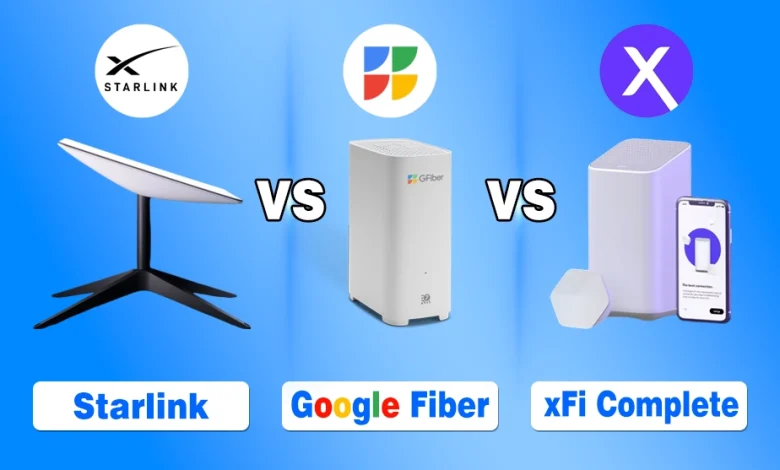
Starlink is now a direct competitor to Google Fiber and xFi Complete, and consequently, selecting the right internet service provider now feels like a high-stakes gamble.
In 2026, the digital landscape has shifted significantly and offers us choices that range from space-based satellites to lightning-fast fiber optics and advanced cable solutions. I have spent a lot of time analyzing these three giants to help you decide which one actually deserves your monthly payment.
Whether you are a rural dweller, a city-based professional, or a tech enthusiast, I want to take you through the real-world performance of Starlink, Google Fiber, and xFi Complete.
| Features | Google Fiber | Starlink (Residential) | xFi Complete (Xfinity) |
|---|---|---|---|
| Technology | Pure Fiber-Optic | LEO Satellite | Hybrid Fiber-Coaxial |
| Base Monthly Cost | $70 | $50 – $120 | $25 (Add-on) + Plan Fee |
| Download Speeds | 1 Gbps – 8 Gbps | 100 Mbps – 400 Mbps | 300 Mbps – 2 Gbps |
| Upload Speeds | Symmetrical (up to 8 Gbps) | 10 Mbps – 25 Mbps | 20 Mbps – 200 Mbps |
| Latency (Ping) | 2ms – 10ms | 25ms – 50ms | 12ms – 25ms |
| Equipment Cost | $0 (Included) | $349 – $599 (Upfront) | Included in $25 add-on |
| Data Cap | None (Unlimited) | Unlimited | None (Unlimited) |
| Contract | No Contract | No Contract | Often 1–2 Years |
| Best For | Power users & Gamers | Rural & Mobile living | Families & Smart homes |
| Availability | Limited (Select Cities) | Nearly Global | Widespread (40+ States) |
Technology Behind the Internet Giants
The reason these three internet services perform so differently lies in the “plumbing” that delivers data to your doorstep.
- Google Fiber is a pure fiber-optic play, sending pulses of light through glass strands to provide near-infinite bandwidth.
- Starlink uses a massive constellation of low-Earth orbit (LEO) satellites to beam internet from space, which is a massive leap over the laggy satellite tech of the past.
- xFi Complete is Xfinity’s premium “smart” layer on top of their robust cable network, which uses a combination of fiber and coaxial cables to blanket your home in high-speed Wi-Fi.
Understanding these structural differences is the first step in knowing why one might be rock-solid while another fluctuates based on the weather or your city’s infrastructure.
Starlink vs Google Fiber vs xFi Complete: A Complete Comparison
When we put these three head-to-head, we are looking at how they handle the real-world stresses of 2026 like 8K streaming, professional-grade video conferencing, and massive cloud backups.
Below, I have created a Starlink vs Google Fiber vs xFi Complete guide across 10 specific categories where these services diverge. While speed is the most talked-about metric, factors like latency, equipment ownership, and data freedom are what actually define your day-to-day happiness with a provider.
Let’s break down exactly how they stack up against one another across the board.
1. Maximum Download Speeds
Speed is often the first thing we look at when comparing internet plans, and the gap here is quite wide, depending on the technology.
- Starlink: Offers speeds ranging from 100 Mbps to 400 Mbps on the Residential Max plans, though these can fluctuate based on satellite density in your area.
- Google Fiber: Remains the undisputed king with symmetrical plans offering 1 Gig, 3 Gig, and a staggering 8 Gig for power users.
- xFi Complete: Provides a range of speeds typically topping out at 1.2 Gbps or 2 Gbps in “Next Generation” markets, though these are asymmetrical.
2. Upload Speed Symmetry
Upload speed is critical for anyone who sends large files or spends hours on Zoom calls, and this is where fiber usually shines brightest.
- Starlink: Typically provides between 10 Mbps and 25 Mbps, which is enough for standard video calls but may struggle with massive cloud uploads.
- Google Fiber: Offers full symmetry, meaning your 1 Gig or 8 Gig upload speed matches your download speed exactly.
- xFi Complete: Recently improved to offer up to 200 Mbps in many areas, but it still falls short of the symmetrical performance found in fiber.
You can also check my guide on the pros and cons of xFi Complete to see if you need this add-on or not.
3. Latency and Ping Times
If you are a competitive gamer or work in a field that requires real-time interaction, latency is actually more important than raw download speed.
- Starlink: In 2026, latency has dropped to an impressive 25ms to 50ms, which is phenomenal for satellite but still higher than wired connections.
- Google Fiber: Boasts the lowest latency in the industry, often hovering between 2ms and 10ms, making it the gold standard for gaming.
- xFi Complete: Sits in the middle with very stable pings usually ranging from 12ms to 25ms, which is perfectly fine for almost any residential use.
Wanna know how to reduce latency? Go to my guide on how to improve home WiFi speed for minimal pings during gaming and streaming.
4. Availability and Geographic Reach
The best internet in the world is useless if you cannot get it at your address, and this is the category where the “where” matters most.
- Starlink: Available almost everywhere in the continental U.S., making it the only viable high-speed choice for deep rural or mobile living.
- Google Fiber: Highly limited to specific metropolitan “fiber cities,” which means that unless you live in a tech hub, you likely cannot get it.
- xFi Complete: Widely available across 40 states, covering the vast majority of suburban and urban neighborhoods where Xfinity has existing lines.
5. Equipment Costs and Ownership
Setting up your home network can come with a significant “entry fee” depending on which provider you choose.
- Starlink: Requires a significant upfront investment of $349 to $599 for the satellite kit, though the hardware belongs to you once paid.
- Google Fiber: Includes a high-end Wi-Fi 7 router and necessary extenders at no extra cost, with zero monthly rental fees.
- xFi Complete: Charges a monthly fee for the gateway, but this fee includes the “xFi Complete” benefits like unlimited data and tech support.
6. Data Caps and Overage Fees
Nothing ruins a weekend like a notification that you have hit your data limit, and obviously, you want to remove Internet data caps in those situations. But providers have very different philosophies on this.
- Starlink: Offers unlimited data on standard residential plans, though they may manage traffic during times of extreme network congestion.
- Google Fiber: Has never had data caps and likely never will, allowing you to use as many terabytes as your hardware can handle.
- xFi Complete: This specific tier is designed to remove the standard 1.2 TB Xfinity data cap, providing true unlimited data for your household.
7. Contract Requirements and Price Locks
Locking into a long-term contract is a thing of the past for some, while others use it to provide price stability.
- Starlink: No contracts are required, allowing you to cancel or pause your service at any time without paying early termination fees.
- Google Fiber: Operates on a month-to-month basis with no contracts and has maintained the same $70 price point for its base plan for over a decade.
- xFi Complete: Often offers a 2-year or 5-year price guarantee in 2026, which provides stability but usually involves a term agreement.
8. Reliability in Extreme Weather
Physical infrastructure and space-based signals respond differently to the elements like heavy rain or snow.
- Starlink: Can be affected by “rain fade” or heavy snow accumulation on the dish, though the hardware includes built-in heating elements to melt snow.
- Google Fiber: Buried fiber lines are virtually immune to weather, which makes it the most reliable option during storms or high winds.
- xFi Complete: Relies on local power and physical lines, which are generally stable but can be susceptible to local outages if lines are above ground, unlike that of Xfinity Pro, which can be converted to LTE.
9. Smart Home and Security Features
The modern internet is about more than just a connection. It is about managing the dozens of devices inside your home so you can get the most from the Internet.
- Starlink: Focuses primarily on the connection itself, offering a basic but functional app for network management without much built-in security.
- Google Fiber: Provides a clean, simple interface and works seamlessly with Google Home, though it lacks specialized “security-as-a-service” layers.
- xFi Complete: Includes “Advanced Security” that blocks threats at the gateway and a “Tech Check” feature that automatically monitors your home’s Wi-Fi coverage.
10. Mobility and Travel Flexibility
For the modern “digital nomad,” the ability to take your internet with you is a feature that only one of these providers truly masters.
- Starlink: Offers a “Roam” plan and a “Mini” dish that can be used while traveling, making it perfect for RVs or secondary homes.
- Google Fiber: Completely stationary; it is tied to the physical fiber line installed in your specific residence.
- xFi Complete: Strictly for home use, although Xfinity customers do gain access to millions of public WiFi hotspots across the country.
Which Internet You Should Use?
I wish there were a simple “this one is best” answer, but the truth is that your location and lifestyle dictate the winner.
- If you are living in a major city like Austin or Raleigh and Google Fiber is available, I strongly recommend you take it for the symmetrical speeds and simple pricing.
- If you are a suburban family with many devices and you already use Xfinity for mobile or TV, xFi Complete is a fantastic upgrade that solves the data cap headache.
- However, if you are building a life off the beaten path or traveling the country in an RV, Starlink is the only service that can offer you a high-speed experience without a physical tether.
In 2026, we have finally reached a point where high-quality internet is no longer just for the lucky few in downtown high-rises. Whether it is through light pulses in a fiber optic cable, signals from a satellite constellation, or an intelligent cable gateway, we have the tools to stay connected.
My advice is to prioritize the service that offers the best reliability for your specific work-from-home needs. I have seen too many people focus on “gigabit” speeds when what they actually needed was lower latency or unlimited data.
Take a look at your monthly data usage and your physical location, and the right choice between these three will become clear.
Final Thoughts
The choice between Starlink, Google Fiber, and xFi Complete represents the diversity of our modern digital needs.
We have moved past the era of settling for whatever the local monopoly offers and into a time of specialized connectivity. Google Fiber remains the speed king, Starlink is the hero of the rural world, and xFi Complete is the smart choice for the suburban household.
I hope this guide has given you the clarity needed to choose the provider that will power your home for years to come. Ultimately, the best internet is the one that you never have to think about because it just works.