10 Key SEO Trends to Learn About in 2026
Businesses must learn about AI in Google Search, Answer Engines, mobile-friendly design, user-centric and local SEO, sales optimization, and visual search to stay competitive.

SEO has changed significantly, but the fundamentals haven’t. Businesses still need useful content, technically accessible websites, relevant links, and a clear understanding of what their audience is searching for.
What has changed is where and how people discover information. Google AI Overviews, AI Mode, ChatGPT, Perplexity, social platforms, video, and traditional search results can all influence the path a customer takes before reaching a business.
Throughout my 15+ years of experience in SEO, I’ve learned how SEO trends change and how to deal with them in a professional way.
In this guide, I will walk you through the top SEO trends defining 2026 and show you how to future-proof your strategy so you stay visible, relevant, and ahead of your competitors.
Why SEO Still Matters in 2026
AI-generated answers have changed search behavior, but they have not eliminated the need for SEO.
Search engines still need to crawl, understand, index, and evaluate web content before they can surface useful pages in traditional Search and many of their AI-powered experiences.
Google’s own guidance for generative AI features continues to emphasize established SEO practices alongside useful, non-commodity content.
Modern SEO now ensures:
- Your content is visible in AI-generated answers
- Your brand is recognized as an entity in your niche
- Your website is trusted across multiple discovery platforms
- Your content is structured for both humans and machines
This matters even more as AI Overviews reshape search behavior. According to Ahrefs research, AI Overviews appear in more than half of U.S. searches and can reduce clicks to top-ranking organic results by 58%.
Top 10 SEO Trends to Watch Out For
SEO is no longer just about reacting to algorithm updates. It’s about understanding where search is heading. From AI-powered results and zero-click searches to intent-driven rankings, the way people discover content is changing rapidly.
In 2026, these emerging SEO trends can help you reach your target audience and drive branded traffic.
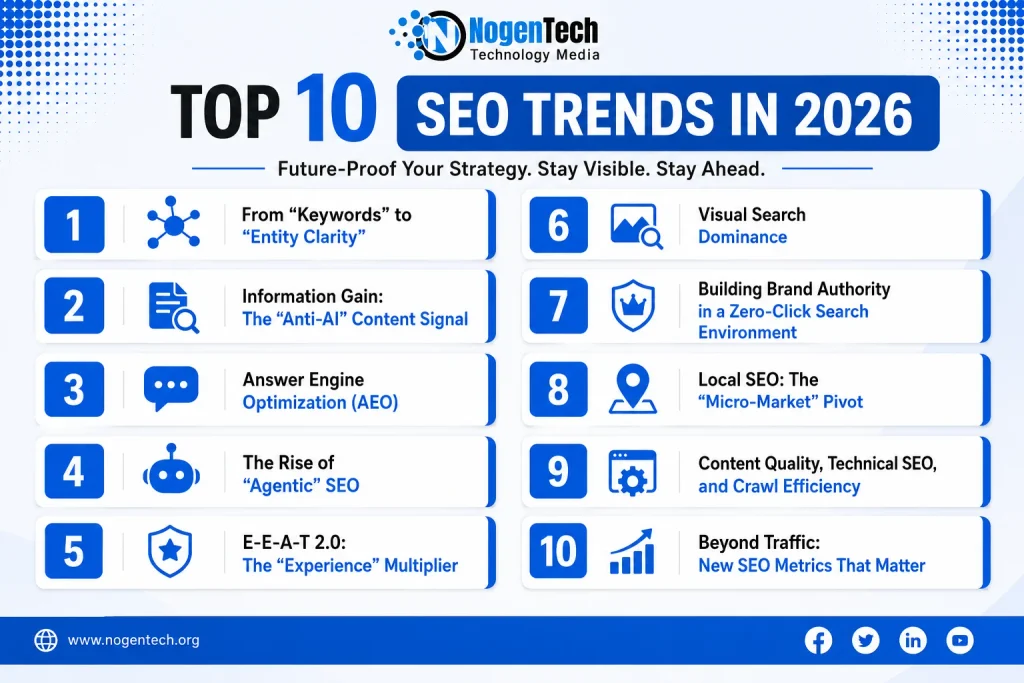
1. From “Keywords” to “Entity Clarity”
Search engines don’t just “read” your text; they “understand” your brand as an entity. Google’s Knowledge Graph has evolved into a sophisticated web of relationships.
- The Trend: Search engines now prioritize “Entities” (People, Places, Things, Brands) over string-based keywords.
- The Strategy: You must define your brand’s relationship to specific topics. This is done through advanced Schema Markup (JSON-LD) that explicitly connects your brand to its founders, products, and core expertise.
- If the AI cannot place you in its internal map of “Trustworthy Sources for [X Topic],” you won’t appear in the AI overview summary.
As I have learned, brands that clearly define who they are, what they do, and which topics they own tend to earn stronger visibility in both traditional search results and AI-generated responses.
2. Information Gain: The “Anti-AI” Content Signal
A common mistake of 2024–2025 was the flood of mediocre AI-generated content that simply recycled information already available on Google. If your content adds nothing beyond what’s already in the SERPs, it’s unlikely to stand out or rank well.
- The Trend: Google specifically prefers content containing original information, research, analysis, and demonstrable first-hand expertise.
- The Strategy: Every piece of content must provide unique value. This could be proprietary data, a controversial counter-opinion, original photography, or a specific case study.
Practical tip professionals gave me: Ask yourself, “Could an AI chatbot write this in 30 seconds?” If the answer is yes, your content probably needs more original insight, experience, or value before you publish it.
3. Answer Engine Optimization (AEO)
Users are increasingly moving toward “Zero-Click” environments. They want the answer directly in the chat interface of ChatGPT, Gemini, or Perplexity, and Google AI Overviews.
- The Trend: Visibility is now measured by Citations, not just Clicks.
- The Strategy: Structure your content so both users and AI systems can easily understand it. Start important sections with concise 40–60-word answer blocks that directly define a term or answer a common question. This makes key information easier to extract, summarize, and potentially reference in AI-generated responses.
Over the last year, you may have noticed that concise definitions, FAQ sections, comparison tables, and direct answers can increase the chances of content being referenced by AI-powered search tools.
4. The Rise of “Agentic” SEO
We are moving from AI that simply answers questions to AI agents that can perform tasks. For example, an AI agent may search for software, compare options, and eventually complete a purchase on a user’s behalf.
- The Trend: Optimization is expanding beyond what users see on the page.
- The Strategy: As AI agents become more capable of researching and completing tasks, businesses should make their content easier for machines to access and understand through structured data, clear content, APIs, and emerging standards like LLMs.txt.
5. E-E-A-T 2.0: The “Experience” Multiplier
While E-E-A-T isn’t new, Experience has become increasingly important as AI-generated content becomes more common. Google E-E-A-T emphasizes content that demonstrates genuine first-hand experience.
- The Trend: AI can summarize existing knowledge, but genuine first-hand experience is harder to replicate.
- The Strategy: Add original experiences, observations, tests, examples, and results where relevant. Instead of simply claiming expertise, show what you did and what you learned from it.
In competitive industries, I’ve found that first-hand experience outperforms generic AI-generated content. Real examples, original screenshots, case studies, testing results, and expert commentary create trust signals that are difficult for automated content to replicate.
6. Visual Search Dominance
With tools like Google Lens, smart glasses, and other visual AI technologies, search is becoming increasingly visual rather than purely text-based.
- The Trend: Visual search is making images a more important part of how users discover products, places, and information.
- The Strategy: Treat images as useful content, not just decoration. Use original photos, diagrams, screenshots, and other visuals that add context or help users understand the topic. Write descriptive alt text that accurately explains relevant images instead of stuffing it with keywords.
Image optimization now goes beyond file names and alt text. Visuals should match user intent, add unique value, and strengthen the overall context of your content.
7. Building Brand Authority in a Zero-Click Search Environment
As more searches end without a click, brand visibility within search results and AI-generated answers is becoming more valuable.
- The Trend: Brand visibility matters even when a search doesn’t result in a click.
- The Strategy: Focus on branded search and authority building. The goal is to make your brand one that users and AI systems recognize and associate with your niche.
- PR, social proof, and community mentions on Reddit, Quora, and niche forums are non-negotiable because AI Search Analytics shows that LLMs use these platforms as their primary “Social Proof” training sets.
SEO success isn’t only about earning the click; it’s also about being visible, recognized, and trusted wherever users search for answers.
8. Local SEO: The “Micro-Market” Pivot
AI search is now hyper-contextual. It knows which region the user is in, what they are looking for, and what they have bought recently.
- The Trend: Local SEO has shrunk from “City-wide” to “Block-wide.”
- The Strategy: Focus on Hyper-Local Entities. Mention specific landmarks, local events, and neighborhood names in your content. Ensure your Google Business Profile is updated daily, not weekly, with real-time photos and “In-Stock” updates.
Local businesses that consistently update their business profiles, i.e GBP, publish local content, and earn authentic customer reviews are more likely to appear in localized AI recommendations.
9. Content Quality, Technical SEO, and Crawl Efficiency
AI crawlers are expensive to run. Search engines are becoming “pickier” about what they crawl.
- The Trend: The “Crawl Budget” is now an “Efficiency Budget.”
- The Strategy: Delete your “Zombie Pages.” A site with 50 high-quality, cited pages will outrank a site with 5,000 mediocre blog posts. Use Clean HTML and avoid heavy JavaScript frameworks that hide content from “Lightweight” AI crawlers.
10. Beyond Traffic: New SEO Metrics That Matter
Currently, if you report “Total Organic Traffic” to your CEO, you are telling half the story.
- The Trend: Traffic alone doesn’t show the full value of your search presence.
- The Strategy: Track metrics beyond clicks, including AI mentions (Share of Model), branded search volume, conversions, and assisted conversions. If your visibility is improving, you may see stronger branded demand and higher-quality conversions even when informational traffic declines.
People Also Ask
What is Search Everywhere Optimization?
Search Everywhere Optimization is the practice of improving brand visibility across multiple platforms, including search engines, AI assistants, social media, video platforms, and online communities, rather than focusing solely on Google rankings.
What is LLM Optimization (LLMO)?
LLM Optimization refers to optimizing content so that Large Language Models (LLMs) like ChatGPT, Gemini, Claude, and Perplexity can easily understand, reference, and cite it in AI-generated responses.
Is traditional SEO still relevant in 2026?
Yes. Traditional SEO remains important because search engines and AI systems still rely on well-structured, authoritative, and relevant content. However, SEO now extends beyond rankings to include AI visibility, entity recognition, and brand authority.
How can businesses prepare for AI-powered search?
Businesses should focus on creating original content, building topical authority, implementing structured data, strengthening brand recognition, improving technical SEO, and publishing content that demonstrates first-hand experience.
Turn SEO Trends into an Actionable Strategy
Currently, SEO is about more than ranking web pages. Brand recognition, authoritative content, and visibility across different search experiences now play a bigger role in how people discover businesses.
These trends are reshaping the SERPs and how users find information. Keep an eye on them and adjust your marketing strategies accordingly.
The goal isn’t to chase every new trend, but to understand changing search behavior and build a strategy that remains useful, visible, and competitive.