OpenAI Is Quietly Buying Tens of Thousands of Mac Minis, And It’s Not What You’d Guess
OpenAI has spent recent months buying tens of thousands of Apple Mac mini and Mac Studio units, not for coding or design work, but to train reinforcement learning systems and AI agents that operate computers on their own.

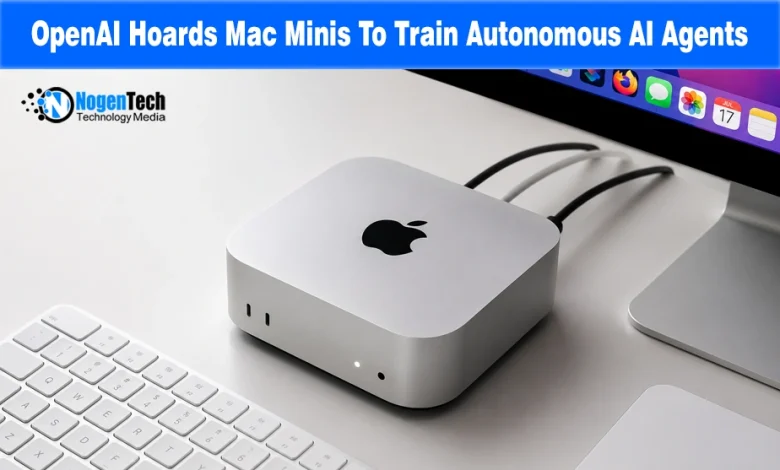
OpenAI has quietly assembled tens of thousands of Apple Mac mini and Mac Studio units in recent months, per The Information, using them to train reinforcement learning systems, a type of machine learning algorithm, and AI agents designed to operate computers autonomously.
The purchases mark a shift from OpenAI’s usual reliance on leased GPU cloud clusters and have reportedly affected Apple’s supply chain, contributing to a hardware refresh that Apple was not expected to announce until later this year.
Why Apple’s Memory Architecture Fits Reinforcement Learning
The appeal of Mac hardware for this work comes down to memory rather than raw processing power.
Apple’s unified memory architecture shares a single RAM pool across the CPU, GPU, and Neural Engine, allowing a Mac mini or Mac Studio to hold larger AI models in active memory than a discrete graphics card setup.
This matters because training computer-use agents, systems that observe a screen, take actions, and receive feedback in a continuous loop, is more memory-intensive than the matrix calculations that dominate large-scale model pretraining.
Traditional GPU clusters remain better for pretraining, making OpenAI’s Mac purchases a targeted addition rather than a replacement for its existing infrastructure.
Apple’s Supply Chain Feels the Squeeze
OpenAI isn’t the only AI lab taking this approach.
According to MoneyControl, Anthropic is renting Mac mini capacity through Amazon Web Services instead of buying the hardware, suggesting the advantage extends beyond its competitor OpenAI.
Demand from both labs, along with developers running AI models locally, has also stretched delivery times for high-RAM Mac mini and Mac Studio configurations.
This demand links to OpenAI’s broader push for memory capacity, including its yearlong effort to secure memory chips from Samsung and SK Hynix for its Stargate data center buildout.
The trend suggests OpenAI’s demand for memory-dense hardware now extends beyond servers to desktop machines Apple originally designed for consumers and creative professionals.
A Signal About Where AI Training Is Actually Headed
The more interesting story here isn’t the purchase order; it’s the timing.
Apple rarely refreshes its Mac lineup outside the autumn window tied to the new iPhone lineup, yet it released an updated Mac mini with its M6 chip and a Mac Studio with an M5 Ultra option earlier than expected.
Apple has not linked the changes to enterprise AI demand, but the timing closely matches reports of increased OpenAI purchases.
Neither company has confirmed the arrangement publicly, which is itself telling.
OpenAI has little reason to reveal the hardware behind its training strategy, while Apple can let Mac sales, its fastest-growing hardware category this past quarter, speak for themselves, without acknowledging a single customer’s outsized influence.
What this signals is that reinforcement learning for computer-use agents has become distinct enough from pretraining that AI labs are looking beyond traditional GPUs.
Source: How Apple Stumbled Into AI Hardware Success With the Mac