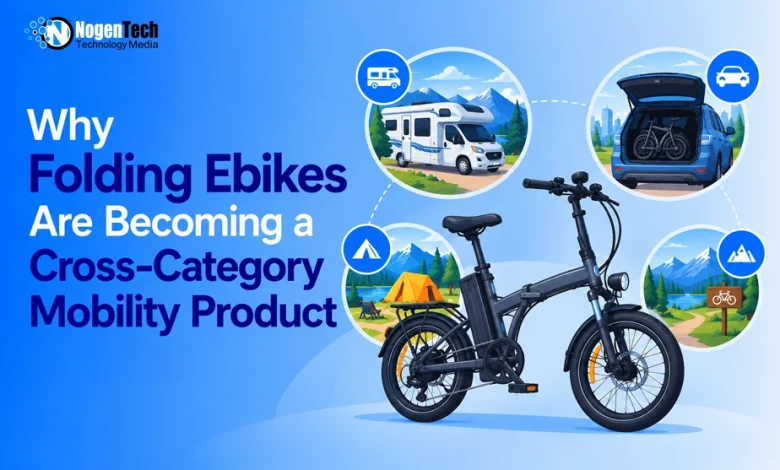
The e-bike industry has spent the last several years growing past its original identity. What started as part of the broader micromobility revolution offering an alternative to cars and public transit has expanded into categories that used to have little to do with cycling: RV travel, camping, road trips, and even trail access.
Folding ebikes are where that expansion is happening fastest, and the reason is simple. A folding frame isn’t just a smaller bike. It’s a format that fits into other industries’ existing products, rather than competing against them.
From Commuter Tool to Multi-Industry Format
Early ebikes largely followed the shape of the bicycle industry they came from: standard frames, sold through bike shops, aimed at people replacing a car trip or a bus ride.
The U.S. Department of Transportation notes that e-bike use is growing rapidly, with federal research increasingly examining how they affect transportation and access. That market is still growing, but the more interesting shift is happening around the edges of it, in categories that never had a natural bike product before.
Folding ebikes fit into an RV’s storage bay. They fit into a sedan’s trunk. They fit into a camper’s cargo hold or a boat’s deck locker. That single design trait, the ability to collapse into a footprint other industries already have space for, is what’s pulling folding ebikes out of the bike category and into adjacent ones.
RV and Camping: A Natural Fit for Local Mobility
RV travel and camping share a common problem: getting around once you’ve already parked or set up camp. A vehicle that’s too large to casually drive into town isn’t a great solution for a short errand, and a campsite often sits some distance from the trailhead, the store, or the lake.
A folding e-bike solves that without adding a second vehicle to the trip. It stores in space an RV or truck bed already has, and the electric assist handles the terrain and distance a regular bicycle would struggle with.
RV manufacturers and outdoor retailers have both taken notice, with more storage compartments, racks, and accessory lines now built with a folding e-bike’s dimensions in mind rather than treated as an afterthought.
A Closer Look: The Velotric Fold 1 Plus as an Example
The Velotric Fold 1 Plus is a useful case study for where this category is heading, less because of any one spec and more because of how those specs come together.
Riding it, the first thing that stands out is that it doesn’t feel like a compromise built around folding. The step-through frame, 3-inch tires, and 60mm suspension fork give it a planted, stable feel on gravel and uneven campground roads that a lot of folding bikes simply don’t manage.
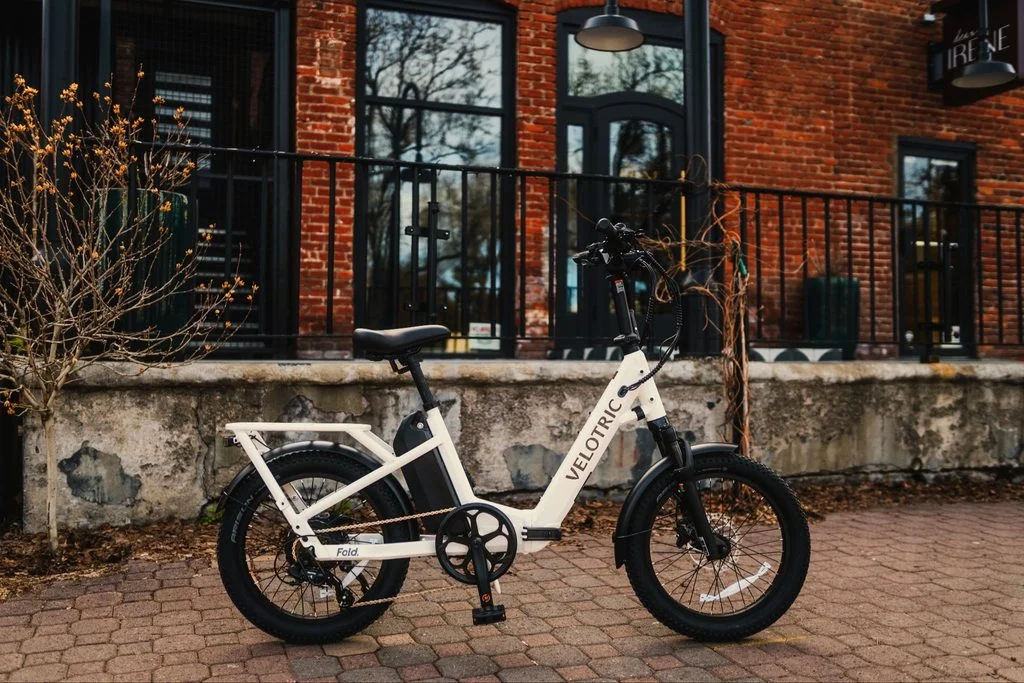
On the road, the 750W motor (1,100W peak) has enough pull to handle a real climb without hesitation, and local rides consistently push well into the 60-mile range before a recharge is needed.
The rear rack held up fine under a loaded pannier, and with a 450-pound payload capacity, the bike never felt pushed past what it was built for.
The headlight is bright enough to actually rely on for an early morning ride rather than treat as decoration, and after getting caught in a light rain more than once, the IPX6 build and IPX7-rated battery held up well enough to just keep riding instead of turning back.
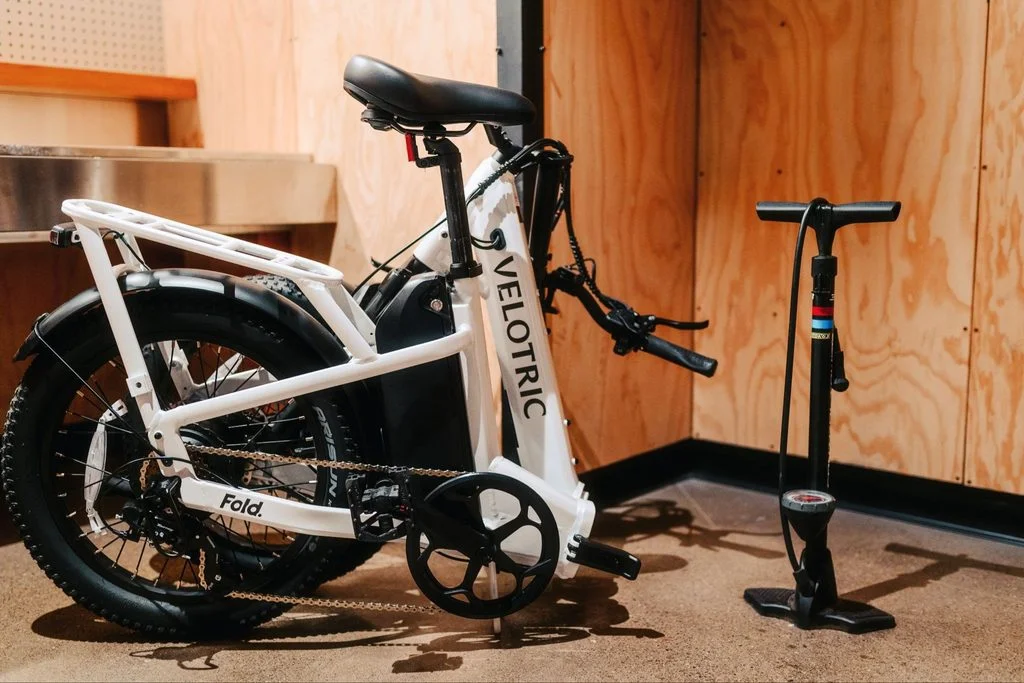
Folded, it comes down to roughly 37.8 × 19.7 × 33.5 inches, small enough for a car trunk, an RV storage bay, or a closet corner. At around 63 pounds, it sits in the middle of the folding e-bike weight range: heavier than an ultralight commuter folder, but light enough to remain a one- or two-person lift rather than something that needs a ramp or a hoist.
What makes it relevant to the broader industry shift isn’t any single number. It’s that the bike doesn’t force a choice between a real ride and a small footprint, which is exactly the trade-off that used to keep folding ebikes out of RV storage bays, car trunks, and outdoor gear lineups in the first place.
The Car Industry's Quiet Overlap With Ebikes
Automakers have been paying attention to this shift too. Several have added bike racks rated specifically for electric bikes, recognizing that a standard rack built for a lightweight road bike often isn’t rated for the extra weight of a motor and battery.
Some manufacturers now list folding e-bike compatibility as a feature in trunk space and cargo specifications, a detail that wouldn’t have appeared in a car’s marketing materials a decade ago.
This overlap reflects a broader trend in personal transportation: fewer people are relying on a single mode of travel for an entire trip. A folding e-bike extends what a car can do without needing a second vehicle, turning a parked car into the start of a bike trip instead of the end of the journey.
Outdoor and Trail Access Markets Are Catching Up
The outdoor industry has followed a similar pattern. As technology reshapes adventure and leisure travel, trail access points, national park visitor programs, and outdoor gear retailers increasingly treat ebikes as a mainstream option rather than a niche one.
Folding models in particular show up where portability matters as much as capability, like a trailhead reached by car or a backcountry access road with limited vehicle parking.
That shift is already visible on U.S. public lands. In 2026, the Bureau of Land Management expanded Class 1 e-bike access around Moab, Utah, opening nearly 200 miles of mountain-bike trails to eligible e-bike riders.
This is also where regulation is still catching up to the market. Trail and land-access rules vary widely by jurisdiction and land manager, and a folding e-bike’s classification can affect where it’s allowed to ride even when the format itself makes it easier to get there in the first place.
What's Driving the Shift
A few underlying factors explain why folding ebikes are expanding into these adjacent categories now rather than a decade ago.
Battery energy density has improved enough that a folding frame no longer means a meaningfully smaller battery or a compromised range, closing the gap that used to separate folding models from standard ones. Motor and drivetrain components have gotten smaller and more efficient too, which matters for a category where every folded inch counts.
Manufacturing costs have also come down as more of the e-bike supply chain has scaled up, making a well-built folding e-bike less of a premium purchase than it was in the segment’s early years. That price shift widens the buyer base beyond dedicated cyclists to RV owners, road trippers, and casual outdoor users who wouldn’t have considered an e-bike purchase otherwise.
What This Means for the Industry Going Forward
Folding e-bikes are no longer just a subcategory within the broader e-bike market. They’re becoming a connective format between industries that otherwise don’t overlap much: bicycles, RVs, automobiles, and outdoor recreation gear.
As more retailers, manufacturers, and land managers build around that reality, the folding e-bike’s growth is likely to keep tracking closer to the mobility and outdoor recreation industries as a whole, rather than staying tied to bicycle sales figures alone.
For an industry that started as an alternative to short car trips, that’s a meaningful shift. Folding ebikes are increasingly being bought not to replace a single mode of transportation, but to extend several of them at once.