Top 10 B2B Marketing Trends in 2026 That Drive Revenue Growth
In 2026, B2B marketing success is defined by revenue-driven strategies that combine AI, personalization, automation, and sales alignment to deliver measurable growth.

In 2026, B2B marketing has one job above all else: drive revenue or get replaced. Boards want proof, CEOs want growth, and CMOs are under pressure to connect every campaign, channel, and dollar spent directly to business outcomes.
Lead volume alone no longer wins, but a predictable pipeline, faster deal cycles, and measurable ROI do.
As buying committees grow larger and buyers become more self-directed, B2B marketing has advanced into a revenue-centric engine powered by AI, first-party data, and hyper-personalized experiences.
The strategies that succeed this year are those that align marketing tightly with sales, decision intelligence, and long-term customer value. That’s why I’ve come up with the best B2B marketing trends that would drive revenue and growth to your business.
Top 10 B2B Marketing Trends Every CMO Should Watch
In the under-section, I’ve elaborated on the top ten B2B marketing trends of 2026 to grab the desired outcomes.
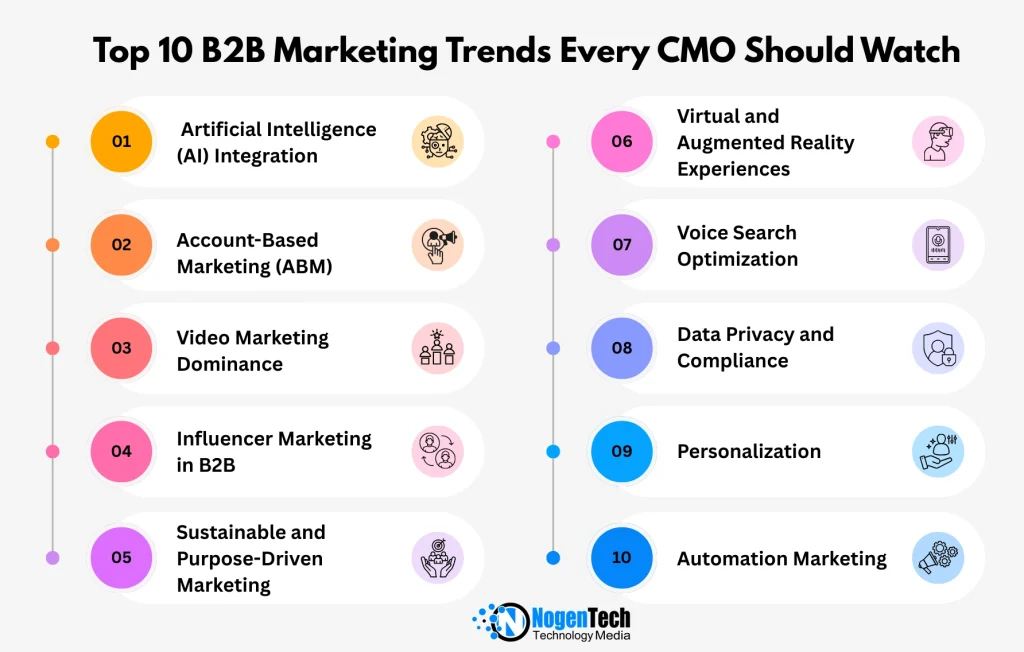
1. Artificial Intelligence (AI) Integration
Artificial Intelligence continues to redefine B2B marketing in 2026. From predictive analytics and intelligent segmentation to AI-powered chatbots and recommendation engines, businesses are utilizing AI to automate processes and make smarter decisions faster.
AI enables marketers to analyze vast amounts of data, anticipate buyer intent, personalize messaging at scale, and optimize campaigns in real time. The result is higher efficiency, improved customer understanding, and better conversion rates across the funnel.
2. Account-Based Marketing (ABM)
Account-Based Marketing remains a cornerstone of high-performing B2B strategies in 2026. Instead of broad outreach, ABM focuses on high-value accounts with tailored messaging, content, and experiences.
By utilizing data-driven insights, marketers can target specific decision-makers, address their unique pain points, and coordinate efforts across sales and marketing teams. When executed correctly, ABM drives larger deal sizes, faster close rates, and stronger customer relationships.
3. Video Marketing Dominance
Video continues to dominate B2B marketing in 2026 as one of the most effective ways to communicate complex ideas quickly and clearly. Businesses are heavily investing in product demos, explainer videos, webinars, customer testimonials, and short-form thought leadership content.
Video content helps humanize brands, increase engagement, and improve trust, which is essential in the era of AI video generators. This approach makes it a powerful driver of demand generation and sales enablement throughout the buyer journey.
4. Influencer Marketing in B2B
Once considered a B2C-only strategy, influencer marketing has firmly established itself in the B2B world. Industry experts, consultants, analysts, and thought leaders now play a crucial role in shaping buying decisions.
Partnering with the right B2B influencers allows brands to build credibility, reach niche audiences, and influence enterprise-level decision-makers. These trusted voices help accelerate trust and shorten buying cycles that drive revenue growth.
5. Sustainable and Purpose-Driven Marketing
Modern B2B buyers increasingly expect brands to stand for something beyond profits. In 2026, purpose-driven and sustainability-focused marketing is no longer optional, but has become a bloodline for B2B companies.
Businesses that clearly communicate their values, whether related to sustainability, ethics, or social responsibility, build stronger trust and long-term loyalty. Purpose-driven messaging helps differentiate brands in crowded markets while strengthening emotional and strategic connections with buyers.
6. Virtual and Augmented Reality Experiences
Virtual Reality (VR) and Augmented Reality (AR) technologies are becoming powerful tools in B2B marketing. These technologies allow businesses to deliver immersive product demonstrations, virtual showrooms, and interactive training experiences.
By offering hands-on experiences without physical limitations, AR and VR help prospects better understand complex solutions, reduce uncertainty, and make faster purchasing decisions.
7. Voice Search Optimization
Voice search is no longer limited to consumer use cases because of advancements in natural language processing (NLP) and AI. In 2026, B2B buyers increasingly rely on voice-enabled devices to research solutions, find vendors, and access information quickly.
Optimizing content for voice search through conversational language, structured data, and SEO best practices improves discoverability, accessibility, and visibility across search platforms.
8. Data Privacy and Compliance
With increased digital adoption comes increased cyber risks. Data privacy and regulatory compliance are now critical components of a B2B marketing strategy. Further, businesses should implement cybersecurity practices in their mundane tasks to stay safe.
Businesses that prioritize secure data practices, transparent consent management, and compliance with global regulations build trust and protect their brand reputation. In 2026, privacy-first marketing is a competitive advantage, not just a legal requirement.
9. Personalization
Personalization is no longer about using a prospect’s name in an email. In 2026, successful B2B marketing relies on deep, data-driven personalization across every touchpoint.
Understanding a company’s industry, challenges, buying stage, and intent allows marketers to deliver highly relevant content and offers. This level of personalization increases engagement, improves conversion rates, and strengthens long-term relationships.
10. Automation Marketing
Automation is at the core of scalable B2B marketing in 2026. From email campaigns and lead nurturing to ad optimization and customer segmentation, automation enables teams to operate more efficiently.
By automating repetitive and time-consuming tasks, marketers can focus on strategy, creativity, and revenue growth. Automation ensures consistency, improves speed, and supports predictable pipeline generation.
Final Verdicts on B2B Marketing Trends
The B2B marketing landscape in 2026 is defined by technology, trust, and measurable revenue impact. Businesses that embrace AI, personalization, automation, and purpose-driven strategies position themselves for sustainable growth in an increasingly competitive environment.
Adopting these trends proactively allows organizations to improve decision-making, strengthen customer relationships, and turn marketing into a true revenue engine. In a market where expectations are higher than ever, precision, transparency, and alignment with business goals will separate leaders from laggards.