Meta Launches AI Mode In-Feed Search on Facebook: Morgan Stanley Sees $10B+ Annual Revenue Potential
Meta is turning Facebook into a conversational search engine with AI Mode, synthesizing real-time public conversations, Groups, and Reels into direct answers, a move that could reshape discovery and unlock massive new ad revenue.

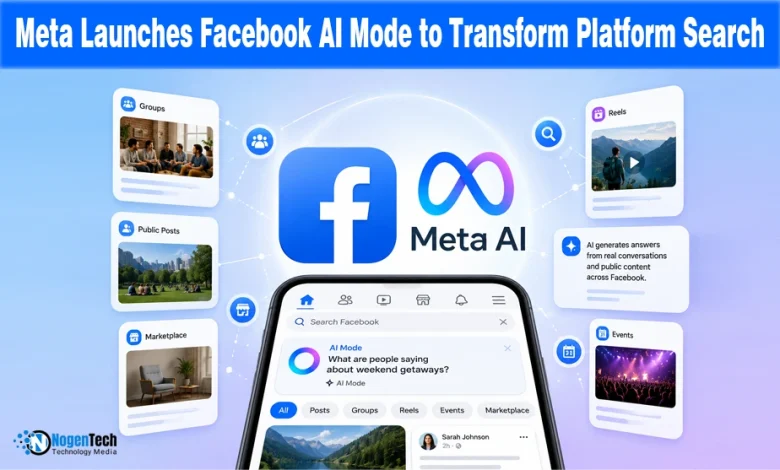
Meta’s June 15 announcement positions Facebook as more than a social feed: it’s now a real-time generative discovery engine.
AI Mode lets users ask natural-language questions and receive synthesized responses drawn from what people are actually sharing publicly across Groups and Reels, rather than generic links or ranked posts.
This builds on years of Meta AI integration but marks the first time the company is directly challenging traditional search paradigms inside its core app.
The feature runs on Muse Spark, the flagship model from Meta Superintelligence Labs, developed after the challenges surrounding Llama 4 and backed by Meta’s $14 billion-plus investment in Scale AI.
From Passive Scrolling to Active Discovery
Traditional Facebook search returns lists of posts and profiles.
AI Mode changes that: query “best hiking spots near Seattle this weekend” or “current iPhone deals in local groups,” and it pulls context from thousands of public discussions, events, and recommendations to deliver conversational answers.
Meta’s official blog highlights that it prioritizes “real perspectives and experiences” from the community over external web results.
This could be particularly powerful for local discovery, event planning, product recommendations, and niche communities; areas where Facebook’s data moat is unmatched.
For creators and businesses, this opens new visibility channels. High-intent queries could drive organic reach through public content, but it also pressures pages to optimize for AI visibility
The $10 Billion Monetization Bet
Wall Street is bullish on the commercial upside. According to Forbes, Morgan Stanley’s Brian Nowak outlined a scenario where retaining around 1 billion users and monetizing just 10% of daily queries through intent-driven Facebook ads could yield $10 billion+ in annual revenue.
Sponsored results and branded answers inserted contextually into AI responses carry premium pricing compared to traditional feed ads.
The strategy aligns with Meta’s broader push toward subscriptions, as the company introduces paid plans across its social apps to help offset rising AI and infrastructure costs. Investors reacted positively, with META shares climbing on the news.
Privacy, Risks, and Open Questions
Meta emphasizes that AI Mode uses only public information; private messages, closed groups, and personal profiles are excluded. Users retain control over visibility settings.
The feature also raises familiar concerns. Because AI Mode pulls from public posts, it could sometimes surface misleading claims or community rumors as factual answers.
It may also encourage more public sharing as users try to make their content more visible. And, like many major Meta launches, it is likely to attract scrutiny over competition, data use, and particularly the growing child safety crackdowns.
Analysts note this is still early, success depends on user adoption, answer quality, and effective ad integration without degrading trust.
What This Means for 2026 and Beyond
Meta is betting that turning its more than 3-billion-user ecosystem into a living knowledge graph will strengthen engagement and give it a stronger position in AI-powered search.
For users, it signals a shift toward public conversations becoming a bigger part of how information is discovered on the platform.
This shift leans heavily on forum-style discussions, building on groundwork Meta laid with Forum, its standalone Facebook Groups app designed to compete with Reddit.
As the rollout expands and AI becomes more deeply woven into Facebook’s core experience, the move could reshape how people search, share, and make decisions online.
Source: New AI Tools to Help You Make Things Happen on Facebook