macOS Golden Gate Just Left Millions of Intel Macs Behind, For Good
In 23 macOS versions, Apple has never completely cut off Intel Macs until now, offering no lightweight update or safety-net track for older hardware.

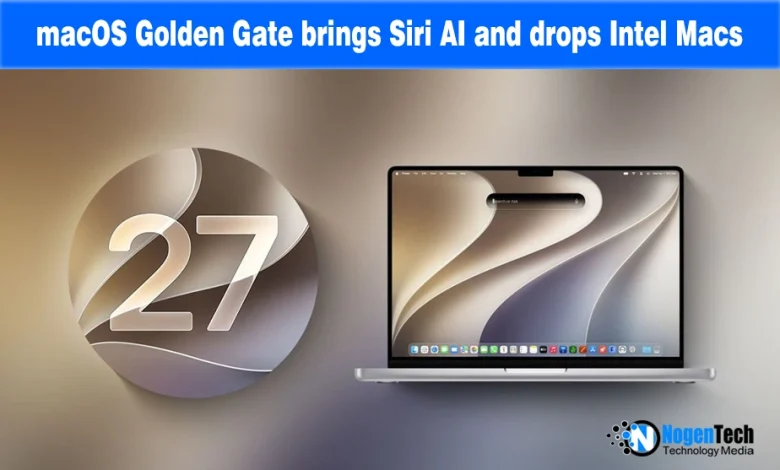
Apple released macOS Golden Gate on Monday, the same day iOS 27 rolled out to iPhones with its own version of the rebuilt Siri AI, moving its entire lineup onto a shared AI foundation.
But for anyone still running an Intel-based Mac, that shared foundation doesn’t include them. macOS Golden Gate requires Apple silicon with no exceptions or reduced versions, making it one of Apple’s biggest Mac compatibility cutoffs in years.
The End of Intel Support Has No Safety Net This Time
Apple had already confirmed last year that macOS Tahoe would be the final version supporting Intel Macs, but Golden Gate makes that cutoff real.
Even the 2020 13-inch MacBook Pro with four Thunderbolt 3 ports, hardware plenty of people are still actively using, cannot install it.
Apple says affected Intel Macs will continue to receive security updates for three years, and Golden Gate is also the last macOS version with the full Rosetta 2 translation layer for older Intel apps.
The practical message is clear: Intel Macs are no longer part of Apple’s future software platform.
Siri AI Finally Comes to the Mac, Built on Apple’s Own Models
For supported Macs, Golden Gate’s biggest addition is Siri AI, a more conversational AI assistant that can handle questions, brainstorming, and understanding follow-ups rather than routing users to web search.
According to Ars Technica, Siri AI and Apple Intelligence use Apple’s AFM 3 model family, including AFM 3 Core, a 3 billion parameter model that runs on-device.
It also includes AFM 3 Core Advanced, a 20 billion parameter sparse model that activates 1 to 4 billion parameters per request, a Mixture of Experts (MoE) design similar to Google’s DiffusionGemma.
Heavier tasks use cloud-based AFM 3 Cloud models.
Visual Intelligence arrives on Mac for the first time, letting users select any portion of their screen and ask Siri to act on it directly, accessible through a dedicated Command-Shift-Space shortcut.
Other updates include the features teased in earlier betas: refined Liquid Glass, a transparency slider, a Liquid Glass interface, better Photos editing, automatic Safari tab grouping, and expanded parental controls.
Beyond features, Golden Gate patches over 50 exclusive CVE vulnerabilities, addressing critical kernel-level privileges, sandbox escapes, and gatekeeper bypasses.
Why This Release Matters More Than Its Feature List Suggests
The real story in Golden Gate is the line Apple has drawn. Ending Intel support entirely, rather than offering a reduced security track, reflects Apple’s approach to ending legacy compatibility.
That same all-or-nothing approach drove Apple’s simultaneous launch of Siri AI on iOS 27 and Golden Gate using the AFM 3 foundation, even as EU regulatory friction keeps the feature paused on iPhone and iPad.
For Apple silicon users, Golden Gate is a solid update. For millions on Intel, it’s the official end of guaranteed software support, with zero ambiguity about when the clock ran out.
Source: OS – macOS 27 Golden Gate