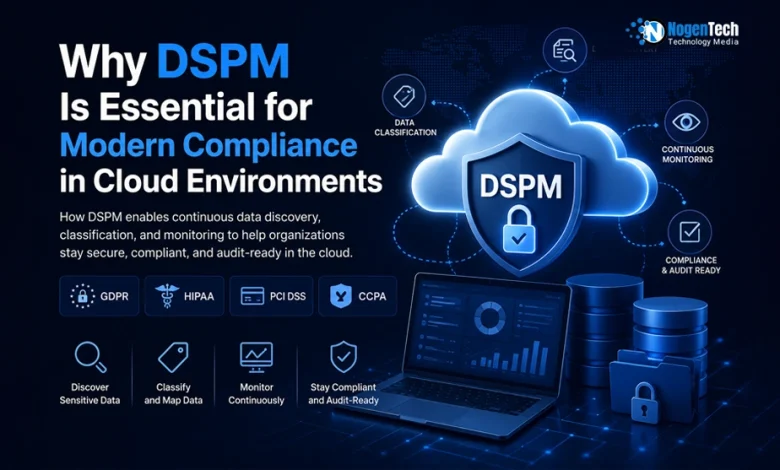
Storing sensitive data in the cloud is easy. Keeping it compliant is the hard part.
Sensitive data is now spread across databases, applications, and analytics systems, making it difficult to track and protect consistently. Regulations such as GDPR, HIPAA, and PCI DSS require clear visibility and control over this data at all times.
Traditional security approaches are often not enough to meet these demands. Data Security Posture Management (DSPM) helps address this gap by providing continuous discovery, classification, and monitoring of sensitive data.
In this DSPM guide for cloud users, we will explain how DSPM supports compliance in modern cloud environments.
What Is DSPM and Why Is It Crucial for Compliance?
Data Security Posture Management (DSPM) is a category of security technology that discovers, classifies, and monitors sensitive data across cloud and multi-cloud environments.
Unlike traditional security tools that focus on infrastructure perimeters, DSPM follows the data itself, identifying where it resides, who has access to it, how it moves, and whether it is adequately protected.
Understanding how DSPM supports compliance is essential because most regulatory frameworks depend on accurate data visibility and control.
DSPM provides this by continuously mapping sensitive data and aligning it with compliance requirements such as GDPR, HIPAA, and PCI DSS, helping organizations maintain ongoing regulatory alignment without manual effort.
Why Data-Centric Security Matters for Compliance
Regulatory frameworks such as GDPR, CCPA, HIPAA, and PCI DSS all share a common thread: they require organizations to know what sensitive data they hold and to demonstrate control over that data.
Without continuous visibility into data stores, shadow data, and access permissions, compliance becomes a manual, error-prone exercise. DSPM closes this gap by automating discovery and classification at scale.
The Compliance Gap DSPM Addresses
Many organizations still rely on spreadsheets, periodic audits, and manual data inventories to satisfy regulatory obligations. These approaches introduce blind spots, especially when data is duplicated across SaaS applications, data lakes, and development environments.
While taking advantage of cloud storage benefits across multiple locations is great for operational efficiency, it dramatically expands your data footprint. DSPM provides the continuous, real-time view needed to secure these distributed environments, transforming compliance from a periodic checkpoint into an ongoing operational discipline
- Automated data discovery – Identifies sensitive data across IaaS, PaaS, SaaS, and DBaaS environments without manual cataloging.
- Contextual classification – Tags data according to regulatory categories (PII, PHI, financial records) to map it directly to compliance obligations.
- Risk-aware prioritization – Highlights the most exposed or over-permissioned data assets so teams can remediate high-impact issues first.
- Continuous monitoring – Detects configuration drift, new data stores, and policy violations as they occur rather than during quarterly reviews.
How DSPM Supports Compliance Requirements for GDPR, CCPA, and More
DSPM supports compliance requirements by aligning its core capabilities with specific regulatory mandates across different frameworks. Each regulation has unique rules for handling, storing, and protecting data, but DSPM provides a unified approach that addresses these shared needs.
GDPR: Data Mapping and Subject Rights
The General Data Protection Regulation requires organizations to maintain records of processing activities (Article 30), respond to data subject access requests (DSARs), and implement data protection by design.
DSPM directly supports these mandates by maintaining a live inventory of personal data across all cloud repositories, enabling faster DSAR fulfillment and demonstrating processing accountability to supervisory authorities.
CCPA/CPRA: Consumer Data Transparency
California’s privacy laws require businesses to disclose what personal information they collect, where it is stored, and with whom it is shared.
DSPM automates the identification of consumer data across distributed systems, making it possible to generate accurate disclosures and honor opt-out and deletion requests within mandated timeframes.
HIPAA, PCI DSS, and Industry-Specific Mandates
Different regulatory frameworks impose different obligations around sensitive data discovery, access control, retention, encryption, and reporting. The table below shows how DSPM capabilities align with common compliance requirements across major regulations.
| Regulation | Sensitive Data Type | DSPM Capability | Compliance Benefit |
|---|---|---|---|
| GDPR | PII | Data discovery + DSAR mapping | Faster subject request fulfillment |
| HIPAA | PHI | Access monitoring | Reduced unauthorized exposure |
| PCI DSS | Payment data | Encryption validation | Cardholder protection |
| CCPA | Consumer data | Data inventory | Better disclosure management |
By consolidating these capabilities under a single data-centric framework, DSPM reduces the operational burden of managing compliance across multiple, sometimes conflicting, regulatory regimes.
Core DSPM Functions for Achieving Audit-Ready Governance
Audit-ready governance requires more than good intentions. It demands documented evidence that security controls are in place, functioning correctly, and continuously monitored.
DSPM delivers the foundational capabilities that make this level of readiness achievable without dedicating entire teams to manual evidence collection.
Continuous Data Inventory and Classification
A DSPM platform maintains a living catalog of all sensitive data assets. Every time a new database, object storage bucket, or data warehouse is provisioned, the platform detects it, scans its contents, and applies classification labels. This eliminates the stale data inventories that auditors frequently flag as deficiencies.
Access Intelligence and Entitlement Analysis
Knowing where data lives is only half the equation. Auditors also want to see who can access it and whether those permissions are justified. DSPM evaluates entitlements across identity providers, IAM roles, and service accounts to surface over-privileged access, orphaned permissions, and cross-account exposure.
Policy Violation Detection and Remediation Tracking
- Real-time alerting – Notifies security teams when data is stored in non-compliant regions, shared with unauthorized principals, or left unencrypted.
- Remediation workflows – Integrates with ticketing and orchestration tools to assign, track, and verify corrective actions.
- Audit trail generation – Logs every detection, alert, and remediation step to produce a defensible record for auditors and regulators.
These functions collectively transform governance from a reactive scramble before audits into a steady-state operational practice, which is the essence of audit-ready governance.
How to Set Risk-Based Policies to Enforce Security Controls
Not all data carries the same level of risk, and treating every asset with the same security controls wastes resources while leaving critical exposures unaddressed. The ability to set risk-based policies allows organizations to align their security investments with actual threat and compliance exposure.
Defining Risk Tiers for Sensitive Data
Start by establishing a tiered classification model that maps data sensitivity to business and regulatory impact. For example:
- Tier 1 (Critical) – Regulated PII, PHI, payment card data, and trade secrets. Requires encryption at rest and in transit, strict access controls, and geographic residency constraints.
- Tier 2 (Sensitive) – Internal financial data, employee records, and customer behavioral data. Requires access logging and periodic entitlement reviews.
- Tier 3 (General) – Publicly available information and non-sensitive operational data. Requires baseline security hygiene.
Translating Risk Tiers into DSPM Policies
Once tiers are defined, encode them as policies within your DSPM platform. Each policy should specify the conditions that trigger an alert or automated remediation action. For instance, a Tier 1 policy might mandate that any S3 bucket containing Social Security numbers must have server-side encryption enabled, public access blocked, and access limited to a named set of IAM roles.
Automating Policy Enforcement
Manual policy enforcement does not scale across hundreds of cloud accounts and thousands of data stores. Modern DSPM solutions can automatically quarantine non-compliant data, revoke excessive permissions, or trigger infrastructure-as-code changes to bring resources back into compliance. This automation reduces mean time to remediation from days to minutes.
When you set risk-based policies through DSPM, you create a repeatable, auditable mechanism that demonstrates to regulators that your security controls are proportionate to the sensitivity of the data you manage.
Leveraging DSPM for Automated Compliance Reporting and Documentation
One of the most resource-intensive aspects of compliance is producing the evidence packages that regulators, auditors, and internal stakeholders require. Automated compliance reporting through DSPM transforms this process from a quarterly fire drill into a continuous output.
What Automated Compliance Reporting Looks Like
Rather than manually assembling screenshots, access logs, and configuration exports, a DSPM platform generates reports that map your current data security posture to specific regulatory controls. These reports typically include:
- Data inventory summaries – Counts and locations of sensitive data assets by classification category.
- Access control matrices – Who has access to what, with justification status and last-review dates.
- Encryption and residency status – Confirmation that data is encrypted and stored within required geographic boundaries.
- Policy compliance scores – Percentage of data assets meeting defined security policies, broken down by business unit or cloud account.
- Remediation history – Timeline of detected violations and their resolution, demonstrating continuous improvement.
Mapping Reports to Regulatory Frameworks
Leading DSPM platforms include pre-built report templates aligned to GDPR, CCPA, HIPAA, PCI DSS, ISO 27001, and SOC 2 controls. This mapping eliminates the manual translation step where compliance teams interpret raw security data and reformat it for auditors. The result is a consistent, repeatable documentation process that reduces human error and accelerates audit cycles.
Stakeholder-Specific Dashboards
Different audiences need different views. A CISO may want a risk-trend dashboard, while a compliance officer needs control-by-control attestation status. DSPM platforms typically support role-based dashboards that serve each audience without requiring separate tooling or manual report customization.
Enforcing Data Minimization and Purpose Limitation at Scale
Data minimization and purpose limitation are foundational principles in nearly every modern privacy regulation. They require organizations to collect only the data they need, retain it only as long as necessary, and use it only for the purposes disclosed at collection. Enforcing these principles across petabytes of distributed cloud data is where DSPM becomes indispensable.
Identifying Redundant, Obsolete, and Trivial (ROT) Data
DSPM scans data stores to identify copies, backups, and derivatives of sensitive data that may no longer serve a legitimate business purpose. This ROT data increases compliance risk without providing value. By surfacing it, DSPM enables data stewards to make informed decisions about deletion or archival.
Enforcing Retention Policies Automatically
Once retention periods are defined for each data category, DSPM can monitor data age and flag or quarantine assets that exceed their retention window. This prevents the common scenario where regulated data lingers in forgotten storage accounts long after its lawful retention period has expired.
Purpose Limitation Through Access and Usage Controls
- Contextual access policies – Restrict access to data based on the requester’s role, project, and stated purpose, not just their identity.
- Cross-environment tracking – Detect when data collected for one purpose (e.g., customer support) is copied into an analytics pipeline or training dataset without authorization.
- Alerting on scope creep – Notify data protection officers when sensitive data appears in environments or workflows that fall outside its approved processing purposes.
Scaling data minimization and purpose limitation without DSPM would require an impractical amount of manual oversight. Automation makes these privacy principles operationally achievable rather than aspirational.
Navigating Global AI Compliance Challenges with a DSPM Framework
The rapid adoption of artificial intelligence has introduced a new layer of compliance complexity. Regulations such as the EU AI Act, Canada’s AIDA, and sector-specific AI guidelines impose requirements on the data used to train, fine-tune, and operate AI models. Navigating global AI compliance demands visibility into how sensitive data flows into and through AI systems.
Why AI Compliance Requires Data-Level Visibility
AI models consume vast quantities of data, often pulled from multiple internal and external sources. Without DSPM, organizations may inadvertently train models on personal data without consent, use biased datasets that violate fairness mandates, or store training data in jurisdictions that conflict with residency requirements. DSPM provides the data lineage and classification intelligence needed to prevent these violations before they occur.
Key AI Compliance Risks DSPM Mitigates
AI systems introduce new governance and regulatory risks because sensitive data can move into training datasets, vector databases, prompts, and inference workflows. The table below highlights the key AI compliance risks DSPM helps mitigate.
| AI Risk | DSPM Role |
|---|---|
| Unauthorized training data | Data lineage tracking |
| Sensitive prompts | Classification monitoring |
| Residency violations | Geographic policy enforcement |
| Shadow AI datasets | Discovery scanning |
Building an AI Governance Layer with DSPM
Organizations have recognized that AI governance cannot be separated from data governance. By extending DSPM policies to cover AI-specific workflows, such as model training pipelines, retrieval-augmented generation (RAG) architectures, and inference endpoints, security teams gain the control surface needed to satisfy emerging AI regulations without slowing innovation.
DSPM vs. CSPM: Understanding the Difference for Compliance
DSPM and Cloud Security Posture Management (CSPM) are complementary but distinct disciplines. Confusing them can lead to gaps in compliance coverage, so it is important to understand where each technology applies.
What CSPM Covers
CSPM focuses on the configuration and security posture of cloud infrastructure: virtual machines, networks, storage accounts, and identity configurations. It detects misconfigurations like publicly exposed storage buckets, overly permissive security groups, and missing encryption settings at the infrastructure level.
What DSPM Adds
DSPM goes a layer deeper by examining the data inside those infrastructure resources. A CSPM tool might tell you that an S3 bucket is publicly accessible. A DSPM tool tells you that the publicly accessible bucket contains 50,000 records of customer PII, making the finding a critical compliance violation rather than a generic misconfiguration.
Side-by-Side Comparison
DSPM and CSPM are often discussed together, but they solve different security and compliance problems. Understanding the distinction is important for building a complete cloud compliance strategy.
| Feature | DSPM | CSPM |
|---|---|---|
| Focus | Data security | Infrastructure security |
| Monitors | Sensitive data | Cloud configurations |
| Detects | Data exposure | Misconfigurations |
| Compliance Role | Regulatory alignment | Infrastructure hardening |
For comprehensive DSPM compliance, organizations need both capabilities working together and to integrate DSPM and CSPM within their Prisma Cloud platform, providing a unified view that connects infrastructure misconfigurations to the sensitive data they expose. This integration eliminates the context-switching that slows down incident response and compliance workflows.
Steps to Implement a DSPM Solution for Compliance in 2026
Deploying a DSPM solution is not a single-day project. It requires planning, stakeholder alignment, and iterative refinement. The following steps provide a practical roadmap for organizations looking to implement DSPM for compliance purposes.
Step 1: Conduct a Data Risk Assessment
Before selecting a tool, inventory your known data stores and identify the regulations that apply to your organization. Map each regulation to the types of sensitive data you are likely to hold. This assessment establishes the scope and priorities for your DSPM deployment.
Step 2: Define Classification Taxonomy and Policies
Establish a data classification scheme that reflects both regulatory categories (PII, PHI, financial data) and business-specific categories (intellectual property, strategic plans). Then define the security policies that apply to each classification tier, including encryption requirements, access restrictions, and retention limits.
Step 3: Select and Deploy a DSPM Platform
Evaluate DSPM vendors based on the following criteria:
- Cloud coverage – Support for your specific cloud providers (AWS, Azure, GCP) and data services (managed databases, object stores, data warehouses).
- Classification accuracy – Quality of built-in classifiers and ability to create custom patterns for industry-specific data types.
- Integration ecosystem – Compatibility with your existing SIEM, SOAR, ticketing, and identity management tools.
- Regulatory mapping – Pre-built compliance frameworks and reporting templates aligned to your regulatory obligations
Step 4: Run Initial Discovery and Baseline
Deploy the platform in observation mode across your cloud environments. Allow it to complete a full scan, classify discovered data, and generate an initial posture baseline. Review the findings with data owners, privacy officers, and cloud engineering teams to validate accuracy and prioritize remediation.
Step 5: Operationalize and Iterate
- Activate automated alerting and remediation workflows for high-severity policy violations.
- Schedule recurring compliance reports and distribute them to relevant stakeholders.
- Refine classification rules and policies based on false-positive rates and emerging regulatory guidance.
- Extend coverage to new cloud accounts, SaaS applications, and AI pipelines as your environment grows.
- Conduct quarterly reviews to align DSPM policies with updated regulatory requirements and business priorities.
Beyond automating discovery and policy enforcement, ensuring your team understands evolving security protocols is just as critical.
Paired with a dedicated compliance training platform, your staff can stay up to date on regulation changes alongside your automated technical controls.
A well-implemented DSPM solution becomes the operational backbone of your compliance program, providing the continuous visibility, automated enforcement, and documented evidence that regulators expect.
By following these steps, organizations can move beyond reactive compliance and establish a sustainable, data-centric security posture that scales with their cloud footprint.
Final Thoughts
DSPM has become an important layer in modern compliance strategies because it focuses directly on the data rather than just infrastructure. By continuously discovering, classifying, and monitoring sensitive information, it helps organizations meet regulatory requirements more efficiently and with less manual effort.
It also improves visibility, reduces risk, and supports audit readiness across cloud environments. As data environments continue to grow in complexity, DSPM provides a practical and scalable way to maintain ongoing compliance and governance.
Frequently Asked Questions (FAQs):
Why is DSPM important for compliance today?
DSPM is important because it gives continuous visibility into where sensitive data is stored and how it is used. This helps organizations meet regulatory requirements without relying on manual tracking.
How does DSPM reduce audit workload?
DSPM automatically generates reports and evidence about data security posture. This removes the need to manually collect screenshots, logs, and configuration details during audits.
Can DSPM help with data access control issues?
Yes, DSPM identifies who has access to sensitive data and flags excessive or unnecessary permissions. This helps reduce the risk of data exposure and improves least-privilege enforcement.
Does DSPM replace other security tools?
No, DSPM does not replace tools like CSPM or SIEM. It works alongside them by focusing specifically on data-level security and compliance.
How does DSPM support ongoing compliance?
DSPM continuously monitors data environments for new risks, changes, and policy violations. This ensures compliance is maintained in real time instead of through periodic checks.