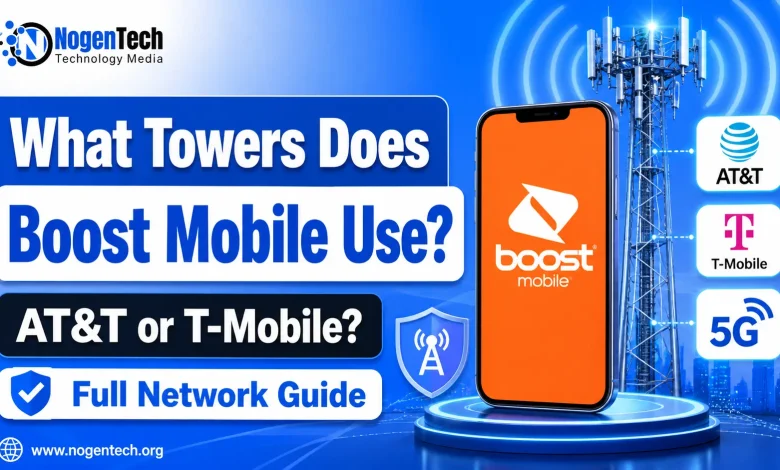
Quick Answer: What Towers Does Boost Mobile Use?
Boost Mobile mainly uses AT&T towers for primary coverage in the United States. Boost Mobile customers can also still get access to T-Mobile’s network in some cases, based on Boost’s official hybrid network setup.
Boost is owned by EchoStar. In 2025, EchoStar announced a major deal with AT&T that made AT&T the primary tower partner for Boost Mobile. EchoStar also said Boost customers would continue to have access to the T-Mobile network, and customers should not see service interruptions.
So, the simple answer is:
Boost Mobile uses AT&T towers first, T-Mobile towers as extra coverage in some cases, and Boost’s own network core behind the scenes.
| Network Question | Simple Answer |
|---|---|
| What towers does Boost Mobile use? | Mainly AT&T towers, with T-Mobile access in some cases. |
| Does Boost Mobile use Verizon towers? | No, Boost Mobile does not normally use Verizon towers. |
| Does Boost Mobile have 5G? | Yes, with a compatible device and 5G coverage in your area. |
| Who owns Boost Mobile? | Boost Mobile is owned by EchoStar. |
What Network Does Boost Mobile Use in 2026?
Boost Mobile uses a hybrid network model. That means Boost is not working like a simple prepaid brand that only rents one network. It uses its own network systems with coverage mainly provided through AT&T towers.
AT&T said in August 2025 that it would be the primary network services partner for EchoStar, which runs Boost Mobile. EchoStar also said Boost subscribers would receive service through Boost Mobile’s cloud-based 5G core connected to AT&T’s nationwide network.
In plain English, your Boost Mobile phone may say Boost on the bill, but the actual cell tower near your home may often be an AT&T tower.
This matters because people often ask, “Is Boost Mobile good in my area?” The real answer depends on how strong AT&T and T-Mobile coverage are where you live, work, and travel. You can also compare this with NogenTech’s guide on the best cell phone coverage in the USA.
Does Boost Mobile Use AT&T Towers?
Yes. Boost Mobile now mainly uses AT&T towers for primary connectivity.
EchoStar clearly stated that primary connectivity for Boost Mobile customers would be provided by AT&T’s towers. AT&T also confirmed that it would be the primary network services partner for EchoStar’s Boost Mobile brand.
This is a big change from Boost’s older days.
Years ago, Boost was linked to Sprint. After Sprint and T-Mobile merged, Boost was sold to Dish Network as part of a government settlement. Later, Dish and EchoStar worked on building their own 5G network. Now, the Boost setup has shifted again, with AT&T playing the main role for coverage.
For users, this means Boost Mobile coverage may feel close to AT&T coverage in many areas.
Does Boost Mobile Use T-Mobile Towers?
Yes, Boost Mobile customers can still have access to T-Mobile’s network in some cases.
EchoStar said that although AT&T towers would provide primary connectivity, Boost Mobile subscribers would continue to have access to the T-Mobile network.
This does not mean every Boost phone is always switching freely between AT&T and T-Mobile like magic. Your phone, plan, SIM or eSIM profile, device support, and location can all affect which network you connect to.
Still, the key point is simple: Boost Mobile is not only tied to one coverage source. AT&T is now the main partner, but T-Mobile access still matters for coverage backup and older setups.
Does Boost Mobile Use Verizon Towers?
No, Boost Mobile does not normally use Verizon towers for regular customer service.
Boost’s public network details point to AT&T as the primary partner and T-Mobile as continued access. There is no official Boost statement showing Verizon as a normal tower partner for Boost Mobile plans.
This is an easy place for people to get confused because many prepaid carriers run on major networks. Some use Verizon. Some use AT&T. Some use T-Mobile.
Boost Mobile is mainly in the AT&T and T-Mobile bucket, not the Verizon bucket. For a wider carrier comparison, read NogenTech’s Verizon vs T-Mobile vs AT&T coverage guide.
Why Did Boost Mobile Move to AT&T Towers?
Boost Mobile moved deeper into AT&T coverage because EchoStar made a major spectrum and network deal with AT&T.
In August 2025, AT&T agreed to buy wireless spectrum licenses from EchoStar for about $23 billion. As part of that deal, AT&T and EchoStar also updated their network services agreement. That agreement lets EchoStar keep offering wireless service under Boost Mobile while using AT&T as the primary network partner.
Spectrum is the invisible wireless “space” phones use to send and receive signals. Carriers need spectrum and towers to run mobile networks.
EchoStar had been building its own 5G network under the Boost Mobile name. In 2024, EchoStar said its Boost Mobile Network was expected to cover 80% of the U.S. population by the end of that year.
But after the AT&T deal, EchoStar said parts of Boost Mobile’s radio access network would be taken down over time. That is why AT&T towers now play the main role.
Is Boost Mobile an MVNO or a Real Carrier?
Boost Mobile is best described as a hybrid mobile network operator.
A normal MVNO rents another carrier’s network and sells plans under its own brand. Many prepaid companies do this.
Boost is a bit different. EchoStar says Boost Mobile customers get service through Boost’s cloud-based 5G core connected to AT&T’s network. AT&T also says EchoStar will operate as a hybrid mobile network operator under the Boost Mobile brand.
For the average customer, this technical label matters less than coverage. You want to know whether calls work, texts send, and data loads fast.
Boost Mobile acts like a prepaid carrier for customers, while the tower coverage mainly comes from AT&T, with T-Mobile access still part of the picture.
Was Boost Mobile on Sprint Before?
Yes. Boost Mobile was historically linked with Sprint.
When T-Mobile and Sprint worked through their merger, the U.S. Department of Justice said Sprint’s prepaid business, including Boost Mobile, had to be sold to Dish Network. The same settlement also required T-Mobile to give Dish access to the T-Mobile network for seven years while Dish built its own 5G network.
That is why older users may remember Boost as a Sprint-based brand.
Here’s the simple timeline:
Boost Mobile used Sprint in the past.
After Sprint merged with T-Mobile, Boost moved under Dish.
Dish and EchoStar worked on a Boost 5G network.
Now Boost mainly uses AT&T towers, with T-Mobile access still available in some cases.
This history explains why different people give different answers online. Some say Sprint, some say T-Mobile, some say AT&T. The current answer is AT&T first, T-Mobile still involved.
How Good Is Boost Mobile Coverage?
Boost Mobile coverage can be good if AT&T or T-Mobile coverage is strong in your area.
Boost’s official coverage page says users can enter an address or ZIP code to check local coverage. It also says its coverage map shows approximate outdoor coverage and that actual service can vary because of terrain, buildings, weather, signal strength, network use, device type, and other factors.
This is very important.
A coverage map may show service in your ZIP code, but your real experience can still be different inside a basement, apartment building, office tower, rural road, or crowded stadium.
Before switching, check these three places:
Your home.
Your workplace.
Your common travel route.
That gives you a better answer than looking at a national map only. For another public coverage check, you can also use the FCC National Broadband Map.
Does Boost Mobile Have 5G?
Yes, Boost Mobile offers 5G service on compatible phones.
Boost’s coverage page says 5G requires a compatible device. It also says coverage is not available everywhere, and actual service can vary based on several real-world factors.
This means you need three things for 5G:
A Boost plan with 5G access.
A 5G phone that works with Boost.
A location where 5G coverage is available.
If any one of those is missing, your phone may connect to 4G LTE instead.
That does not always mean something is wrong. It may simply mean your area, phone, or network signal is using LTE at that moment. For speed terms like Mbps, upload, download, and latency, you can read the NogenTech Internet Speed Guide.
Can You Bring Your Own Phone to Boost Mobile?
Yes, but your phone must be unlocked and compatible.
Boost Mobile’s compatibility page says users should enter their IMEI to check whether a phone will work with Boost. Boost also says the phone should be unlocked by the current carrier before switching.
This matters because tower access is not only about the carrier. Your phone must support the right network bands and settings.
For example, a phone may work great on one network but have weak support for another. An older device may also miss newer 5G bands.
Before buying a Boost plan, check your IMEI on Boost’s site. This is the safest way to avoid activation problems.
Why Does One Boost Customer Get Better Signal Than Another?
Two Boost users can have different signal quality because they may have different phones, SIM profiles, locations, and network conditions.
One person may be near a strong AT&T tower. Another may be indoors behind thick walls. One phone may support more 5G bands. Another may fall back to LTE more often.
Boost also notes that coverage can be affected by terrain, weather, foliage, buildings, construction, signal strength, busy network times, and customer equipment.
So, if someone says, “Boost is amazing,” and another person says, “Boost is weak,” both may be telling the truth for their own area.
Cell phone coverage is local. Very local.
Sometimes the best carrier on one street is not the best carrier five miles away.
Is Boost Mobile Coverage the Same as AT&T?
Boost Mobile coverage may be close to AT&T coverage in many places, but it should not always be treated as exactly the same.
Boost Mobile mainly uses AT&T towers, so its coverage can strongly follow AT&T’s footprint. But plan terms, phone support, and network load can still change the real result.
This is why the Boost coverage map and IMEI checker matter before switching.
Is Boost Mobile Coverage the Same as T-Mobile?
No, Boost Mobile should not be treated as the same as T-Mobile coverage in 2026.
T-Mobile access still exists for Boost customers in some cases, but AT&T is now the primary tower partner. EchoStar’s own statement puts AT&T first and T-Mobile as continued access.
This means a person switching from T-Mobile to Boost should not assume the signal will be identical.
In some areas, Boost may work better because AT&T is stronger. In other areas, T-Mobile may still be better. In some locations, both may work well.
Again, the best test is local coverage.
What Towers Does Boost Mobile Use for Rural Areas?
In rural areas, Boost Mobile mainly depends on AT&T coverage, with T-Mobile access where available.
AT&T’s low-band spectrum and tower network often matter in rural coverage because low-band signals can travel farther than higher-band signals. AT&T said the EchoStar spectrum purchase included 600 MHz low-band spectrum and 3.45 GHz mid-band spectrum across more than 400 U.S. markets.
That does not mean every rural area will have perfect Boost service.
Rural coverage depends on tower distance, hills, trees, building materials, and network buildout. If you live outside a city, check the exact address on Boost’s map before switching. Also ask neighbors which carriers work well in that area.
Local proof beats national ads every time.
What Towers Does Boost Mobile Use for 5G?
Boost Mobile 5G mainly runs through its hybrid setup with AT&T as the main tower partner.
Boost’s official coverage page says it offers 5G and asks users to check coverage by address or ZIP code. It also states that 5G speeds require a compatible device.
In the past, EchoStar also built its own cloud-native Open RAN 5G Boost Mobile Network. In 2024, EchoStar said that network was expected to cover 80% of the U.S. population by year-end.
But after the AT&T deal in 2025, EchoStar said parts of Boost Mobile’s radio access network would be taken down over time.
So for a current buyer, the practical answer is: expect Boost 5G coverage to depend mostly on AT&T’s network, with some T-Mobile access still part of Boost’s wider setup.
How Can You Check Which Boost Mobile Tower You Are Using?
The easiest way is to check coverage first, then test the phone after activation.
Boost does not give every user a simple public button that says “you are on AT&T tower number 123.” But you can still get a good idea.
Start with Boost’s coverage map. Enter your ZIP code or full address. Boost says the map gives approximate outdoor coverage and is not a guarantee of service quality.
Then check your phone compatibility using the IMEI tool. Boost says it uses IMEI to verify whether your device will work with Boost coverage.
After activation, advanced users can use signal-checking apps, field test mode, or network settings to view carrier and band details. But for most people, the coverage map and real-world testing are enough.
Should You Switch to Boost Mobile?
Boost Mobile can be a good pick if you want prepaid pricing and AT&T-based coverage works well in your area.
It may be a weaker pick if Verizon is the only strong network where you live, because Boost does not normally use Verizon towers for regular service.
Before switching, ask yourself:
Does AT&T work well at my home?
Does T-Mobile work well in my city?
Is my phone unlocked?
Does my phone pass Boost’s IMEI check?
Am I okay with prepaid-style service instead of a premium postpaid carrier plan?
But coverage is personal. A cheaper plan is only a good deal if the signal works where you actually use your phone.
If you are also comparing home internet or fixed wireless options, check NogenTech’s guides on choosing the best internet provider and home internet types and speeds.
Final Answer: What Towers Does Boost Mobile Use?
Boost Mobile mainly uses AT&T towers in 2026. Boost customers can also still have access to T-Mobile’s network in some cases. Boost does not normally use Verizon towers for regular service.
The most accurate current answer is:
Boost Mobile uses AT&T as its primary tower/network partner, keeps T-Mobile access for added coverage, and runs under EchoStar’s hybrid network model.
Before switching, check Boost’s coverage map, run your phone through the IMEI checker, and test the service in the places that matter most: home, work, school, and your daily route.
FAQs About Boost Mobile Towers
What towers does Boost Mobile use?
Boost Mobile mainly uses AT&T towers for primary coverage. Some Boost customers can also still access T-Mobile’s network in certain cases.
Does Boost Mobile use AT&T towers?
Yes. AT&T is now the primary network partner for Boost Mobile under EchoStar’s hybrid network agreement.
Does Boost Mobile use T-Mobile towers?
Yes, but T-Mobile is no longer the main tower partner. Boost customers may still have T-Mobile access in some cases.
Does Boost Mobile use Verizon towers?
No. Boost Mobile does not normally use Verizon towers for regular customer service.
Is Boost Mobile coverage the same as AT&T?
Boost Mobile coverage may be close to AT&T coverage in many places, but the experience can still vary because of plan terms, device support, network use, and location.
How can I check Boost Mobile coverage in my area?
Use the official Boost Mobile coverage map and enter your address or ZIP code. You should also check your phone’s IMEI on Boost’s compatibility page before switching.