In March 2026, UPI recorded a total of 22.64 billion transactions, according to data from the National Payments Corporation of India (NPCI).
That scale shows how naturally digital payments now sit inside everyday buying behaviour in India. For online businesses, checkout is no longer a simple payment step.
It is the moment where customer intent, speed, trust, and convenience meet. Even a small delay at this stage can influence how confidently a customer completes the purchase.
As buying journeys become more mobile-led and time-sensitive, the payment experience has become a direct part of conversion planning.
A UPI payment gateway fits into this shift by supporting the kind of checkout flow customers already recognise. Let’s look at how this can shape better checkout outcomes.
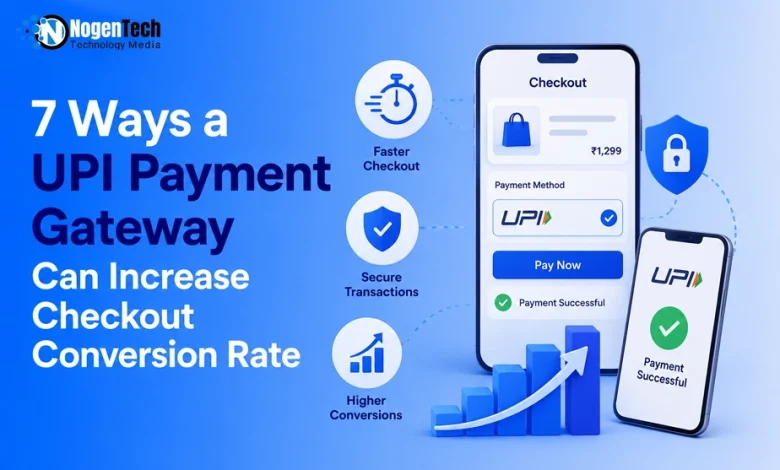
7 Ways a UPI Payment Gateway Increases Checkout Conversion Rate
The final payment step often decides how smoothly a ready customer moves from intent to completion. Here are 7 main ways a UPI gateway increases checkout conversions for a business:
1. Reduce checkout friction before customers drop off
Checkout conversion often depends on the final few seconds before payment. Customers may already like the product, trust the price, and accept the delivery timeline. The payment step then decides completion.
Globally, nearly 70% of online shopping carts are abandoned, with payment friction cited as a leading cause, underlining how much the final payment step can make or break a sale.
A UPI payment gateway supports faster movement by reducing manual input. Customers can pay through familiar UPI apps without entering long card details. This creates a simpler route from cart to confirmation.
This is also visible in how the mobile payment app development industry is changing, with a growing focus on embedding one-tap and in-app payment flows directly into the user journey, rather than treating checkout as a separate, disconnected step.
For businesses, this can improve completion across product purchases, bookings, renewals and service payments. It also keeps the checkout journey cleaner across mobile and desktop channels.
2. Speed up mobile payments with app-led UPI journeys
Mobile commerce has made payment speed a key conversion factor. Customers often complete purchases during short breaks, commutes, or quick browsing moments.
This mirrors a global pattern, with digital wallets now accounting for 56% of global e-commerce value, as app-based and wallet-led payments increasingly replace manual entry at checkout.
A UPI payment gateway supports this mobile-first behaviour through app-led payment approval. Customers can authorise payments through UPI apps they already use for daily transactions.
This reduces hesitation during high-intent mobile sessions. It also helps businesses serve customers across cities, categories, and transaction values with a payment journey that feels natural.
3. Improve payment confidence with real-time confirmation
Customers value clarity once they approve payment. A delayed or unclear payment status can interrupt the feeling of completion. A UPI payment gateway can support quicker status updates after payment approval.
Besides customer experience, the right payment method can also improve cash flow almost instantly. It directly affects decisions around inventory, payroll, and day-to-day operations.
Clear confirmation helps align payment processing with order fulfilment and customer communication. In addition, same-day settlement ensures that funds reach the merchant quickly, reducing financial uncertainty and improving cash flow.
Together, real-time confirmation and same-day settlement create a seamless post-payment experience without adding extra effort for the customer, while strengthening trust and operational efficiency.
4. Support stronger cart completion during peak demand
Peak demand moments can place pressure on checkout systems. Festive periods, product launches, campaign traffic, and limited-period promotions often bring higher transaction volumes.
A UPI payment gateway with multi-acquirer support can help businesses manage these high-intent windows with stable payment flows. When purchase intent is strong, payment reliability becomes important for conversion.
Consistent transaction handling supports better cart completion during important revenue periods. It also helps operations and finance teams work with clearer payment data when order volumes rise.
5. Make repeat purchases easier for returning customers
Returning customers usually expect a quicker journey than first-time buyers. They already understand the business and want payment to feel simple.
A UPI payment gateway can support repeat purchases through a familiar approval process. Customers can return to their preferred UPI app and complete payment with less effort.
This continuity can support stronger repeat order behaviour across subscriptions, e-commerce orders, food delivery, travel, and service payments. It also helps businesses build steadier customer lifetime value.
6. Strengthen reconciliation with clearer payment tracking
Checkout performance also depends on what happens behind the screen. Finance and operations teams need accurate visibility as digital order volumes grow.
A UPI payment gateway can support clearer tracking across payment status, order confirmation, refunds, and settlement records. This helps teams work with stronger operational discipline.
Better tracking can support faster internal decisions when transaction reviews are needed. It can also help teams identify payment patterns across completed, pending, and refunded transactions.
7. Turn payment convenience into measurable checkout performance
Payment convenience drives stronger business outcomes when it is supported by seamless integration and robust security. A UPI payment gateway allows effortless setup with online checkout systems, reducing technical delays and simplifying adoption.
Advanced security measures protect both merchants and customers while maintaining a smooth payment experience. This combination of convenience and trust ensures that customer intent reliably converts into completed revenue.
UPI vs Card payments: how do they compare at checkout?
Both UPI and cards are widely used at Indian checkouts, but they work differently and affect conversion in different ways.
UPI relies on app-based approval through a linked bank account, while cards involve entering details or using saved tokens. Understanding these differences helps businesses choose the right mix of payment options for their checkout flow.
| Feature | UPI | Card |
| Checkout steps | App approval, minimal manual entry | Card number, expiry, CVV, OTP |
| Speed | Near-instant authorisation | Slightly longer due to detailed entry |
| Mobile experience | Built for app-led, mobile-first flows | Works well, but more typing-heavy on mobile |
| Setup for repeat use | Familiar UPI app, low effort | Saved card/tokenisation required |
| Settlement | Often same-day | Varies by acquirer/network |
Conclusion
Checkout conversion depends on speed, clarity, and familiarity in the final payment step. UPI fits naturally into how Indian customers already pay, reducing friction and supporting smoother completion across devices and use cases.
As digital payment volumes continue to rise, businesses that prioritise a simple, reliable checkout experience are better placed to convert ready customers into completed orders, while maintaining clear visibility into payment performance.
Frequently Asked Questions (FAQs):
What is a UPI payment gateway?
A UPI payment gateway is a service that lets businesses accept payments through UPI apps during online checkout. It connects the customer’s bank account to the merchant’s system for quick, app-based payment approval.
Is UPI safe for online payments?
Yes, UPI transactions are secured through bank-level authentication and require approval directly from the customer’s UPI app. Each payment also needs a UPI PIN, adding an extra layer of protection.
Why do customers prefer UPI over cards at checkout?
UPI lets customers pay without entering card numbers, expiry dates or CVVs, making the process faster. It also feels more familiar since most customers already use UPI apps for everyday transactions.
Can UPI handle high transaction volumes during sales or festive periods?
Yes, a UPI payment gateway with multi-acquirer support can manage higher transaction loads during peak periods. This helps maintain stable payment flows even when order volumes spike.
How quickly do businesses receive funds from UPI payments?
Settlement timelines depend on the payment gateway and acquirer bank, but many support same-day settlement. This helps businesses maintain better cash flow and financial visibility.