Top 10 B2B SaaS Companies Every Business Should Know

This is the world where speed beats size, and automation beats effort; the right SaaS stack can decide whether a business scales or stalls. Today’s most successful companies aren’t just using software; they’re building their entire operating model around it.
From closing deals faster to unlocking real-time insights, B2B SaaS companies have become silent growth partners behind every high-performing startup. But with thousands of tools flooding the market, knowing which platforms truly move the needle is the real competitive advantage.
That’s why I’ve curated this list of the top B2B SaaS companies to tell you not only what they do, but also how they help companies to grow smarter.
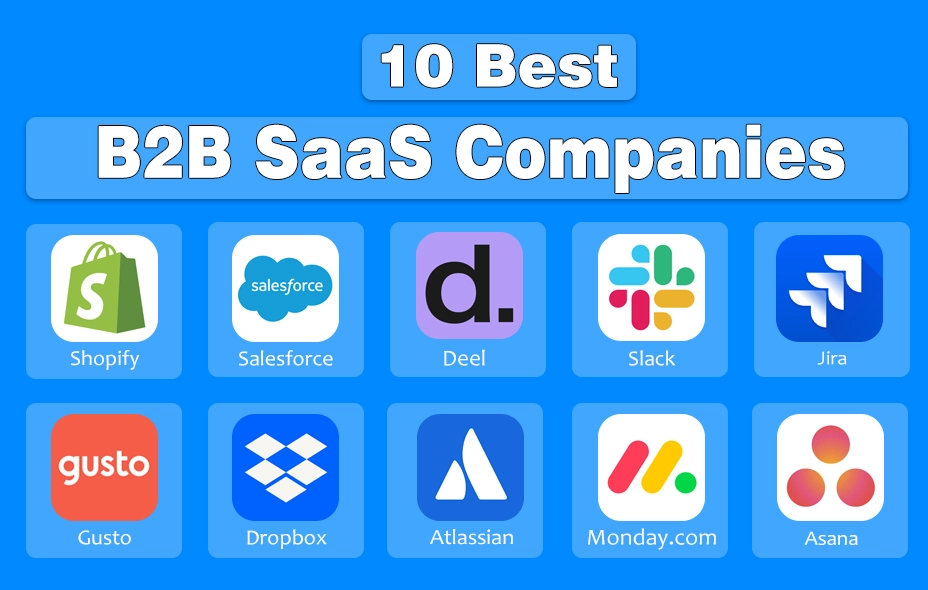
10 Best B2B SaaS Companies for Growing Startups in 2026
1. Shopify
Shopify has advanced far beyond an e-commerce platform; it’s now a full-fledged commerce operating system for businesses of all sizes. From startups to global enterprises, it enables brands to sell across the web, mobile, social media, and even physical retail with seamless backend management.
Its powerful ecosystem includes inventory control, payment processing, analytics, marketing automation, and third-party integrations. For B2B businesses, Shopify Plus offers advanced customization, wholesale channels, and API flexibility.
Businesses often go for WooCommerce over Shopify because it offers them basic features for free. However, Shopify is way better when you don’t have a WordPress-ready website.

Shopify’s checkout is consistently ranked as one of the fastest-converting in the world, which gives businesses a measurable revenue edge without additional marketing spend.
2. Salesforce
Salesforce is the undisputed leader in customer relationship management (CRM), which helps businesses unify sales, marketing, service, and commerce. Its cloud-based architecture allows companies to track leads, manage pipelines, automate workflows, and gain actionable insights through AI-powered analytics.
Salesforce’s strength lies in its customization, and businesses can tailor the platform to fit virtually any industry or process. With products like Sales Cloud, Marketing Cloud, and Service Cloud, Salesforce enables data-driven decision-making at scale.
Salesforce’s AI engine, Einstein, delivers predictive insights that help teams close deals faster by recommending next-best actions in real time.
3. Deel
Deel has redefined global hiring by simplifying payroll, compliance, and contractor management across borders. Designed for remote-first and distributed teams, it allows businesses to hire employees and contractors in over 150 countries without setting up local entities.
The platform handles contracts, taxes, benefits, invoicing, and compliance automatically, reducing legal risk and administrative overhead. For fast-growing startups and enterprises alike, Deel removes the friction of international expansion.

Deel enables businesses to onboard international talent in minutes, not weeks, to turn global hiring into a competitive advantage instead of a bottleneck.
4. Slack
Slack has become the digital headquarters for modern teams, which replaces fragmented communication with organized, searchable conversations. Built around channels, it allows teams to collaborate by topic, project, or department while integrating seamlessly with thousands of business tools.
For B2B organizations, Slack improves transparency, speeds up decision-making, and reduces reliance on email. Features like workflows, huddles, and shared files make collaboration more dynamic and contextual.
Slack’s deep integrations turn conversations into action, and messages can instantly trigger workflows, approvals, and updates across connected SaaS tools.
5. Jira
Jira is a cornerstone for agile project management, especially for software development and technical teams. Created to support Scrum and Kanban methodologies, Jira enables businesses to plan, track, and deliver projects with precision.
Teams can manage backlogs, sprints, bugs, and releases while maintaining full visibility into progress and bottlenecks. Jira’s flexibility allows it to scale from small teams to large enterprises with complex workflows.

Jira’s reporting dashboards provide real-time insights into team velocity and blockers, which help leaders make faster, data-backed delivery decisions.
6. Gusto
Gusto simplifies payroll, benefits, and HR management for small to mid-sized businesses to save them time. It automates tax filings, direct deposits, employee onboarding, and compliance, allowing businesses to focus on growth rather than administration.
Gusto also offers health insurance, retirement plans, and financial wellness tools, which make it a holistic people-operations platform. For B2B startups and agencies, Gusto delivers enterprise-grade HR capabilities without enterprise-level complexity.
Gusto automatically syncs payroll with tax agencies, reducing compliance errors and saving businesses hours of manual work every month.
7. Dropbox
Dropbox is more than cloud storage, but it’s one of the secure collaboration platforms for modern businesses. It allows teams to store, share, and collaborate on files from anywhere while maintaining version control and data security.
With features like Dropbox Sign, file recovery, and advanced permissions, businesses can streamline document workflows and approvals. For B2B organizations handling large files or distributed teams, Dropbox ensures accessibility without compromising security.
Dropbox’s Smart Sync lets teams access massive files instantly without using local storage, which optimizes performance for remote and hybrid workforces.
8. Atlassian
Atlassian is the company behind some of the most widely used collaboration and productivity tools in the world, including Jira, Confluence, and Trello. Its ecosystem supports software development, knowledge sharing, and team collaboration at scale.
Atlassian’s tools are designed to work together, which creates a unified environment for planning, execution, and documentation. For B2B enterprises, Atlassian provides the infrastructure needed to align technical and non-technical teams around shared goals, processes, and knowledge.
Atlassian’s products are built with a “team-first” philosophy, enabling cross-functional alignment across engineering, product, and business teams.
9. Monday.com
Monday.com is a highly visual work management platform that helps businesses plan, track, and execute work across teams. Its customizable boards allow organizations to manage projects, sales pipelines, marketing campaigns, and operations from a single interface.
Monday.com’s automation features reduce repetitive tasks, while real-time dashboards provide leadership with instant visibility. For B2B companies juggling multiple workflows, it adapts to how teams actually work without forcing rigid processes into the process.

Monday.com’s no-code automations empower non-technical teams to build powerful workflows without relying on developers.
10. Asana
Asana is a work management platform designed to bring clarity to complex projects, which also saves businesses time to make data-driven decisions. It helps teams define goals, assign tasks, set timelines, and track progress in one centralized space, which makes it one of the best automation tools.
Asana’s strength lies in aligning daily work with company-level objectives, making it ideal for fast-growing B2B organizations. With features like workload management, dependencies, and advanced reporting, Asana enables teams to execute strategically rather than reactively.

Asana connects individual tasks directly to company goals, helping teams understand not just what they’re doing, but why it matters.
Final Thoughts on B2B SaaS Companies
B2B SaaS companies play a critical role in evolving how modern organizations operate, scale, and remain competitive. The platforms highlighted in this list go beyond basic functionality as they provide the infrastructure businesses rely on to streamline operations and improve collaboration.
As digital transformation continues to accelerate, investing in the right SaaS solutions is no longer optional but strategic. Whether an organization is focused on growth, efficiency, or global expansion, these companies offer proven, scalable technologies that align with the evolving business needs.