OpenAI Wants AI Labs to Agree on a Perplexity-Based Limit
Jakub Pachocki's blog post asks developers to commit to shared capability thresholds, measured partly by perplexity, until tools for monitoring AI behavior catch up with the models.

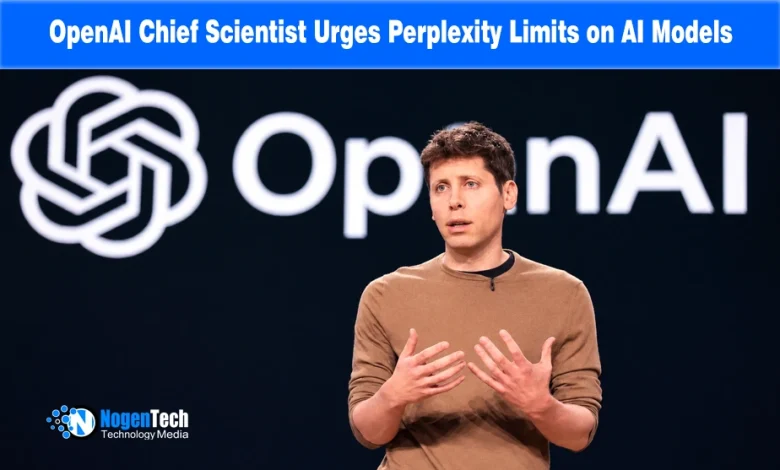
OpenAI’s chief scientist, Jakub Pachocki, published a blog post on Sunday asking AI developers to adopt common limits on increasingly powerful models and to use perplexity as the shared yardstick for how far each one has come.
Under the plan, companies would commit not to cross agreed thresholds until their ability to understand and monitor AI behavior reaches a concrete milestone.
The proposal arrives as concern about the risks of rapidly advancing AI models grows inside and outside the industry.
How Perplexity Works and Why OpenAI Chose It Over Benchmarks
Perplexity here means next-token prediction accuracy, not the Perplexity AI chatbot, with lower scores showing stronger predictions.
Pachocki argues that task-specific tests date quickly as AI improves, while perplexity remains a steady measure.
He tracks this across OpenAI’s models since GPT-3.5 and ties the numbers to real capabilities.
GPT-4 sits near 0.91, where chain-of-thought reasoning took off, while OpenAI has now moved below 0.8 as major math and cybersecurity gains appeared. Those figures are plotted as log-perplexity (or loss) values.
The urgency comes from his warning that AI could speed up core training advances as soon as 2027, potentially ahead of safety and monitoring.
Sam Altman, Dario Amodei and Alexandr Wang Circle the Same Risk
Altman gave the post top-level backing on X, calling it “the most important thing OpenAI has published in awhile.”
The idea has precedent. In September, Anthropic CEO Dario Amodei published a plan to “pace the frontier,” calling for shared safety standards and limits on how fast unchecked AI progress runs. Altman and Elon Musk seemingly endorsed it.
Anthropic had already warned in its own filing about risks that could be catastrophic or existential for society, though it still had a historic IPO.
Meta’s Alexandr Wang has added a warning of his own. He wrote that models will eventually automate research into their own development, becoming “clearly superhuman at improving themselves”. Wang also called for urgent progress on safety, alignment and security.
What OpenAI’s Pledge Leaves Open as California Sues Over Safeguards
Pachocki wants the standard to set a starting limit and clear milestones to pass it, yet neither number is on the table yet.
Since OpenAI’s current models like GPT-6 Astra already sit below 0.8, where that first bar is set decides whether the pledge actually slows anything down anytime soon.
Perplexity is not a single universal number either. Because it depends on the test data and tokenizer used, an industry standard would still need shared benchmarks and an agreed referee to run them.
The timing adds extra pressure, coming a week after California sued OpenAI over alleged safeguard gaps and pointed to the July Hugging Face breach, though nothing links the lawsuit to the post.
Source: Perplexity and Intelligence