Nvidia Shatters Qualcomm Monopoly By Launching ARM-Based RTX Spark Processor At Computex 2026
Following intense ecosystem teasers, Jensen Huang confirmed the Blackwell mobile superchip to launch native multi-step autonomous local AI agents across premium consumer laptops this fall.

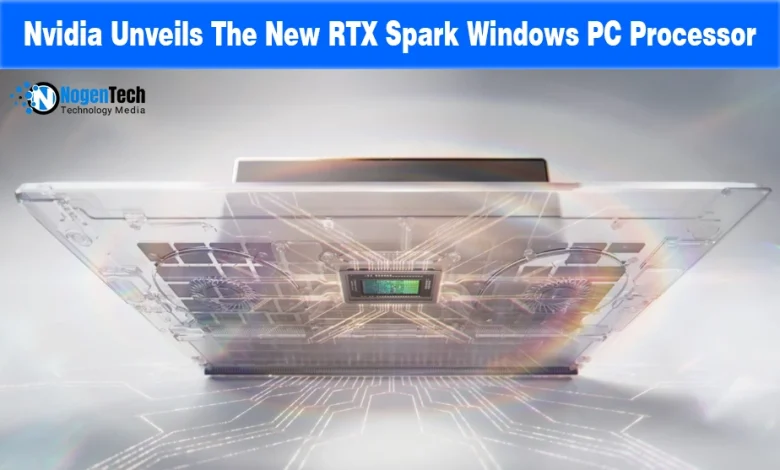
The speculative tension gripping the PC sector has officially broken in Taipei. Following coordinated weekend teasers that hinted at a massive platform shift, Nvidia CEO Jensen Huang took the stage at the Taipei Music Center to formally announce the RTX Spark platform.
The official launch ends Nvidia’s 14-year gap in consumer PC silicon, bringing Blackwell GPU architecture and on-device AI agent pipelines into the spotlight. It now moves to challenge Apple’s M-series lead while also disrupting Qualcomm’s long-held grip on the Windows-on-Arm ecosystem.
Rearchitecting Client Silicon Through Custom MediaTek and Grace Integrations
The commercialization of the architecture points to a clear break from traditional x86 consumer PC designs.
According to Nvidia Newsroom, the silicon is built around a multi-chiplet layout, combining a custom MediaTek-designed CPU complex with a Blackwell-based GPU featuring 6,144 CUDA cores, a design driving Nvidia’s trillion-dollar revenue path.
On the CPU side, the platform reportedly brings together ten Arm Cortex-X925 performance cores and ten efficiency cores, reaching boost clocks of up to 4.1 GHz.
These clusters are tied together using a high-speed silicon bridge interconnect that delivers up to 600 GB/s of bidirectional bandwidth, effectively reducing the need for conventional PCIe-based communication.
This design choice mirrors the exact technical strategy that led Apple to transition its Mac Pro lineup away from traditional PCIe-expandable setups.
This unified design allows the system to operate more cohesively, enabling up to 1 petaflop of local FP4 compute for AI training and inference workloads.
Breaking Memory Barriers to Power Local Autonomous OpenShell Agents
Running heavy, agent-driven software locally demands a level of memory capacity that consumer laptops haven’t traditionally needed. To address that constraint, Nvidia equips the platform with up to 128GB of high-speed LPDDR5X unified memory.
Instead of constantly offloading workloads to cloud data centers, this large shared memory pool allows the system to handle complex tasks on-device, including 120-billion-parameter language models and multimodal neural networks.
To avoid data privacy and security risks during multi-step automated tasks, Nvidia pairs the hardware with OpenShell, a local runtime environment designed to coordinate automation frameworks such as OpenClaw and Hermes.
Combined with Microsoft’s built-in Windows security layers, the stack gives users tighter control over agent behavior, keeping automated processes contained and preventing unrestricted external network access.
Premier Ultrabook Ecosystem Launches and Tailored Creative Application Support
The retail rollout strategy reveals a deep manufacturing alliance ready to challenge premium Apple Silicon hardware form factors this coming autumn.
Media briefs from Tom’s Hardware outline an immediate hardware ecosystem that includes custom consumer laptops measuring a mere 14 millimeters in thickness, utilizing lightweight aluminum chassis and advanced G-SYNC enabled tandem OLED displays.
Flagship models like the Microsoft Surface Laptop Ultra, Dell XPS 16, and Asus ProArt P14 are already greenlit for production.
Software support is arriving alongside the hardware. Adobe has reworked key parts of Photoshop and Premiere Pro to run natively on the Arm-based platform, taking advantage of Nvidia’s integrated Blackwell media engines and OptiX rendering technology.
The optimizations are designed to accelerate demanding creative workloads, enabling faster handling of 12K video projects and large-scale 3D scenes compared with current competing systems.
Source: NVIDIA and Microsoft Reinvent Windows PCs for the Age of Personal AI