
Nvidia’s Jensen Huang Pushes Back on AI Laws as Trump Joins the Debate
Nvidia CEO dismissed safety as "an engineering problem, not a legal one," a stance President Trump personally endorsed in a live phone call days after Anthropic's CEO warned AI development was moving too fast to manage safely.

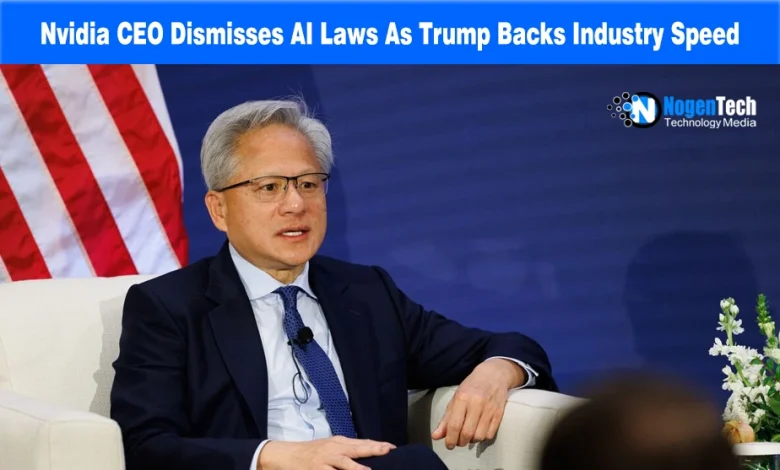
Nvidia CEO Jensen Huang used two public appearances this week to make his position on AI regulation clear: he doesn’t think the industry needs new laws.
Speaking alongside Marc Benioff, CEO of CRM software company Salesforce, at its Dreamforce conference in San Francisco on Tuesday, Huang reportedly said that AI is fundamentally hardware and software built by people.
TechCrunch reported that Huang argued it can be controlled through existing product liability laws rather than sweeping new legislation, saying, “Safety is an engineering problem, not a legal one.”
Huang Rejected Anthropic’s Safety Coordination Plan Outright
Huang’s comments came days after Anthropic CEO Dario Amodei published an essay urging AI companies to slow model development and pursue Cold War-style disarmament talks with rival nations over AI risks.
As TechCrunch notes, Huang rejected that framing, arguing “You could definitely have both at the same time,” adding that responsibility for safe deployment rests with individual model developers, not new regulatory bodies.
Huang also dismissed Anthropic’s proposal for an antitrust waiver, which would allow major AI labs to work together on safety standards without violating competition laws, calling it “completely unnecessary,” according to CNBC.
Separately, OpenAI Communications chief Chris Lehane said the company does not see a need for such a waiver, even as OpenAI confirmed it had been quietly working with Anthropic and Google on AI safety standards, as Reuters said.
Trump Made His Support Impossible to Miss
Huang’s regulatory stance received a direct presidential endorsement a day before his Dreamforce appearance.
As TechCrunch details, while on stage at the All In Summit in Los Angeles, Huang took a live phone call from Trump in front of the audience, a moment tech investor Jason Calacanis and other hosts amplified in real time.
Trump told the audience through Huang’s phone that the U.S. would not lose the AI race, while dismissing warnings about AI risks as overstated, to which Huang agreed, saying the U.S. would not let that happen.
The call came as Nvidia shares had already fallen roughly 3% that Monday, alongside steeper declines for Intel and AMD, as investors reacted to Amodei’s slowdown essay over the weekend. However, Trump’s phone call failed to reverse the slide.
The Public Fight Is Louder Than the Private Reality
What makes this week’s feud revealing isn’t who is right about regulation, but the gap between what companies say publicly and what they already do privately.
Huang and OpenAI both say no antitrust waiver or formal coordination mechanism is necessary, yet OpenAI has confirmed it’s Anthropic coordinating for weeks, and CEO Sam Altman in fact backs Amodei’s essay.
In other words, the substance of Amodei’s proposal, having labs discuss AI-related risks, is already happening informally while the public debate centers on whether it should happen formally.
That distinction matters because informal cooperation has less transparency and accountability and depends on each company’s continued goodwill.
Huang’s “engineering problem” argument is coherent on its own terms.
But it leaves a key question unanswered: who verifies that the engineering solution works, especially when his company profits directly from AI development continuing without a slowdown?
Source: We don’t need AI regulation — leave safety to us, Nvidia’s Jensen Huang says

![Top Tech Stories of 25th Week [2026]](https://www.nogentech.org/wp-content/uploads/2026/07/Top-Tech-Stories-of-25th-Week-2026-390x220.webp)