Boost Production Efficiency with Innovative Software Solutions: Reduce Wastes and Downtime in 2026

If you are running a business today, you already know one uncomfortable truth. Doing things the old way is no longer enough. Markets move fast, customer expectations change overnight, and competition is no longer limited to your city or even your country.
I have seen companies with great products still struggle simply because their production processes could not keep up. That is where innovative software solutions come in.
Now, we will explore practical use cases, mindset shifts, and tools that actually make work smoother, faster, and more predictable.
Importance of Production Efficiency in the Modern Era
Production efficiency now sits at the intersection of time management, cost control, data visibility, and human productivity.
When one of these areas is weak, the entire system slows down. This is exactly why software has become such a powerful lever. It connects processes, people, and information into a single flow rather than isolated tasks.
You can use software to enhance your everyday life as well as your entrepreneurial skills. It is no longer just about producing more units in less time. It is about producing smarter, with fewer errors, lower stress on teams, and better use of resources.
From my experience, businesses that focus only on speed often burn out their teams. Those that focus only on cost often compromise quality. Software allows you to balance both without choosing one over the other.
Why Traditional Production Systems Fail to Scale?
When businesses grow, their systems are often left behind. What worked for a team of five becomes chaos for a team of fifty. I have seen production managers rely on spreadsheets, paper logs, and verbal updates long after they stopped being effective.
The real issue with traditional systems is not effort. People work hard. The issue is visibility. When data is scattered, decisions are delayed. When approvals are manual, bottlenecks multiply. And when reporting is reactive, problems are discovered too late.
It is where innovative software solutions quietly change the game. They remove guesswork and replace it with clarity. They turn production from a reactive process into a proactive one.
The Role of Innovative Software Solutions in Boosting Production Efficiency
Innovative software is not just about automation. It is about intelligence built into workflows. These solutions collect data in real time, analyze patterns, and help teams make better decisions without adding complexity.
Before breaking this down into specific categories, I want to make something clear. No software magically fixes broken processes. What it does is amplify whatever system you already have. If your process is chaotic, software exposes it. If your process is structured, software strengthens it.
Now, I am going to show you how different types of software directly improve production efficiency.
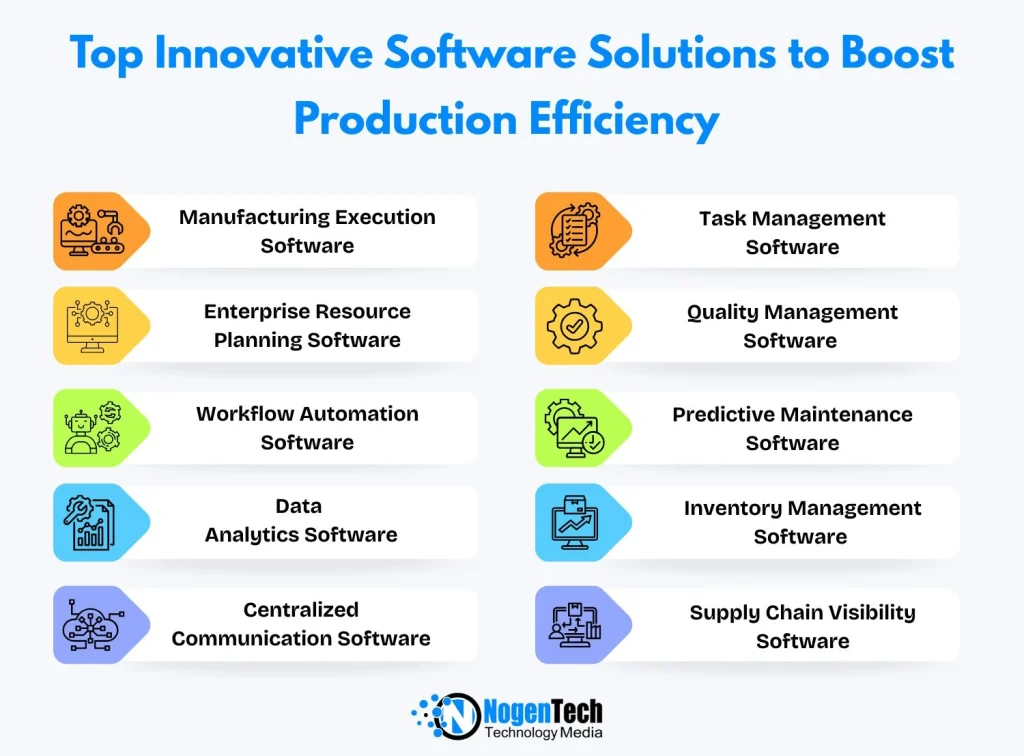
1. Manufacturing Execution Systems and Real Time Control
Manufacturing execution systems act as the nervous system of production. They connect machines, operators, and managers into one unified environment.
I have seen how real time dashboards alone can transform behavior on the floor. When teams can see output, downtime, and defects as they happen, accountability becomes natural. There is no need for blame or long meetings. The data speaks clearly.
These systems also reduce delays caused by manual reporting. Instead of waiting for end of day summaries, managers can intervene immediately when something goes off track. That single change often results in massive efficiency gains over time.
2. Enterprise Resource Planning Software for Smarter Planning
Enterprise resource planning software helps you see the bigger picture. It connects inventory, procurement, finance, and production into one system.
What I like about these platforms is how they reduce overproduction and shortages at the same time. Businesses stop wasting resources by forecasting demand accurately and aligning it with production schedules.
When materials arrive exactly when needed and production plans adjust automatically to demand changes, efficiency improves without pushing people harder. This is one of the most overlooked benefits of integrated planning software.
3. Workflow Automation Tools That Eliminate Friction
Workflow automation is where many teams see instant relief. Repetitive tasks like approvals, data entry, and status updates quietly drain time every day.
Automation tools remove these friction points. For example, instead of chasing approvals through messages and emails, workflows move automatically once conditions are met. This keeps production flowing without interruptions.
From my perspective, automation is less about replacing people and more about protecting their focus. When teams can concentrate on meaningful work, output quality improves naturally.
4. Data Analytics Platforms for Smarter Decisions
Data analytics software turns production data into insight. It helps answer questions like why delays happen, where waste occurs, and which processes need improvement.
One thing I always tell teams is this. Intuition is useful, but data ends arguments. When production issues are backed by clear trends and numbers, decisions become faster and more confident.
Over time, analytics also supports continuous improvement. Patterns that were invisible before suddenly become obvious, allowing small changes that compound into major efficiency gains.
5. Centralized Communication Platforms
Centralized communication tools and collaboration tools reduce confusion and delays. Instead of switching between calls, messages, and emails, teams work in one shared space.
I have noticed that when conversations are visible and searchable, decisions happen faster. New team members also onboard more easily because knowledge is documented naturally through discussion.
It directly impacts production timelines, especially when quick clarifications are needed to avoid stoppages.
6. Task Management Software for Clear Ownership
Task management tools bring clarity to responsibility. Every task has an owner, a deadline, and a visible status.
This visibility reduces follow ups and misunderstandings. When everyone knows what needs to be done and by when, production moves forward with fewer interruptions.
In my experience, this clarity alone can reduce delays more effectively than any motivational talk ever could.
7. Quality Management Software for Consistent Output
Quality management software ensures that standards are followed consistently, not based on memory or individual judgment.
Instead of discovering defects after production is complete, quality checks happen at defined stages. This early detection prevents rework and material waste.
What I appreciate most is how these systems turn quality into a shared responsibility rather than a final inspection task.
8. Predictive Maintenance Software to Reduce Downtime
Predictive maintenance software monitors machine performance and identifies potential failures before they happen.
Unexpected breakdowns are one of the biggest threats to production efficiency. This software reduces that risk by alerting teams early.
When maintenance becomes planned instead of reactive, production schedules stabilize and stress levels drop across the operation.
9. Inventory Management Software for Material Accuracy
Inventory management software provides real time visibility into stock levels, usage rates, and reorder points.
It prevents both shortages and overstocking by aligning inventory with actual production needs.
From what I have seen, accurate inventory data alone can unlock efficiency by removing delays caused by missing materials and excess capital tied up in unused stock.
10. Supply Chain Visibility Software for End to End Coordination
Supply chain visibility software connects suppliers, logistics, and production planning into one transparent system.
When delays occur upstream in the supply chain, production teams can adjust schedules instantly rather than reacting too late.
This level of coordination transforms production from an isolated function into a synchronized part of a larger ecosystem.
Final Thoughts
Boosting production efficiency is no longer about pushing harder or cutting corners. It is about working smarter with systems that support people rather than overwhelm them. Innovative software solutions give businesses the clarity, speed, and control they need to grow sustainably.
I truly believe that when technology is implemented thoughtfully, it becomes a silent partner in success. If you are serious about improving output, reducing waste, and empowering your teams, the right software is not a luxury anymore.
It is a strategic necessity that shapes how efficiently your business operates today and how confidently it competes tomorrow.