Is your business spending more time managing customer information than building customer relationships? If so, disconnected processes may be costing you valuable time, sales, and long-term growth.
It’s a brutal reality these days that as customer interactions increase, relying on manual processes or scattered data makes it even harder to drive sustainable growth. However, a Customer Relationship Management (CRM) system helps eliminate these challenges by centralizing customer data and streamlining everyday operations.
The benefits of CRM for business go beyond contact management. It enables organizations to:
- Improve the overall customer experience
- Increase sales productivity
- Improve team collaboration
- Gain real-time business insights
Whether you’re a small business or navigating small business digital transformation trends, understanding the key CRM benefits can help you improve operational efficiency, support sustainable business growth, and maximize every customer interaction.
What Are the Key Benefits of CRM Systems for Businesses?
A CRM system delivers measurable business value by improving customer management, streamlining operations, and supporting sustainable growth through the following key benefits:
- Improve customer relationships
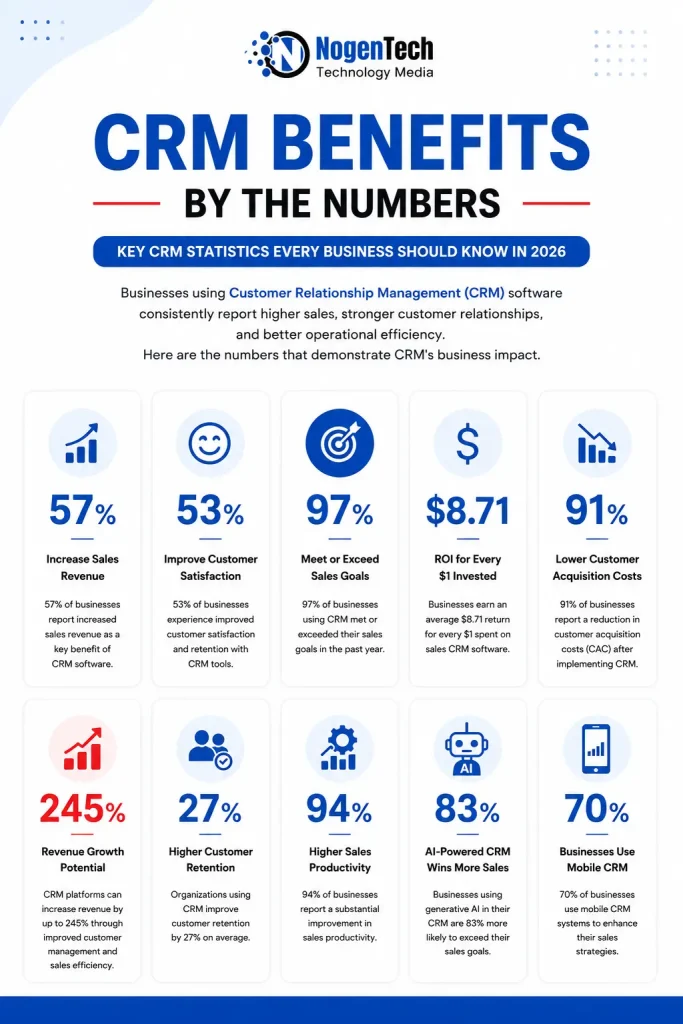
- Increase sales and revenue
- Boost team productivity
- Enhance customer service
- Support data-driven decision-making
- Increase customer retention
- Scale business operations efficiently
- Reduce operational costs and improve ROI
- Leverage AI for smarter customer management
How Does a CRM System Improve Customer Relationships?
CRM software improves customer relationships through personalized communication, unified customer data, and consistent customer experiences.
Businesses can understand customer preferences, respond faster, and maintain consistent interactions across sales, marketing, and support. Better collaboration reduces communication gaps, improves customer satisfaction, and builds long-term loyalty.
Key business outcomes
- Increase customer satisfaction
- Improve customer loyalty
- Deliver personalized experiences
- Build long-term relationships
How Can CRM Increase Sales and Revenue?
CRM increases sales by improving pipeline visibility, customer engagement, and data-driven selling across the sales process.
Sales teams identify high-value opportunities faster, prioritize qualified prospects, and maintain consistent follow-ups. By learning how to improve lead conversion rates with AI CRM, organizations can significantly shorten sales cycles while driving steady revenue growth.
Better visibility into the sales pipeline shortens sales cycles while improving conversion rates and revenue growth.
Key business outcomes
- Increase conversion rates
- Shorten sales cycles
- Improve sales performance
- Drive revenue growth
Why Does CRM Improve Team Productivity?
CRM improves productivity by automating workflows, reducing manual tasks, and giving teams instant access to customer data.
Utilizing essential CRM features for business software allows employees to spend less time on administrative work and more time serving customers.
Employees spend less time on administrative work and more time serving customers. Streamlined processes improve collaboration, reduce duplicate work, and increase operational efficiency across departments.
Key business outcomes
- Save employee time
- Reduce manual work
- Increase operational efficiency
- Improve productivity
How Does CRM Improve Customer Service?
CRM improves customer service by providing complete customer history for faster, more personalized support.
Support teams resolve issues efficiently because every interaction is available in one place. Faster responses and informed conversations improve customer satisfaction while strengthening trust.
Key business outcomes
- Resolve issues faster
- Improve customer satisfaction
- Deliver consistent support
- Strengthen customer trust
How Does CRM Help Businesses Make Better Decisions?
CRM enables data-driven decisions through real-time analytics, customer insights, and business performance reporting.
Businesses identify trends, measure KPIs, and evaluate performance using accurate data instead of assumptions. Better insights support planning, resource allocation, and long-term growth strategies.
Key business outcomes
- Improve strategic planning
- Make data-driven decisions
- Identify growth opportunities
- Reduce business risks
Why Is CRM Important for Customer Retention?
CRM improves customer retention through personalized engagement, consistent communication, and proactive relationship management.
Businesses identify customer needs earlier, deliver better experiences, and strengthen long-term relationships. Higher retention also increases customer lifetime value while reducing acquisition costs.
Key business outcomes
- Increase customer retention
- Improve customer loyalty
- Encourage repeat business
- Increase customer lifetime value
How Does CRM Support Business Growth?
CRM supports business growth by standardizing processes, improving collaboration, and scaling customer management efficiently.
Growing businesses maintain consistent operations while handling more customers and sales activities. For instance, when expansion involves physical restructuring or shifting offices, leveraging strategic technology for business relocation ensures your customer data and communication channels remain uninterrupted throughout the move.
To tailor these workflows at scale, you must know the role and importance of a CRM developer, who can help you customize software to your exact expansion goals without reducing service quality.
Key business outcomes
- Scale operations efficiently
- Support business expansion
- Improve organizational consistency
- Maintain service quality
How Does CRM Reduce Costs and Increase ROI?
CRM reduces operational costs by improving efficiency, automating processes, and maximizing return on investment (ROI).
Businesses eliminate repetitive work, reduce manual errors, and avoid common pitfalls so they can get rid of overpaying for CRM software. Using resources effectively and avoiding bloated licensing fees leads directly to long-term profitability.
Key business outcomes
- Lower operational costs
- Improve resource utilization
- Increase business efficiency
- Maximize CRM ROI
How Is AI Enhancing Modern CRM Systems?
AI-powered CRM improves productivity through automation, predictive analytics, and intelligent customer insights.
Platforms like Salesforce Einstein, Microsoft Copilot, and HubSpot AI automate routine work, predict customer behavior, and recommend next actions. Pairing these capabilities with flexible on-the-go access, such as comparing mobile CRMs vs. traditional CRMs, helps teams stay connected and make smarter decisions anywhere.
Key business outcomes
- Increase employee productivity
- Improve decision-making
- Personalize customer experiences
- Support business growth
Frequently Asked Questions About CRM Benefits
Is CRM worth it for small businesses?
Yes. CRM helps small businesses improve customer relationships, automate repetitive tasks, increase sales productivity, and scale operations using centralized customer data.
How does CRM improve business efficiency?
CRM improves business efficiency by automating workflows, reducing manual tasks, centralizing customer information, and improving collaboration across teams.
Can CRM help increase customer retention?
Yes. CRM increases customer retention by improving customer experiences through personalized communication, proactive engagement, and consistent relationship management.
How does AI improve modern CRM systems?
AI enhances CRM systems through predictive analytics, intelligent automation, lead scoring, and personalized customer recommendations that improve business decisions.
Final Thoughts: Turn CRM Into a Long-Term Business Advantage
A CRM system is most valuable when it becomes part of your everyday business strategy, not just another tool in your software stack.
Businesses that consistently use CRM insights to strengthen customer relationships, improve operational efficiency, and support smarter decisions are better positioned for sustainable growth.
Rather than focusing on features alone, I believe the real advantage comes from using CRM to build meaningful customer experiences that drive loyalty, revenue, and long-term success.