
Anthropic’s New Claude Fable 5.1 Is Cheaper, Smarter, and Says No Less Often
Anthropic released Claude Fable 5.1 and Claude Mythos 5.1, cutting agentic workload costs by up to 45%, easing overly cautious safety refusals, and outperforming rivals including OpenAI's GPT-5.6 Sol across multiple benchmarks.

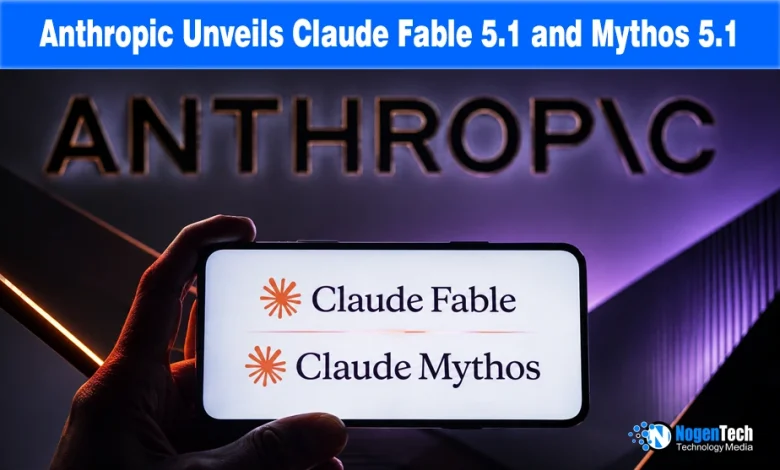
Anthropic introduced Claude Fable 5.1 and Claude Mythos 5.1, the successors of Fable 5 and Mythos 5, on Tuesday, describing them as the world’s most advanced models for coding and knowledge work.
Fable 5.1 is available to everyone across Anthropic’s platforms, including Amazon Web Services, Google Cloud, and Microsoft Azure. Mythos 5.1, designed for cybersecurity and life sciences, is limited to vetted U.S. organizations in Anthropic’s trusted access programs.
The release directly targets three complaints Anthropic says it has heard repeatedly from customers: price, data retention, and overly aggressive safety refusals.
Fable 5.1 Gets Cheaper Without Getting Weaker
The most immediate change for developers is cost.
Base pricing remains $10 per million input tokens and $50 per million output tokens, but Anthropic cut cache read pricing by 75% to $0.25 per million tokens.
This lets the models reuse processed context instead of starting from scratch, reducing costs by about 25% on typical workloads and up to 45% on highly agentic tasks, according to Anthropic.
The model also outperforms its predecessor Fable 5, Anthropic’s Opus 5, and OpenAI’s GPT-5.6 Sol across several published benchmarks, while matching or beating Fable 5’s results even when run at lower effort settings, reducing the cost of comparable output.
Safeguards Get More Precise, Not Just Looser
Anthropic also rebuilt its safety layer to better distinguish real threats from harmless requests.
Claude Code users should see about 60% fewer cybersecurity interventions per session than with Fable 5, while Fable 5.1 can identify software vulnerabilities directly, though generating exploits remains off-limits, per Anthropic.
The company also launched the Life Sciences Verification Program with the U.S. government, mirroring its Project Glasswing, giving vetted scientists access to Mythos 5.1’s advanced biology capabilities, with broader enrollment expected soon.
The company paired those changes with Enterprise Frontier Safeguards, a system that stores customer data entirely on the customer’s own cloud infrastructure, delivering zero-data-retention-level privacy without sacrificing misuse detection.
The system will roll out in phases starting this fall.
The Real Story Is What the System Card Admits
Beyond the benchmarks, Anthropic’s system card, highlighted by TechCrunch, rates Mythos 5.1 as “low-risk” for accelerating AI research and development, with its current pace “in line with current trends” rather than an alarming jump.
That’s notable for a company that has spent the past month reporting on AI models breaking out of test environments, suggesting Anthropic still sees this risk as manageable rather than unpredictable.
The system card also says Mythos 5.1 is slightly more prone to misaligned behavior than Opus 5, a trade-off Anthropic attributes to the model’s expanded capabilities rather than a safety regression.
The release proves Anthropic can make cheaper, less frustrating models without sacrificing safety, while transparently publishing complex test results as it races toward the next version.
Source: We’re introducing Claude Fable 5.1 and Claude Mythos 5.1

![Top Tech Stories of 12th Week [2026]](https://www.nogentech.org/wp-content/uploads/2026/04/Top-Tech-Stories-of-14th-Week-2026-390x220.webp)

![Top Tech Stories of 24th Week [2026]](https://www.nogentech.org/wp-content/uploads/2026/06/Top-Tech-Stories-of-24th-Week-2026-390x220.webp)