Your smartphone knows what you want before you say a word. It suggests the next video you will watch, finishes your sentences, flags spam emails, and even helps your camera take better photos. None of this is magic. It is machine learning at work.
Machine learning is the technology that allows computers to learn from experience instead of following fixed instructions. Rather than being programmed step by step, machines study data, recognize patterns, and improve their decisions over time.
In this guide, you’ll explore what machine learning really means using simple language and everyday examples you already interact with. No technical overload, no confusing theories.
What is Machine Learning?
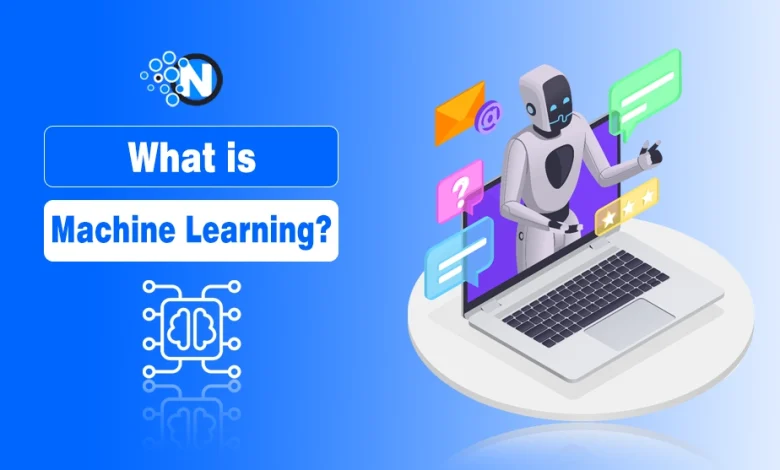
Machine learning is a branch of artificial intelligence that enables computers to learn from data and improve their performance without being explicitly programmed.
Instead of following fixed rules written by humans, machines analyze patterns, learn from experience, and make decisions on their own. Think of it like teaching a child. You do not give them a rulebook for every situation. You show examples, correct mistakes, and over time, they get better.
Core Types of Machine Learning Explained Simply
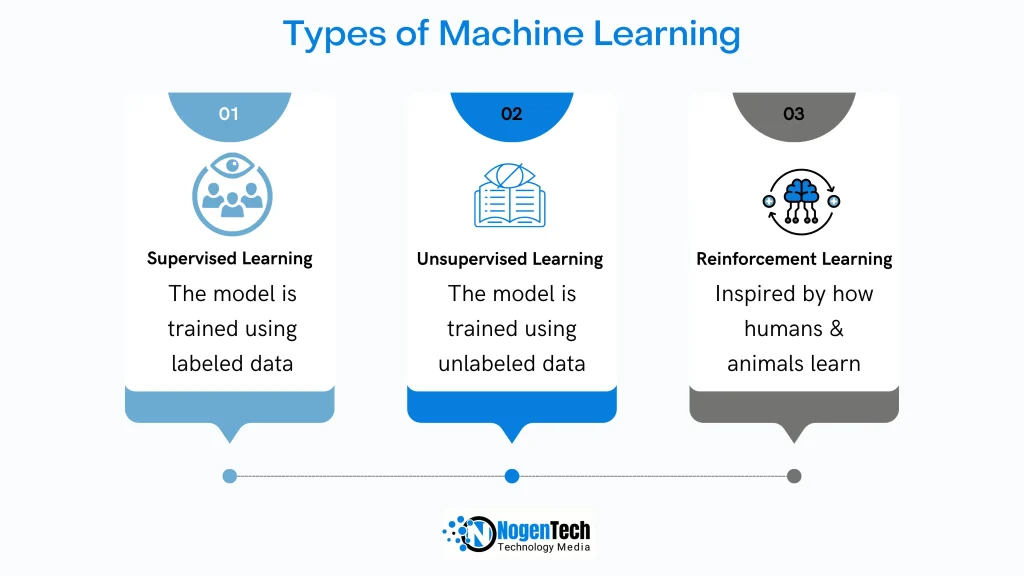
Machine learning is usually divided into three main types, based on how the system learns from data and experience. Each type solves different kinds of problems and is used in everyday technologies you already interact with.
1. Supervised Learning
Supervised learning is the most common form of machine learning. In this approach, the model is trained using labeled data, which means the correct answers are already known.
For example, if you want a system to recognize animals, you feed it thousands of images labeled “cat” or “dog.” Over time, the model learns which visual features belong to each category and can correctly classify new images it has never seen before.
Supervised learning is widely used for:
- Email spam detection
- Credit score evaluation
- Medical diagnosis
- Image and speech recognition
Because the system learns from clear examples, supervised learning is highly accurate when quality data is available.
2. Unsupervised Learning
Unsupervised learning works differently. Here, the model is given unlabeled data, which means it does not know the correct answers in advance. Instead, it explores the data on its own and looks for hidden patterns, similarities, or groupings.
A simple way to understand this is customer behavior analysis. An unsupervised model can analyze shopping habits and automatically group customers with similar interests, even if no categories were defined beforehand.
Unsupervised learning is commonly used for:
- Customer segmentation
- Market research
- Trend discovery
- Fraud and anomaly detection
This type of learning is especially useful when dealing with massive datasets where manually labeling data would be impractical or impossible.
3. Reinforcement Learning
Reinforcement learning is inspired by how humans and animals learn through experience. Instead of learning from labeled data, the system learns by trial and error.
The model takes actions in an environment and receives feedback in the form of rewards or penalties. Actions that lead to positive outcomes are encouraged, while poor decisions are discouraged. Over time, the system learns the best strategy to maximize rewards.
Reinforcement learning is used in:
- Game-playing AI
- Robotics and automation
- Self-driving systems
- Recommendation optimization
This learning method is powerful because it allows machines to adapt, improve, and make decisions in dynamic, real-world environments.
How Does Machine Learning Work?
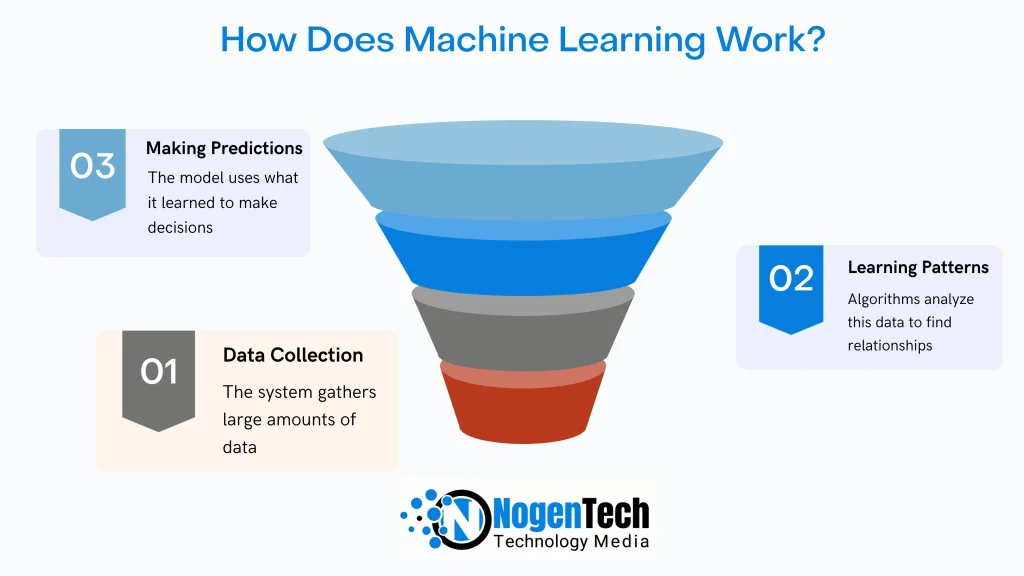
Machine learning works the same way, as a child learn nwe things over time, but with data instead of life lessons. At a basic level, machine learning follows three core steps:
- Data collection – The system gathers large amounts of data, such as images, text, numbers, or user behavior.
- Learning patterns – Algorithms analyze this data to find relationships, trends, and patterns.
- Making predictions – The model uses what it learned to make decisions or predictions on new data.
The more quality data the system receives, the better its predictions become. This is why modern machine learning systems constantly improve over time.
Everyday Examples of Machine Learning You Already Use
Machine learning is not something you only encounter through complex software or advanced technology. It is quietly embedded into tools you rely on daily, often without you even noticing.
These systems continuously learn from your behavior to deliver faster, smarter, and more personalized experiences.
1. Personalized Streaming Recommendations
When a streaming platform suggests a movie or series that feels perfectly aligned with your taste, that is machine learning at work. Services like Netflix analyze what you watch, how long you watch it, what you skip, and even when you stop watching.
Based on previous experiments, the system builds a detailed preference profile and compares it with similar users. This allows it to recommend content that matches your interests rather than showing the same list to everyone.
2. Smarter Search Results and Voice Assistants
Search engines such as Google use machine learning to understand user intent, not just keywords. This is why searching for short or vague phrases still produces accurate results in the search engine pages.
Voice assistants take this further by learning how you speak, what you usually ask for, and when you need information. The more you interact with them, the better they become at predicting your needs.
3. Email Spam Filtering and Smart Inbox Sorting
Machine learning plays a critical role in keeping your email inbox clean. Email services like Gmail study patterns such as sender behavior, message structure, and user interactions to identify spam, phishing attempts, and promotional emails.
Each time users mark an email as spam or safe, the system learns and improves, while protecting millions of inboxes simultaneously.
4. Online Shopping and Product Recommendations
E-commerce platforms use machine learning to understand buying behavior and suggest relevant products. If you browse shoes and later see related recommendations, it is because the system has learned from your activity.
Companies like Amazon rely heavily on machine learning to personalize product listings, optimize pricing, and even manage inventory based on demand predictions.
5. Smartphone Cameras and Photo Enhancements
Modern smartphone cameras are powered by machine learning models that recognize faces, objects, lighting conditions, and motion. These systems automatically adjust brightness, sharpness, and color balance to produce high-quality images with minimal effort.
This is why portrait mode blurs backgrounds accurately and night mode captures clear photos in low light.
Machine Learning vs Traditional Programs
Traditional programming and machine learning solve problems in fundamentally different ways.
In traditional software development, humans define every rule the system must follow. The computer simply executes those instructions exactly as written. If a situation changes, developers must manually update the code.
Machine learning flips this approach. Instead of writing detailed rules, developers provide data and let the system learn patterns on its own. The model improves through experience, adapts to new inputs, and handles complexity that would be impossible to manage with fixed logic alone.
This shift is especially important in today’s data-driven world, where user behavior, language, images, and environments constantly change. Machine learning systems can evolve automatically, while traditional programs remain static unless rewritten.
Machine Learning vs Traditional Programming (Comparison Table)
Start creating Verdict in seconds, and convert more of your visitors into leads.
Why This Difference Matters
As digital systems become more intelligent and user-centric, traditional programming alone is no longer enough.
Machine learning enables software to understand behavior, predict outcomes, and personalize experiences at scale. That is why modern applications increasingly combine both approaches, using traditional programming for structure and machine learning for intelligence.
Why Machine Learning Matters Today
Machine learning matters today because the digital world has grown far too complex for traditional, rule-based systems to manage on their own. Every second, massive amounts of data are generated from searches, social media, online purchases, sensors, and smart devices.
At this time, it’s the only practical way to process this data at scale and turn it into meaningful insights. One of the biggest reasons machine learning is so important is automation with intelligence. Instead of simply automating repetitive tasks, machine learning allows systems to make informed decisions.
This is why businesses can predict customer needs, detect fraud in real time, and personalize experiences for millions of users simultaneously. It also improves accuracy and efficiency across industries to help humans understand what to expect in reality.
First, in healthcare, it helps analyze medical images and identify diseases earlier. In finance, it detects unusual transactions and reduces risk. In marketing, it understands user behavior and delivers the right message to the right audience at the right time.
These improvements are not just faster; they are often more reliable than manual processes.
Final Thoughts on Machine Learning
Machine learning is not about replacing humans. It is about enhancing how technology understands and supports us. From personalized recommendations to smarter devices, machine learning quietly improves daily experiences without demanding attention.
Now that you understand what machine learning is and how it works through everyday examples, you can better recognize its role in the digital world around you. And chances are, the next time your phone predicts exactly what you need, you will know why.