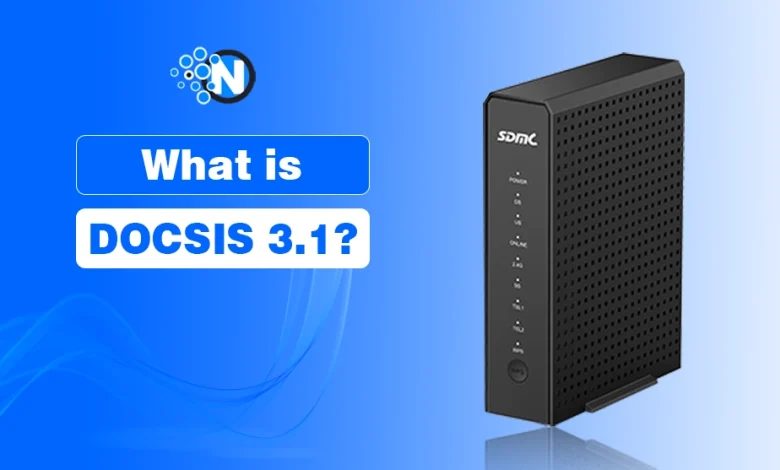
If you have looked at your cable modem recently or signed up for a new gigabit plan, you have likely seen the acronym DOCSIS 3.1.
But what does it actually mean for your Friday night 4K streaming or your Monday morning Zoom marathon? In the ever-evolving landscape of digital connectivity, the terms we use to describe our “fast” internet are constantly shifting.
As we navigate 2026, where “high speed” is no longer a luxury but a utility, understanding the engine under the hood of your home network is vital. In this guide, I am going to describe what is DOCSIS 3.1 and why it still matters in 2026.
What is DOCSIS 3.1?
DOCSIS stands for Data Over Cable Service Interface Specification, and it is the international telecommunications standard that allows high-bandwidth data to be sent over existing cable television (CATV) systems.
Essentially, it is the “language” your modem and your Internet Service Provider (ISP) use to talk to each other through the copper coaxial cables already buried in your neighborhood.
The Evolution: Why DOCSIS 3.1 Changed the Game
Before DOCSIS 3.1, we lived in the world of DOCSIS 3.0. While 3.0 was revolutionary in 2006 for introducing “channel bonding” (combining multiple channels to increase speed), it hit a ceiling. DOCSIS 3.1, released by CableLabs, was designed to smash that ceiling.
For better understanding, I often describe it as a highway:
- DOCSIS 3.0 was like a 4-lane road. It worked well, but if too many cars (data packets) got on at once, traffic slowed down.
- DOCSIS 3.1 isn’t just a wider road. It is a hyper-efficient multi-level transit system that uses advanced mathematics to pack more “passengers” into the same space without the lanes interfering with each other.
How DOCSIS 3.1 Works?
To understand why DOCSIS 3.1 matters in 2026, we have to look at the three technical pillars of its operation.
1. OFDM (Orthogonal Frequency Division Multiplexing)
It is the “secret sauce.” Older standards used single-carrier modulation, which required gaps between data channels to prevent interference and wasted space. DOCSIS 3.1 uses OFDM, which breaks data into thousands of tiny, overlapping “sub-carriers.”
Because these sub-carriers are mathematically “orthogonal” (they don’t interfere with each other), they can be packed incredibly tight. This increases the efficiency of the cable by about 50% compared to previous generations.
2. Higher-Order Modulation (4096-QAM)
Modulation is how digital data is converted into electrical signals. DOCSIS 3.0 used 256-QAM. DOCSIS 3.1 steps this up to 4096-QAM, with the capability to scale even higher. Hence, it allows for a much denser “data payload” per signal.
One more thing is that DOCSIS 3.1 is technically “suitable” for WiFi 7, but DOCSIS 4.0 is the only standard that truly matches its potential.
3. Active Queue Management (AQM)
Have you ever noticed your internet lag when someone else in the house starts a large download? That’s “bufferbloat.”
DOCSIS 3.1 introduced AQM, a smart traffic-control algorithm that reduces delays in the network buffers. It ensures that small, time-sensitive packets (like your voice in a VoIP call) don’t get stuck behind massive file downloads.
Why DOCSIS 3.1 Matters in 2026?
While DOCSIS 4.0 is the new shiny object on the horizon of the WiFi, DOCSIS 3.1 is the undisputed workhorse of the global internet infrastructure today.
As of early 2026, DOCSIS 3.1 remains the dominant standard, holding approximately 43.5% of the market share in the cable modem termination system (CMTS) space.
1. Gigabit Speeds for the Masses
The theoretical limit of DOCSIS 3.1 is 10 Gbps download and 1-2 Gbps upload. In the real world, this has allowed ISPs like Xfinity, Spectrum, and Cox to offer 1 Gbps and 2 Gbps plans over the same copper wires that were installed decades ago.
Without 3.1, we would have been forced to dig up every street to lay fiber-optic cables, a process that would have cost billions more and taken decades longer. If you are on the old plans of Xfinity, you have to subscribe to xFi Complete to get the benefits of DOCSIS 3.1.
2. The “Mid-Split” and “High-Split” Revolution
One of the biggest complaints about cable internet has always been slow upload speeds (typically capped at 35 Mbps).
In 2026, DOCSIS 3.1 is solving this through “High-Split” upgrades. ISPs can now offer upload speeds of 200 Mbps to 1 Gbps on DOCSIS 3.1 hardware by reallocating the frequency spectrum. This is a lifesaver for:
- Remote Workers: Uploading large CAD files or video projects to the cloud.
- Gamers: Lowering latency and providing a stable “ping” for competitive play.
- Content Creators: Seamless 4K live-streaming to platforms like Twitch or YouTube.
3. Energy Efficiency and Reliability
DOCSIS 3.1 isn’t just faster. It is greener. It includes “light sleep modes” that reduce power consumption when the modem is idle.
Additionally, the standard uses LDPC (Low-Density Parity Check) error correction, which makes the signal much more resilient to “noise” or interference on the line, leading to fewer random disconnections.
A Comparison of the DOCSIS Standards (2026 Update)
| Feature | DOCSIS 3.0 | DOCSIS 3.1 | DOCSIS 4.0 |
| Max Download | 1 Gbps | 10 Gbps | 10 Gbps |
| Max Upload | 100 Mbps | 1-2 Gbps | 6 Gbps |
| Efficiency Tech | SC-QAM | OFDM / OFDMA | OFDM / Full Duplex |
| Latency | High (20-40ms) | Low (<10ms) | Ultra-Low (<1ms) |
| 2026 Status | Legacy / Phasing Out | Global Standard | Early Adoption / High Cost |
Should You Upgrade to DOCSIS 4.0?
If you are still using an older DOCSIS 3.0 modem in 2026, you are likely leaving performance on the table. Even if your plan is “only” 500 Mbps, top computer networking modems use DOCSIS 3.1, which will handle that speed more efficiently, with better stability during peak hours and lower latency.
However, if you are looking at buying a new modem today, whether it is an Xfinity compatible modem or for another ISP, ensure it has a 2.5 GbE (Gigabit Ethernet) port. Many modern ISP plans exceed 1 Gbps, and a standard 1 Gbps port on an old modem will act as a bottleneck, capping your real-world speed at around 940 Mbps.
Final Thoughts
DOCSIS 3.1 matters because it bridged the gap between the “old” internet and the “future” internet. It gave us fiber-like speeds without the fiber-like construction headaches.
While DOCSIS 4.0 will eventually bring symmetrical multi-gigabit speeds to everyone, DOCSIS 3.1 is the reason the modern digital world stays connected, stable, and fast today. Stay connected to this type of Internet unless you are bound to tasks that require ultra-low latency to survive in this competitive landscape.