
What are the Pros and Cons of Chatbots for Your Business in 2026?

Chatbots have resolved up to 80% of routine customer inquiries, which drastically cuts response times and frees human staff for more complex work.
In practice, many businesses have seen customer satisfaction improve simply because customers get answers faster without waiting in long queues or repeating themselves. By 2026, Artificial Intelligence chatbots will no longerbe a “nice-to-have” or a futuristic experiment.
They’re already part of how customers interact with brands, from getting support and booking services to discovering products and completing purchases. Still, just because chatbots are everywhere doesn’t mean they’re always the right choice.
So the real question is: Will chatbots actually help your business, or could they frustrate your customers and hurt retention?
That’s why this guide walks you through the real pros and cons of chatbots for businesses in 2026. At the end, you’ll figure it out, whether they’re a smart move for your customer experience or a risk you should rethink.
What are Chatbots?
Chatbots are software programs designed to simulate human conversation and interact with users through text or voice.
They use predefined rules or AI, such as natural language processing (NLP) and machine learning, to understand questions, provide answers, and complete tasks automatically. In simple terms, a chatbot is a digital assistant that can talk to customers, respond instantly, and work 24/7 without human involvement.
Pros and Cons of Chatbots for Your Business [TL;DR]
Here is the comparison table of pros and cons of chatbots for your business in 2026 in a short, but accurate format:
Pros of Chatbots for Your Business in 2026
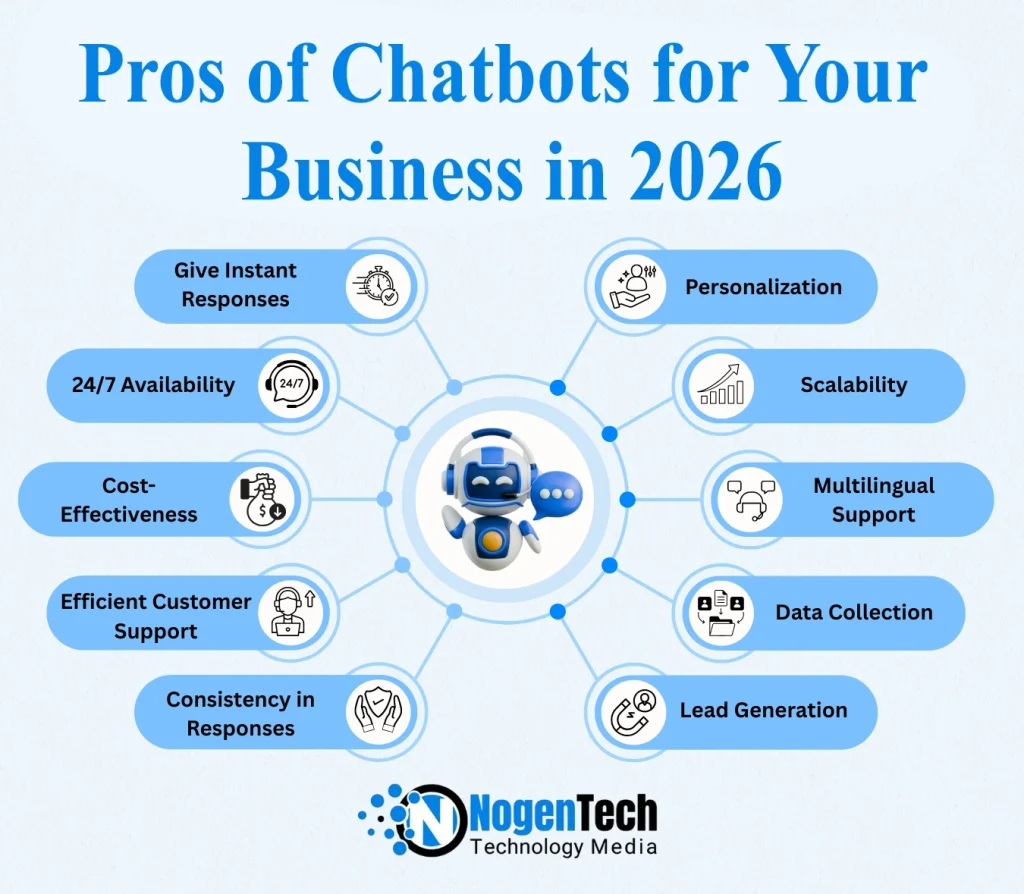
After understanding how chatbots streamline your business processes, I’ve enlisted some of their pros. Look at them if you are also on your way to integrating them into your company’s working model.
1. Give Instant Responses
Chatbots powered by advanced AI models can respond to customer queries instantly, which eliminates wait times entirely. This immediacy shapes positive customer perception, as users associate fast responses with professionalism and reliability.
In 2026, when customers expect real-time interaction across platforms, instant replies significantly influence buying decisions and reduce bounce rates. Further, it increases the likelihood of conversions by keeping potential customers engaged at the right moment.
2. 24/7 Availability
Unlike human support teams limited by shifts and working hours, chatbots operate continuously without breaks. They provide round-the-clock assistance, which ensures customers receive help whenever they need it, regardless of time zones.
This constant availability enhances customer experience, builds trust, and prevents lost opportunities. In global digital markets, 24/7 chatbot support allows businesses to serve international audiences and capture leads even outside traditional business hours.
3. Cost-Effectiveness
Chatbots significantly reduce operational costs by minimizing the need for large customer support teams. Instead of recurring salaries, businesses invest once in chatbot implementation and maintenance to improve their customers’ satisfaction.
In 2026, AI-driven chatbots handle multiple conversations simultaneously without additional expense. This cost efficiency allows companies to reallocate budgets toward growth strategies while maintaining high-quality support.
4. Efficient Customer Support
Chatbots are designed to guide customers smoothly throughout their journey with a business. They handle repetitive queries consistently, which prevents human agents from burning out due to answering the same questions repeatedly.
By automating routine support tasks, chatbots improve overall efficiency while allowing human teams to focus on complex issues. This balance results in faster resolutions, reduced employee stress, and a more reliable customer support experience.
5. Consistency in Responses
Chatbots deliver uniform and accurate responses every time; that’s what eliminates inconsistencies caused by human error, fatigue, or miscommunication. Their answers remain aligned with brand guidelines and updated knowledge bases.
In 2026, consistency is critical for maintaining trust across digital touchpoints. By providing clear, concise, and reliable information, chatbots save customers time, reduce confusion, and ensure users receive the same quality of service on every interaction.
6. Personalization
Modern chatbots make use of customer data, browsing history, and previous interactions to deliver personalized responses. In 2026, AI-driven personalization goes beyond basic greetings, offering tailored product suggestions and contextual support.
These customized interactions make customers feel understood and valued, increasing engagement and loyalty. By adapting conversations to individual preferences, chatbots help businesses stand out in competitive markets while improving conversion rates and long-term customer relationships.
7. Scalability
As businesses grow, customer inquiries increase rapidly, which makes manual handling inefficient and slow at the same time. Chatbots are highly scalable, capable of managing thousands of conversations simultaneously without performance loss.
In 2026, scalability is essential for handling seasonal traffic spikes, marketing campaigns, and fast expansion. Chatbots allow businesses to serve larger audiences effortlessly, which makes sure consistent service quality while avoiding the delays and costs associated with hiring and training additional staff.
8. Multilingual Support
With businesses increasingly serving global audiences, multilingual chatbots have become essential for them. Using advanced natural language processing, chatbots can understand, translate, and respond in multiple languages accurately.
This capability removes language barriers and improves accessibility for international customers. In 2026, multilingual chatbot support enables brands to expand globally, delivering localized experiences and fostering stronger relationships with customers.
9. Data Collection
Chatbots continuously collect valuable data on customer behavior, preferences, and pain points during interactions. This real-time data enables businesses to gain actionable insights into customer needs and expectations.
In 2026, such insights drive smarter decisions in product development, customer experience optimization, and marketing strategies. By analyzing chatbot data, companies can refine offerings, personalize campaigns, and improve conversion rates and overall revenue growth.
10. Lead Generation
Chatbots play a powerful role in lead generation by engaging visitors instantly, asking qualifying questions, and guiding them through the sales funnel. In 2026, AI-powered chatbots proactively identify high-intent users and route them toward relevant solutions.
This automated qualification reduces friction, improves conversion rates, and shortens sales cycles. They further help businesses capture more opportunities to maximize revenue by nurturing leads in real time.
Cons of Chatbots for Your Business in 2026
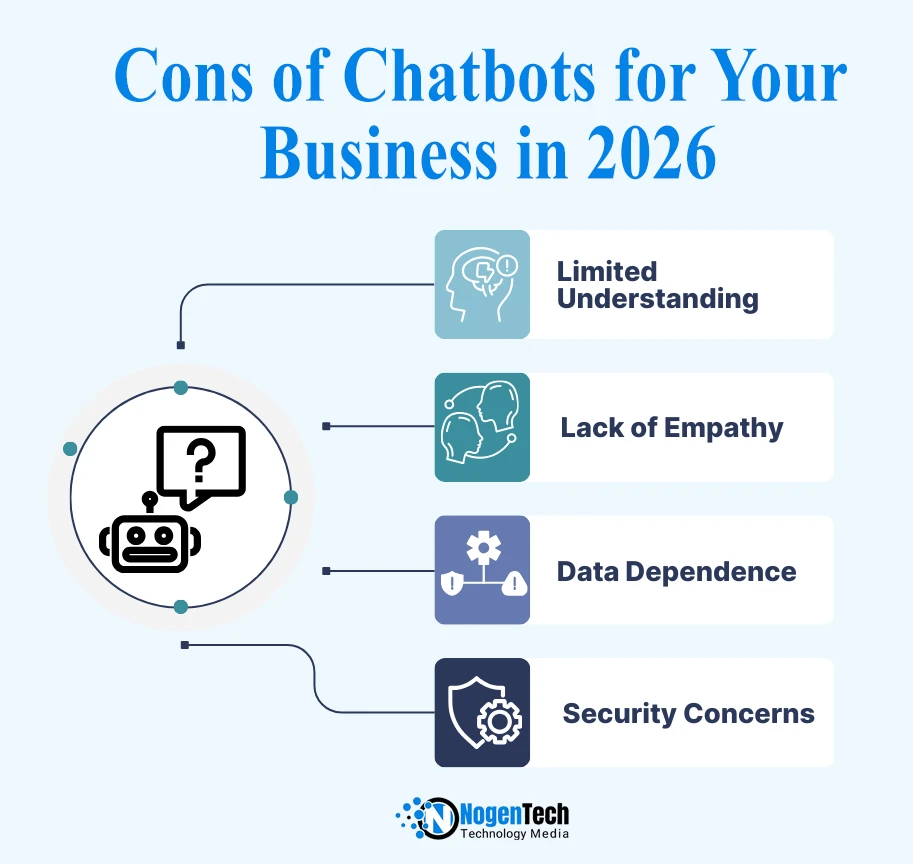
1. Limited Understanding
Despite major advancements in AI, chatbots still struggle with complex, ambiguous, or highly contextual questions. They rely on trained data and predefined logic, which can cause inaccurate or irrelevant responses when queries fall outside expected patterns.
In 2026, this limitation can frustrate users who expect human-like understanding. When chatbots fail to resolve nuanced issues, they risk damaging user trust and negatively impacting the overall customer experience.
2. Lack of Empathy
Although chatbots use natural language processing to sound conversational, they cannot truly understand or respond to human emotions. In sensitive situations, such as complaints or service failures, this lack of empathy may leave customers feeling unheard or undervalued.
In 2026, when emotional intelligence is a key factor in customer loyalty, over-reliance on chatbots can frustrate users and potentially push long-term customers away from your brand.
3. Data Dependence
Chatbots rely heavily on accurate, updated data to deliver relevant and personalized responses. If the underlying data is outdated, incomplete, or biased, the chatbot may provide misleading information to your customers.
In 2026, businesses managing dynamic products or policies must continuously update chatbot databases. Failure to maintain data quality can result in customer confusion, reduced credibility, and poor decision-making experiences.
4. Security Concerns
Chatbots often process sensitive customer information, which makes them attractive targets for cyberattacks. Weak security measures, improper integrations, or poor data handling can expose personal and financial data to breaches.
In 2026, rising cybersecurity threats make chatbot security a critical concern. Businesses must invest in encryption, compliance, and regular audits, as data breaches caused by chatbot vulnerabilities can severely damage customer trust and brand reputation.
Should You Integrate Chatbots into Your Business?
Choosing to integrate chatbots depends on your business goals, customer needs, and operational capacity. In 2026, chatbots excel at providing instant, consistent, and cost-effective support, which boosts engagement and lead generation.
However, they may struggle with complex queries, empathy, or outdated data. Businesses should weigh these advantages against limitations, considering hybrid approaches that combine AI chatbots with human support to maximize efficiency and customer satisfaction.