

Jensen Huang Claims Nvidia Has Achieved AGI on Lex Fridman Podcast
The Nvidia CEO made the declaration on March 23, 2026, while appearing on Lex Fridman's podcast, but immediately narrowed his claim with a definition that reframes what AGI actually means.

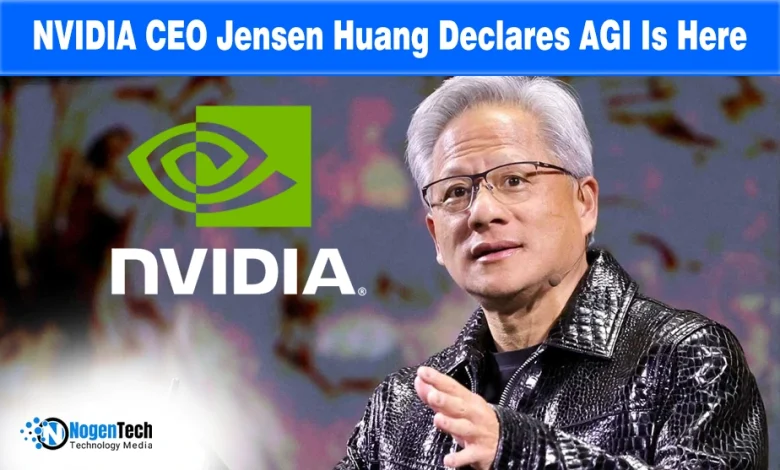
NVIDIA CEO Jensen Huang declared on March 23, 2026, that artificial general intelligence(AGI) has already arrived.
Speaking on episode 494 of Lex Fridman’s podcast, Huang responded to Fridman’s definition of AGI, an AI system autonomously starting and running a billion-dollar tech company, with a direct answer: “I think it’s now. I think we’ve achieved AGI.”
As Forbes reported, the declaration cuts sharply against a growing trend of tech executives deliberately distancing themselves from the term.
But as multiple outlets noted within hours of the episode’s release, Huang’s claim rests on a specific and narrow definition of AGI; one that carries significant consequences for how the broader industry interprets the milestone.
How Huang Defines AGI on Lex Fridman
The Verge reported that Huang’s statement did not emerge unprompted, it was a direct response to Fridman’s framing. Fridman asked Huang for a timeline: five, ten, or twenty years before an AI system could “start, grow, and run a successful technology company.” Huang did not hesitate. “I think it’s now,” he said, before adding: “I think we’ve achieved AGI.”
As Sherwood News noted, Huang immediately narrowed the definition: “You said a billion, and you didn’t say forever.” He framed AGI not as a long-term, human-like mind, but as a short-term commercial sprint.
In this view, an AI doesn’t need to run a company for decades like a human CEO. It only needs to prove it can “win the game” by generating massive economic value for a specific window of time.
To illustrate this, Huang referenced OpenClaw, an open-source AI agent platform created by Peter Steinberg, seeing viral growth.
He noted developers are using OpenClaw agents to build social applications and automated communities. Huang further said he “wouldn’t be surprised” if one of those agent-driven projects became an instant commercial success.
Why Huang’s AGI Definition Matters Technically
According to TechBuzz, Huang’s AGI declaration marks a significant departure from the industry’s recent trend. Over the past year, major AI companies shifted toward terms like “reasoning models,” “frontier AI,” and “agentic systems” because AGI carries immense legal and contractual weight.
The report further added that the term AGI is built into legal contracts between giants like OpenAI and Microsoft. In these deals, reaching “AGI” acts as a massive financial trigger. If a system is labeled AGI, it can change who gets paid, how much money changes hands, and who is legally responsible for the risks.
Firstpost reported that Huang’s claim forces this contested conversation back into the spotlight. The technical divide remains: current large language models write production-grade code and pass professional exams, but still hallucinate and lack persistent memory.
The outlet noted that whether these flaws stop a system from being called AGI depends entirely on which rulebook you use. Huang’s claim disrupts industry plans to avoid the term, forcing a heated debate over the true meaning of artificial intelligence.
Huang and the OpenClaw Agent Platform
Times Now framed that Huang’s OpenClaw reference highlights AI agents’ ability to generate a billion dollars locally without centralized infrastructure. Under Fridman’s economic benchmark for AGI, Huang argued that such platforms already demonstrate the core capability: an AI system that can generate a billion dollars in value, even briefly.
But Huang’s own caveat told a more cautious story. As Sherwood News reported, when the conversation turned to whether AI agents could build a company like Nvidia itself, Huang was unequivocal: “The odds of 100,000 of those agents building Nvidia is zero percent.”
That gap, between an AI generating short-lived commercial value and an AI sustaining the institutional complexity of a multi-trillion-dollar company, is precisely where the AGI debate lives.
Who Does Jensen Huang’s Statement Affect
For the AI research community, Huang’s declaration serves as a provocation rather than scientific proof. Because NVIDIA controls roughly 80 percent of the AI chip market, Huang’s framing of AGI carries outsized influence. This remains true regardless of whether researchers actually agree with his commercial definition.
When the CEO whose hardware trains nearly every major AI model says AGI has arrived, competitors, regulators, and investors are forced to respond.
For developers and enterprises, the more practical takeaway is Huang’s endorsement of agentic AI platforms like OpenClaw as production-ready tools.
Forbes noted that Huang’s comments coincided with a separate remark at Nvidia’s GTC, where he unveiled the Vera Rubin platform and raised the company’s revenue outlook to $1 trillion. He told engineers he would be “deeply alarmed” if a $500,000 professional was not consuming at least $250,000 in AI compute tokens.
This signals that Huang views aggressive AI adoption within technical teams as a baseline expectation rather than an aspiration.
What’s Next For the AGI Debate
Huang’s declaration will not settle the AGI debate, but it will intensify it. As Mashable reported, Fridman himself acknowledged on the podcast that Huang’s statement would “get a lot of people excited,” a recognition that the claim is as much a cultural moment as a technical one.
However, this cultural shift has real-world consequences. The AI industry now faces renewed pressure to establish clearer, publicly agreed-upon benchmarks for what AGI means. This is particularly urgent given the legal and contractual weight the term already carries in major corporate agreements.
Ultimately, whether Huang’s economic-output definition gains traction or gets dismissed as a reframing will shape how the next wave of agentic AI products are positioned, funded, and regulated.
Source: #494 – Jensen Huang: NVIDIA



![Top Tech Stories of 6th week [2026]](https://www.nogentech.org/wp-content/uploads/2026/02/Top-Tech-Stories-of-6th-Week-2026-390x220.webp)