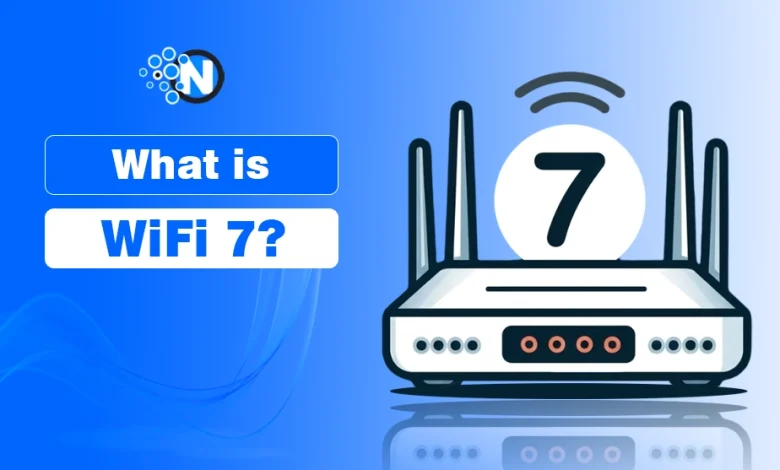
Officially known by the technical designation IEEE 802.11be, Wi-Fi 7 is the latest generation of wireless technology designed for “Extremely High Throughput” (EHT).
As of 2026, it has moved from being a futuristic promise to the backbone of our digital lives, powering everything from 8K lag-free streaming to professional-grade Augmented Reality (AR) and fully automated smart homes.
In this guide, I am going to cover the definition of WiFi 7 along with its key features and comparison with older versions.
What is WiFi 7?
Wi-Fi 7 (802.11be) is the 2026 wireless standard delivering “Extremely High Throughput” up to 46 Gbps. It utilizes 320 MHz channels, 4K-QAM, and Multi-Link Operation (MLO) to provide fiber-like speeds, ultra-low latency, and stable connections for 8K streaming and AR/VR.
While Wi-Fi 7 works with DOCSIS 3.1, you will likely face an upload bottleneck. The real magic happens with DOCSIS 4.0. This 2026 standard introduces symmetrical speeds, which means your 2 Gbps upload finally matches your download. It is essential for Wi-Fi 7’s Multi-Link Operation (MLO) to function at its peak.
The Big Three Features of Wi-Fi 7
What actually makes Wi-Fi 7 different? It boils down to three massive technical upgrades that work together to kill “buffering” forever.
1. The Core Pillar: Extremely High Throughput (EHT)
The primary goal of Wi-Fi 7 was simple yet ambitious: to make wireless connections indistinguishable from a physical Ethernet cable. To achieve this, the engineers at IEEE introduced several radical changes to the way data is packaged and sent through the air.
a) The 320 MHz Frequency
In previous generations, even on the 6 GHz band introduced with Wi-Fi 6E, the “lanes” were limited to 160 MHz. Wi-Fi 7 doubles this to 320 MHz.
It is essentially doubling the width of the pipe. Through using these ultra-wide channels, a single device can download data at speeds that were previously theoretical. In a dense environment like a 2026 apartment complex, this extra “width” is the difference between a stuttering video call and a crystal-clear holographic meeting.
b) 4K-QAM: Packing More Data
QAM stands for Quadrature Amplitude Modulation. It’s a fancy way of saying how much data is packed into each radio signal. Wi-Fi 6 uses 1024-QAM, but Wi-Fi 7 jumps to 4096-QAM. This technical leap allows for a 20% increase in peak data rates.
2. Multi-Link Operation (MLO): The Intelligent Brain
This is arguably the most significant practical upgrade in Wi-Fi 7. In every previous generation, your devices, such as smartphones, gaming laptops, or smart TVs, had to “pick a lane.” It connected to either the 2.4 GHz, 5 GHz, or 6 GHz band.
If that band became crowded, or you walked behind a thick wall, your connection suffered while the device struggled to switch to a different frequency.
MLO changes the game by allowing a device to connect to multiple bands simultaneously.
- Aggregation: It can combine the speeds of the 5 GHz and 6 GHz bands to give you one massive “super-connection.”
- Seamless Redundancy: If your neighbor starts a massive download on the 5 GHz frequency, your Wi-Fi 7 router instantly shifts your data packets to the 6 GHz band without a single millisecond of dropped connection. For gamers and remote surgeons in 2026, this “hitless” failover is a necessity.
3. Preamble Puncturing: No More Wasted Space
In older Wi-Fi versions, if a small part of a wide channel was being used by a legacy device (like an old smart fridge), the entire channel would often be blocked for other devices. This was incredibly inefficient.
Wi-Fi 7 introduces Multi-RU (Resource Unit) Puncturing. It allows the router to “carve out” the specific slice of the frequency that is experiencing interference and use the rest of the channel anyway.
It is like having a pothole in one lane of the highway, but still being able to drive around it rather than closing the entire road.
WiFi 7 vs The Previous WiFi Generations (2026 Perspective)
To truly appreciate the evolution of WiFi 7 and its upgraded performance as compared to older generations of WiFi, we have to look at the metrics that matter.
| Feature | Wi-Fi 6/6E (802.11ax) | Wi-Fi 7 (802.11be) |
| Max Theoretical Speed | 9.6 Gbps | 46 Gbps |
| Channel Width | 160 MHz | 320 MHz |
| Modulation | 1024-QAM | 4096-QAM |
| Latency | Low | Ultra-Low (Deterministic) |
| Efficiency | High | Exceptional (Multi-RU) |
Considering these benefits, many top ISPs, especially Xfinity is now including the XB10 gateway in its XFi Complete add-on as it supports WiFi 7. Hence, users can enjoy the perks of fast internet speed.
Why You Need WiFi 7 in 2026?
You might be thinking, “My Wi-Fi 6 is fine, why do I care?” In today’s landscape, the demands on our networks have moved past simple web browsing.
1. The Rise of XR and the Metaverse
Virtual Reality (VR) and Augmented Reality (AR) have matured. For VR headsets to feel natural, latency must be below 5 milliseconds.
Wi-Fi 7 is the first wireless standard designed from the ground up to support the “deterministic latency” required for these immersive experiences.
2. 8K Streaming and Beyond
With 8K displays becoming the standard for home theaters in 2026, the bitrates required for smooth streaming are staggering.
Wi-Fi 7 handles these streams with enough “headroom” to allow other family members to browse, game, and work simultaneously without any noticeable drop in quality. But there is a precaution that faster speed and 4k streaming may cause you to exceed your 1.2 TB data limit in no time, resulting in extra charges.
To avoid such risks, you can check my guide on removing Internet data caps in the USA through legal and effective methods.
3. The Dense Smart Home
The average home now contains over 40 connected devices, from AI-driven security cameras to smart appliances.
Wi-Fi 7’s ability to manage 16×16 MU-MIMO (Multiple Input, Multiple Output) streams means the router can talk to more devices at once, significantly reducing the “wait time” for every gadget in your house.
And if you are on new Xfinity Internet plans or using other ISPs like Google Fiber, Verizon Fios, and AT&T Fiber, you need not worry about data limits, as they come with unlimited data.
Final Thoughts
Wi-Fi 7 is a fundamental redesign of how wireless data moves. As it uses the 6 GHz band more efficiently and allows devices to talk across multiple frequencies at once, it has finally closed the gap between wireless convenience and fiber-optic speed.
If you are looking for a network that can handle the AI-driven, high-resolution world of 2026, Wi-Fi 7 is no longer a luxury. It is the standard.