What is Natural Language Processing (NLP)? Key Components and Its Applications

Natural Language Processing (NLP) is one of the most impactful advancements in modern technology. By combining linguistics, computer science, and artificial intelligence, NLP enables machines to understand, interpret, and generate human language in a meaningful way.
From chatbots and virtual assistants to language translation and sentiment analysis, NLP powers many of the digital experiences we rely on daily. As this technology continues to evolve, it is reshaping how businesses communicate, analyze data, and interact with users at scale.
Over 14 years, I’ve seen this technology evolving at a rapid pace, which has led to the production of numerous applications. That’s why I’ve developed this guide on NLP and its top innovations in the real world use.
What is Natural Language Processing (NLP)?
Natural Language Processing (NLP) is a branch of artificial intelligence (AI) that focuses on enabling computers to understand, process, and respond to human language, both written and spoken.
Unlike traditional programming, NLP allows machines to interpret context, intent, sentiment, and semantics, making interactions more natural and human-like. This capability bridges the gap between human communication and machine understanding, which enables smarter automation and data-driven decision-making.

Key Components of Natural Language Processing
NLP is not a single technique but a complex ecosystem of interconnected components. Each component plays a critical role in ensuring accurate language understanding and generation.
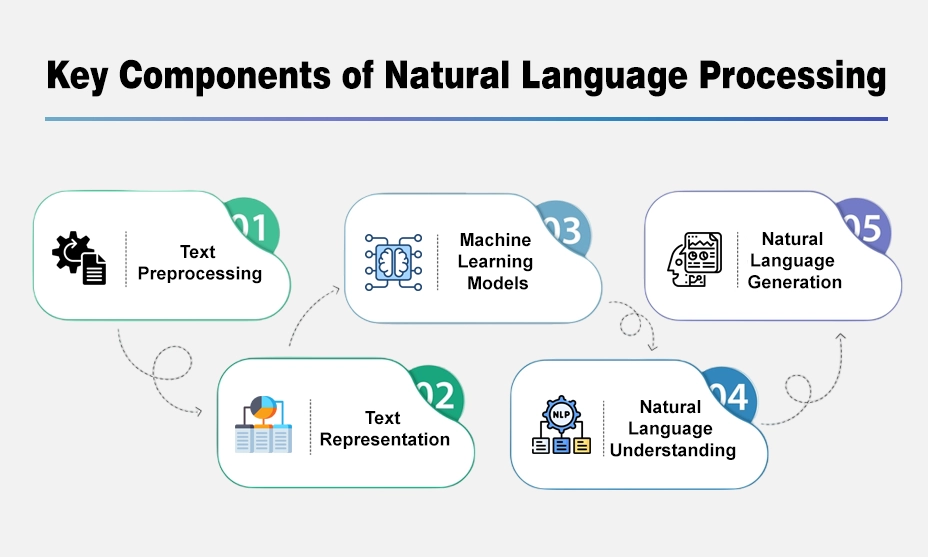
1. Text Preprocessing
The foremost component of natural language processing is text preprocessing. It involves different crucial steps that must be followed precisely to ensure accurate results.
Otherwise, you will get certain functional anomalies in the performance section. The vital steps are mentioned below.
- Tokenization: It is the process of splitting the text into words.
- Stemming: This method is mainly utilized to reduce words to their root forms.
- Removal: In this step, the developers remove the stop words like “the” and “is”.
2. Text Representation
Another critical component of NLP is text representations. It is compulsory to make machines understand and learn the commands. We all know that AI models work on numerical values instead of letters.
Thus, text representation is the process of converting the text into numerical data by the utilization of various tools and software. Generally, the most usable techniques in this process are:
- One-hot encoding
- Word Embedding
3. Machine Learning Models
Natural language processing also uses the power of machine learning models to process and understand the context of the text. Thus, it can ensure automated answer generation alongside bringing efficiency to the whole procedure.
Although machine learning is an essential component, it is not used deeply, as it may result in some negative consequences. The only techniques to be integrated into NLP are:
- Recurrent Neural Networks (RNNs)
- Transformer-based models, like BERT
4. Natural Language Understanding
NLU focuses on comprehending language meaning through:
- Semantic Analysis: Extracting meaning from text at the word, sentence, and document levels.
- Named Entity Recognition: Identifying specific elements like names, places, and dates.
- Part-of-Speech Tagging: Categorizing words as nouns, verbs, adjectives, etc.
- Syntactic Parsing: Analyzing sentence structure to understand relationships between words.
5. Natural Language Generation
Natural language processing mainly focuses on understanding the language as well as generating human-like texts.
- Text Summarization: Condensing lengthy content while preserving key information.
- Response Generation: Creating contextually appropriate replies (as in chatbots).
- Content Creation: Producing articles, reports, and creative writing.
- Data-to-Text: Converting structured data into narrative descriptions.
Applications of Natural Language Processing
Now, you have learned about the components of natural language processing. It’s time to get complete insights regarding the applications of NLP that have taken the world by storm and impacted the business’s functioning greatly.
1. Language Translation
Machine translation has evolved from simple word-by-word conversion to sophisticated systems that preserve context, tone, and cultural nuances. Recent advancements include:
- Zero-shot translation: Translating between language pairs not explicitly included in training.
- Real-time translation devices: Wearable technology for instant language conversion.
- Domain-specific translation: Systems specialized for medical, legal, or technical content.
- Preservation of cultural context: Maintaining cultural references and idioms across languages.
One of the biggest examples of this application is Google Translate. You only have to put the text and choose the desired language in which you want the information. Hence, NLP plays a crucial role in facilitating global communication.
2. Sentiment Analysis
Sentiment analysis is very important in this highly competitive world to determine the needs and requirements of customers. These analysis now extends far beyond positive/negative classification:
- Emotion detection: Identifying specific emotions (joy, frustration, anxiety)
- Aspect-based sentiment analysis: Determining sentiment toward specific features or aspects
- Multi-modal sentiment analysis: Combining text, voice tone, and facial expressions
- Cultural sentiment adaptation: Accounting for cultural differences in expression
NLP has come to the market with its effective sentiment analysis power to bring automation in several steps. As a result, companies can make more informed decisions to resonate with the preferences of their customers.
3. Chatbots and Virtual Assistants
Natural language processing has caused the improvement of chatbots and virtual assistants that can serve big blessings in this rapid-paced surroundings.
- Contextual awareness: Maintaining conversation history for coherent exchanges.
- Personalization: Adapting responses based on user preferences and history.
- Domain expertise: Specialized knowledge in specific fields (healthcare, finance).
- Emotional intelligence: Recognizing and responding appropriately to user emotions.
- Multi-turn reasoning: Following complex instructions across multiple interactions.
The top VAs like Siri and Alexa are constantly impressing the sector with their super features. Similarly, the improvement of chatbots has made them a precious asset in the customer support phase.
4. Healthcare System
NLP solutions have improved patient care, clinical workflows, and accelerated medical research. These technologies help address critical challenges such as physician burnout, information overload, and the need for personalized patient engagement.
- Clinical documentation assistance: Automating medical note creation from patient interactions.
- Medical literature analysis: Synthesizing research findings across thousands of papers.
- Predictive diagnostics: Identifying potential health issues from patient descriptions.
- Patient engagement: Personalized health communication and education.
Healthcare organizations using NLP report up to 45% time savings on documentation and 30% faster clinical literature reviews. NLP-driven predictive tools also aid early detection of conditions like depression, diabetes complications, and post-surgical issues by identifying patterns in patient data often missed in traditional assessments
5. Education Technology
Educational institutions and platforms have embraced NLP technologies to create more effective, accessible, and personalized learning experiences. These applications support both students and educators by automating routine tasks, providing immediate feedback, and adapting content to individual learning needs.
- Personalized learning: Adapting content based on student responses.
- Automated assessment: Providing feedback on writing and conceptual understanding.
- Language learning assistance: Customized language instruction and practice.
- Research assistance: Summarizing and synthesizing academic literature.
These tools ease administrative tasks by automating grading with in-depth performance analytics. They also enhance accessibility by adapting content and delivering personalized support for diverse learners, including non-native speakers and those with learning disabilities.
6. Financial Services
Financial institutions need to manage lots of unstructured data, keeping in mind that they must obey the rules and detect any fraud. Through automation of market reports, earnings calls, filings, communication, and social media analysis, NLP quickens decision-making and reduces expenses.
- Algorithmic trading: Using news and social media sentiment for investment decisions.
- Fraud detection: Identifying suspicious patterns in communications.
- Customer service automation: Handling routine inquiries and transactions.
- Risk assessment: Analyzing company reports and market communications.
Leading financial institutions now use specialized NLP models trained on financial terms and regulations. This enhances risk management, boosts market responsiveness, and strengthens regulatory compliance by automating communication monitoring for potential violations.
Final Thoughts on NLP
Natural language processing is one of the most widespread technologies, with its branches in almost every field. Embedded with numerous components, it ensures the proper text processing and generation that can take the experience and functional capabilities of businesses to an advanced level.
Further, it has led to the development of numerous tools, like chatbots and virtual assistants, that are influencing the world. Certain challenges are present in their usage that will be addressed soon to ensure more precision and accuracy in the results.