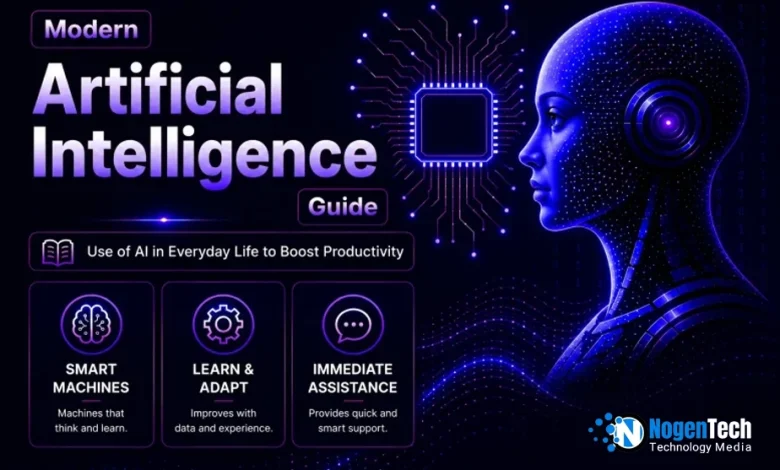
When I started exploring technology more than 15 years ago, Artificial Intelligence was not more than a science fiction concept seen only in movies about intelligent robots and futuristic machines.
But today, AI tools are part of everyday life, from search engines and voice assistants to recommendation systems and content creation tools.
Despite how common AI has become, many people still struggle to explain what it actually is, how it works, why it makes mistakes, and what separates it from traditional software.
Now moving next, I will walk you through everything clearly, covering Machine Learning, Generative AI, neural networks, AI agents, real-world applications, risks, limitations, and where Artificial Intelligence is heading in 2026.
What Is Artificial Intelligence (AI) in Simple Terms?
Artificial Intelligence (AI) is the ability of machines to perform tasks that normally require human intelligence, such as
- Understanding language
- Recognizing patterns
- Making predictions
- Writing text
- Translating languages
- Learning from new information over time
This is primarily different from traditional software that follows fixed instructions; AI systems learn from data and improve through experience.
For example, a calculator always follows the same formula, but an AI spam filter learns by analyzing thousands of emails labeled “spam” or “not spam” and gradually becomes more accurate.
AI is also an umbrella term covering several related technologies.
- Artificial Intelligence is the broad concept of machines behaving intelligently.
- Machine Learning (ML) is a branch of AI where systems learn from data
- Deep Learning is a type of Machine Learning that processes complex data like images, audio, and language.
Think of it as layers; AI is the broad field, Machine Learning is a subset of AI, and Deep Learning is a subset of Machine Learning.
Helpful AI Guides on NogenTech
Before getting started with this detailed guide, I’ve also published several AI guides on NogenTech covering ChatGPT tools, Google AI, automation, content creation, and AI-powered platforms that go beyond what this guide covers. Here are the ones worth checking out:
ChatGPT & AI Assistants
- Best ChatGPT Extensions: Extensions to improve your AI workflow
- AIPRM Alternatives: Prompt tools for better ChatGPT responses
- ChatGPT Alternatives: AI chatbots with unique features
- Perplexity AI vs ChatGPT: Comparison of two popular AI assistants
- ChatGPT vs Gemini: OpenAI and Google AI comparison
- Bing Chat Review: Features and performance overview
- Beta Character AI: AI chatbot platform for conversations
Google AI & Gemini
- Gemini in Google Assistant: Features and benefits explained
- Google AI Mode Guide: Overview of Google’s AI search experience
- Google Gemini 3 Flash: Features and capabilities overview
- How to Turn Off Google AI: Disable AI-powered Google features
- Google SynthID Text: AI watermarking technology explained
AI Tools & Content Creation
- Namelix: AI business name generator
- AI Answer Generator: Tools for instant AI answers
- AI Quiz Generators: Create quizzes automatically with AI
- Copy AI vs Jasper AI: AI writing tools comparison
- AI-Powered Typography: AI in modern typography design
AI Marketing & Creativity
- AI Image Generation in Marketing: AI visuals for digital campaigns
- AI for Social Media Presence: Improve engagement with AI tools
- How AI is Changing Art: AI’s Impact on Creative Industries
- AI Essay Review Tools vs Human Editors: AI Editing vs. Manual Editing
AI Industry & Automation
- Future of AI: The future of artificial intelligence
- Top AI Development Agencies in Spain: Leading AI Companies
- AI Agent Platforms: AI automation tools for businesses
- What is Project Ava: AI project overview
- Multilingual Video Creation with Seedance: How to generate AI videos across multiple languages
What is the History of Artificial Intelligence?
AI began as a philosophical idea long before computers:
- 1950: Turing introduced the concept of machine intelligence
- 1956: AI officially became a research field
- 1970s–1980s: Two AI Winters slowed progress
- 2000s: Machine Learning revived AI using big data + computing power
- 2012: Deep Learning breakthrough changed everything
- 2020s–2026: Generative AI and large language models transformed industries
The Idea Is Older Than Computers
The concept of intelligent machines existed long before modern computing:
- Ancient myths across cultures described mechanical beings with human-like intelligence.
- The formal foundation of AI began in 1950 when British mathematician Alan Turing asked a key question: “Can machines think?”
- He introduced the Turing Test, which evaluates whether a machine can mimic human responses so well that a human cannot reliably distinguish it from another person in conversation.
This idea became the foundation of AI research for decades.
The Birth of Artificial Intelligence (1956)
- The term “Artificial Intelligence” was officially introduced at the Dartmouth Conference (1956) by John McCarthy.
- Researchers aimed to build machines that could simulate human intelligence.
- Early optimism was extremely high, with predictions that machines would soon match human intelligence.
However, these expectations were far ahead of the actual technology at the time.
How Did Early AI Wins Turn Into the AI Winter (1960s–1980s)?
In the early days of AI, between the 1960s and 1980s, AI progressed quickly in controlled environments but failed in real-world complexity. This mismatch between expectation and reality led to two major funding crashes and slowed AI research for years, known as AI Winters.
Early AI Successes (1960s)
During the 1960s, AI systems delivered strong early results:
- Solved algebra problems
- Proved geometric theorems
- Played checkers at near-human performance
At this stage, optimism grew quickly, and investment in AI increased. However, limitations soon became clear.
Why Did Early AI Start to Fail?
Despite early success in structured environments, AI struggled in real-world scenarios:
- Real-world data was too complex and unstructured
- Natural language understanding was far more difficult than expected
- Common-sense reasoning could not be captured with simple logic rules
- Rule-based systems lacked adaptability
The gap between “playing checkers” and “understanding conversation” exposed a major limitation: AI lacked true general intelligence.
When was the First AI Winter?
The first AI Winter took place in the 1970s, when expectations collapsed and:
- Funding for AI research dropped sharply
- Government and industry interest declined
- Progress in the field slowed significantly
This period became known as the First AI Winter, driven by the failure of early systems to scale beyond controlled environments.
What were Expert Systems?
Expert systems were early Artificial Intelligence programs designed to simulate human decision-making using manually written rules.
Its key characteristics were:
- AI programs built using manually written rules
- Designed to replicate human expert decision-making
- Worked in narrow, specific domains
Why Did Expert Systems Fail?
Despite early promise, expert systems had major limitations:
- Too rigid to adapt to new or unexpected situations
- Expensive and time-consuming to develop and maintain
- Unable to generalize beyond their predefined rule sets
As a result, AI experienced another decline in the late 1980s, known as the Second AI Winter.
When Was the Second AI Winter?
AI saw a temporary revival through expert systems, but it did not last, and a second AI winter took place in the 1980s.
The major reason behind it was:
- Funding for AI research declined again
- Industry confidence in AI has reduced significantly
- Many AI projects failed to deliver scalable results
This was mainly caused by the limitations of rigid and expensive expert systems, which were unable to adapt beyond predefined rules.
How has Machine Learning revolutionized AI?
The machine learning revolution evolved AI in the 2000s by replacing rigid, hand-coded rules with direct, data-driven learning and pattern recognition, powered by exploding data and computing advances.
1. Explosion of Data
- Internet growth created massive datasets
- Social media, search engines, and digital systems generated a constant data flow
2. Massive Computing Power
- Advances in hardware (especially GPUs)
- Moore’s Law enabled faster, cheaper computation
After that, instead of manually writing rules, systems began to learn directly from data, identify patterns automatically, and AI can improve your critical thinking and performance over time
When did the Deep Learning Revolution Begin in AI?
The deep learning revolution began in 2012 when the AlexNet model shattered image recognition benchmarks, shifting AI from hand-coded rules to deep neural networks that surpassed human performance and paved the way for modern Generative AI.
During the ImageNet competition, AlexNet delivered a dramatic improvement in image recognition accuracy, which:
- Proved deep neural networks could outperform traditional AI methods
- Showed that large datasets + powerful GPUs could dramatically improve AI performance
- Accelerated global investment and research in deep learning
After that, deep learning systems soon achieved human-level or better performance in:
- Face recognition
- Speech recognition
- Playing complex games like Go
- Protein structure prediction
- Realistic image generation
By the 2020s, transformer-based large language models (LLMs) such as GPT, Claude, and Gemini pushed AI even further.
These models enabled AI systems to:
- Hold natural conversations
- Write and debug code
- Summarize long documents
- Translate languages
- Perform complex reasoning tasks
By 2025, AI had become deeply integrated into:
- Everyday productivity tools
- Business automation systems
- Search engines and AI assistants
- Creative and content workflows
And today, both you and I live in the era of Generative AI, where AI systems can create text, images, code, audio, and realistic video instead of only analyzing information.
What Are the Main Types of AI and How Do They Differ?
AI is classified into two main types based on its capability and underlying architecture:
- Capability: It includes existing Narrow AI and hypothetical General and Super AI.
- Architecture: It spans Reactive Machines, modern Limited Memory systems, and future Theory of Mind and Self-Aware AI.
Categories of AI Based on Capability
Artificial Intelligence is commonly divided into three categories based on how advanced its capabilities are and what tasks it can perform.
Narrow AI (Weak AI)
Narrow AI, also called Weak AI, is designed to perform one specific task extremely well.
It can often outperform humans within its assigned task, but it cannot transfer that intelligence to unrelated activities. Here are some of the most common examples of it:
- Netflix and YouTube recommendation algorithms
- Credit card fraud detection systems
- Voice assistants and speech transcription tools
- AI chatbots and image recognition systems
Every AI system currently used in the real world is a form of Narrow AI; even Generative AI falls into it. Although highly capable in specialized areas, Narrow AI cannot think, reason, or operate outside its training domain.
General AI (AGI)
General AI, also called Strong AI or Artificial General Intelligence (AGI), is a theoretical form of AI that can perform any intellectual task a human can do. AGI would be able to:
- Learn across multiple domains
- Transfer knowledge between tasks
- Adapt to unfamiliar situations
- Reason more like humans
Now I will give you some of the real-world examples:
- A human who learns chess can apply strategic thinking to business decisions
- A human who learns to write can also write code comments or research summaries
AGI would be capable of similar cross-domain intelligence. At present, AGI does not exist, and researchers continue debating how close modern AI is to achieving it.
Super AI (Artificial Superintelligence)
Super AI refers to a hypothetical future AI system that surpasses human intelligence in every domain. This includes:
- Scientific reasoning
- Creativity
- Problem-solving
- Decision-making
- Emotional and strategic intelligence
I mentioned earlier that AGI would match human intelligence, but when we talk about Super AI, it would significantly exceed it.
Why does Super AI matter?
- Raises major questions about AI safety and control
- Creates concerns around alignment with human goals
- Could fundamentally reshape society and human civilization
Super AI remains entirely theoretical, but organizations like OpenAI, Anthropic, and DeepMind actively research long-term AI safety because of its potential future impact.
Categories of AI Based on Architecture
Another classic framework divides AI systems into four types based on their relationship with memory and understanding:
Reactive Machines
Reactive Machines are the most basic type of AI. They:
- Respond only to current inputs
- Have no memory of past events
- Cannot learn or improve over time
A classic example is IBM’s Deep Blue, the chess computer that defeated world champion Garry Kasparov in 1997. It is able to:
- Could analyze millions of chess positions per second
- Made decisions based only on the current board state
- Had no memory of previous matches
- Could not apply its chess knowledge to any other task
Reactive Machines are powerful for specific rule-based tasks but lack learning capability.
Limited Memory AI
Limited Memory AI can learn from historical data and improve its performance over time.
This is the category where almost all modern AI systems exist today. Here are some of the most common examples of Limited Memory AI:
- Self-driving cars use driving data to improve decisions
- Recommendation systems learn from viewing history
- AI assistants trained on large datasets
- Fraud detection systems are improving based on transaction patterns
These systems are not like reactive machines, as they can use past information to make better future decisions. Most modern Machine Learning and Deep Learning systems are forms of Limited Memory AI.
Theory of Mind AI
Theory of Mind AI is a theoretical type of AI designed to understand:
- Human emotions
- Beliefs and intentions
- Perspectives and social interactions
This capability is important because humans constantly interpret the thoughts and emotions of others during communication. If this comes into existence, Theory of Mind AI would enable:
- More human-like conversations
- Better emotional understanding
- Improved social interaction between humans and machines
Researchers are actively working toward this type of AI, but a fully functional Theory of Mind AI does not yet exist.
Self-Aware AI
Self-Aware AI is the most advanced and entirely hypothetical form of AI. It would possess:
- Consciousness
- Self-awareness
- Subjective experiences and emotions
It is not like current AI systems; Self-Aware AI would theoretically understand its own existence and internal state. The reason behind its staying theoretical is:
- Science still does not fully understand human consciousness
- No existing AI system has genuine awareness or emotions
- Raises major philosophical and ethical questions
Self-Aware AI currently exists only as a theoretical concept in AI research and science fiction discussions.
What Are the Core Subfields of Artificial Intelligence?
The core subfields of artificial intelligence (AI) include:
- Machine learning
- Deep learning
- Natural language processing (NLP)
- Computer vision
Machine Learning (ML)
Machine Learning trains systems using examples. This enables them to identify patterns and improve over time, instead of fixed rules. The need for such systems arose because traditional software follows explicit instructions, such as a spam filter might use rules like:
- “If an email contains ‘win money,’ mark it as spam.”
- “If the sender is unknown, block the email.”
The problem is that spam tactics constantly change. Machine Learning solves this differently:
- The system is trained on thousands or millions of labeled examples
- It analyzes patterns in words, formatting, behavior, and sender data
- It builds its own predictive model
- The model improves as more training data becomes available
This allows AI systems to adapt instead of relying on rigid rules.
What are Neural Networks and Deep Learning?
Neural Networks are layered mathematical systems inspired loosely by the human brain that process information through connected layers of computational units.
Deep Learning is a specialized branch of Machine Learning that uses these networks with many layers to automatically learn complex patterns directly from massive datasets.
Each layer processes information and passes it to the next layer. In deep neural networks:
- Early layers detect simple patterns
- Middle layers detect shapes and structures
- Later layers recognize complex concepts and meaning
For example, in image recognition:
- Early layers detect edges and colors
- Middle layers detect textures and shapes
- Final layers identify objects like faces or animals
Why is Deep Learning so Powerful?
Deep learning is so powerful because it automatically learns features from massive datasets instead of relying on manually written rules.
Its training works by:
- Feeding millions of examples into the network
- Adjusting internal parameters through optimization algorithms
- Improving accuracy over time
This enables AI systems to perform tasks such as:
- Image recognition
- Speech synthesis
- Machine translation
- Protein structure prediction
- Generative AI
- Large language models (LLMs)
What are the Limitations of Deep Learning?
The limitations of deep learning include:
- Requirements of massive datasets
- It needs enormous computing power
- Can fail on unfamiliar inputs
- Often lacks explainability
Even experts sometimes struggle to fully understand why deep neural networks make certain decisions.
What is the Concept of Natural Language Processing in AI?
In the simplest terms, Natural Language Processing (NLP) is another field of AI that helps enable machines to understand, generate, and work with human language. Human language is extremely difficult for AI because meaning depends on:
- Context
- Tone
- Intent
- Culture
- Ambiguity
- Shared knowledge
For decades, this was one of the hardest problems in AI.
What is the Transformer Architecture in NLP?
Transformers analyze relationships between words across entire sentences simultaneously instead of processing words one at a time.
This architecture was a major breakthrough that came in 2017andch dramatically improved AI language understanding. Modern AI assistants like OpenAI ChatGPT, Google Gemini, and Anthropic Claude rely heavily on NLP and transformer models.
What is AI Computer Vision?
Modern Computer Vision systems use Convolutional Neural Networks (CNNs), Vision Transformers, and Multimodal AI models, enabling AI systems to interpret and understand images and videos, which is called Computer vision.
It gives machines the ability to “see” visual information.
What can Computer Vision do?
Modern computer vision systems can:
- Recognize faces
- Detect objects
- Analyze medical scans
- Understand video footage
- Generate images from text
- Track movement in real time
Real-world Applications of Computer Vision
Computer vision powers technologies such as:
- Facial recognition
- Self-driving cars
- Medical imaging AI
- Factory quality-control systems
- Security surveillance
- Visual search tools
What is Multimodal AI?
Multimodal AI combines language, images, audio, and video into one system. This allows AI to:
- Analyze photos and answer questions about them
- Generate images from text prompts
- Understand both visual and written information together
Multimodal AI is one of the fastest-growing areas of Artificial Intelligence in 2026.
How Does AI Actually Work? The Process from Data to Decision
Artificial Intelligence works by training machines on large amounts of data so they can recognize patterns, make predictions, improve over time, and make decisions without relying only on fixed human-written rules.
Modern AI systems follow a multi-step process that transforms raw data into intelligent outputs.
Step 1: Collecting Data
Every AI system begins with data. The quality, quantity, and diversity of that data largely determine how accurate and reliable the final AI model will be. AI systems learn patterns by training on large volumes of examples available to them.
Different AI applications require different types of data:
- Image recognition needs millions of labeled images
- Large language models need massive text datasets
- Medical AI needs verified clinical records
- Fraud detection systems need transaction histories
In many AI projects, collecting high-quality data is the most difficult and expensive step.
Step 2: Cleaning and Preparing the Data
Raw data is usually incomplete, inconsistent, or fluff. Before training begins, the data must be cleaned and standardized, and this is where data processing comes in.
What is Data Processing in AI?
Data preprocessing involves:
- Removing duplicate records
- Fixing formatting issues
- Handling missing values
- Correcting mislabeled examples
- Normalizing data formats
- Balancing datasets
Poor-quality data produces unreliable AI models. Experienced AI engineers often spend 60-80% of their time preparing data rather than building algorithms.
The major reason behind it is that bad data can cause AI systems to:
- Learn incorrect patterns
- Produce biased results
- Generate inaccurate predictions
- Fail in real-world environments
Clean training data improves model accuracy and reliability.
Step 3: Choosing the Right Architecture
Different AI problems require different model architectures. There is no single model that works best for every task. Here are some of the most common architectures that specialize in different types of data:
- Convolutional Neural Networks (CNNs) work best for images
- Transformers excel at language and sequential data
- Graph Neural Networks handle connected data structures
- Recurrent Neural Networks (RNNs) process time-based sequences
Choosing the wrong architecture is one of the most common reasons AI projects fail. The model structure must match the problem being solved.
Step 4: Training
Training is the process by which AI systems learn patterns from data. During training:
- The model receives input data
- It makes predictions
- The predictions are compared to the correct answers
- The error is measured
- Internal parameters are adjusted to reduce future errors
This process repeats millions or billions of times.
How Do AI Models Improve Over Time?
AI models improve through optimization algorithms such as:
- Gradient descent
- Backpropagation
- Reinforcement feedback loops
Over time, the model becomes better at identifying accurate patterns and making reliable predictions. LLMs are refined through a process called Reinforcement Learning from Human Feedback (RLHF).
Why is AI Training so Expensive?
Modern AI training is expensive enough because it requires enormous computing power. Large AI systems use:
- GPUs (Graphics Processing Units)
- TPUs (Tensor Processing Units)
- Massive cloud computing clusters
Training advanced large language models can cost millions of dollars and take weeks or months to complete.
Step 5: Evaluation
After training, the AI model is tested on data it has never seen before. This determines whether the system can generalize beyond its training examples.
What is Overfitting in AI?
Overfitting happens when a model memorizes training data instead of learning real patterns. An overfitted AI system may:
- Perform well during training
- Fail on real-world data
- Make unreliable predictions
AI systems are measured using metrics such as:
- Accuracy
- Precision
- Recall
- F1 score
This evaluation also helps you identify hidden weaknesses and biased behavior. And this is why reliable AI systems require extensive real-world testing before deployment.
Step 6: Deployment and Monitoring
Once an AI model performs well, it is deployed into real-world applications. It includes:
- AI chatbots for technical support
- Fraud detection systems
- Recommendation engines
- Medical diagnosis tools
- Self-driving systems
But deployment is not the end of the process. After that, you need to continually monitor how the system performs, identify issues, and make improvements over time. It is because real-world conditions constantly change, such as:
- User behavior evolves
- New fraud patterns appear
- Language changes
- Data distributions shift
This is known as model drift. AI systems must be:
- Continuously monitored
- Retrained with updated data
- Optimized for new conditions
- Regularly evaluated for bias and accuracy
Without ongoing updates, even highly accurate AI systems eventually become outdated.
How Retrieval-Augmented Generation is the Architecture Behind Modern AI Search
As NLP and Machine Learning are cores of AI, similarly, Retrieval-Augmented Generation (RAG) is another framework of AI that combines large language models with real-time information retrieval.
Traditional AI models are trained on data available only up to a certain point. After training, their knowledge becomes fixed, which means they may provide outdated or incorrect information about recent events or new topics.
RAG solves this problem by retrieving relevant information from external sources before generating an answer.
Why is RAG important?
RAG helps AI systems:
- Access current information
- Reduce hallucinations
- Generate more accurate responses
- Cite reliable sources
- Use external knowledge bases
Modern AI tools like Perplexity AI and Google AI Overviews use retrieval-based systems to provide grounded answers.
What is the Influence of AI Across Industries?
Artificial Intelligence is now used across major industries to automate tasks, improve decision-making, increase efficiency, and reduce operational costs. It is no longer limited to research labs or tech companies.
Healthcare
AI is improving healthcare through:
- Medical image analysis
- Disease prediction
- Drug discovery
- Personalized treatment recommendations
Deep learning systems can analyze X-rays, MRIs, and CT scans with high diagnostic accuracy, helping doctors detect diseases earlier and improve patient care. Now, multimodal AI medical assistants can read clinical notes and images simultaneously
Food Production and Agriculture
AI is transforming agriculture through precision farming and automation. Modern AI systems help with:
- Crop monitoring
- Soil analysis
- Irrigation optimization
- Supply chain forecasting
- Produce quality inspection
AI-powered sensors, drones, and computer vision systems help reduce waste while improving agricultural productivity and sustainability.
Engineering and Scientific Research
AI is accelerating engineering and scientific innovation.
It is widely used for:
- Generative design
- Product optimization
- Simulation modeling
- Scientific data analysis
- Protein structure prediction
AI systems like Google DeepMind’s AlphaFold significantly advanced biological research by solving complex protein-folding challenges.
Customer Support and Business Operations
AI has become a major part of customer service and business automation.
Businesses use AI for:
- AI chatbots
- Customer support automation
- Predictive analytics
- Workflow optimization
- Churn prediction
- Data-driven decision-making
Modern AI assistants can handle routine customer inquiries while allowing human agents to focus on more complex interactions.
Creative Industries
AI is rapidly changing creative workflows across content, design, and media production. AI tools now support:
- Content writing
- Image generation
- Video editing
- Music generation
- Marketing content creation
These tools increase production speed and accessibility, while also raising ongoing discussions around copyright, originality, and creative ownership.
Finance and Fraud Detection
Financial institutions use AI to analyze large amounts of real-time data and detect unusual behavior. AI applications in finance include:
- Fraud detection
- Credit scoring
- Risk assessment
- Algorithmic trading
- Compliance monitoring
- AI banking assistants
Machine learning systems help identify suspicious financial activity within milliseconds by analyzing patterns and behavioral signals.
Energy and Utilities
AI is optimizing the energy sector through smart grid management and sustainability forecasting. Its key applications include:
- Smart grid management
- Renewable energy forecasting
- Predictive maintenance
- Carbon emission tracking
- Energy consumption optimization
Machine learning algorithms analyze weather data and usage patterns in real time to predict solar and wind outputs, balancing the electrical grid and reducing reliance on fossil fuels.
How AI Agents Are Exactly the Next Major Shift
AI agents are one of the biggest shifts in modern Artificial Intelligence. They can plan, decide, and take actions autonomously to complete multi-step tasks on your behalf.
How Do AI Agents Work?
An AI agent is typically given:
- A goal, such as researching competitors or automating AI-driven customer support
- Access to tools: like web browsing, code execution, APIs, email, or software apps
- Decision-making ability: to determine the best steps needed to complete the task
Instead of waiting for human instructions after every step, the agent can act independently until the task is finished.
How are AI Agents Different from Chatbots?
Traditional AI chatbots mainly answer questions or generate responses. AI agents can go further by:
- Searching the web for information
- Using software and digital tools
- Completing multi-step workflows
- Generating reports or summaries automatically
- Coordinating with other AI systems
For example, instead of simply answering “Who are our competitors?”, an AI agent can research competitors, compare products, analyze pricing, and deliver a complete report.
What are the Benefits of AI Agents?
AI agents can help small businesses:
- Automate repetitive workflows
- Reduce manual effort
- Work continuously without fatigue
- Handle multiple tasks simultaneously
- Improve operational efficiency
This makes them valuable for customer support, research, operations, marketing, and software development.
What are the Risks of AI Agents?
Because AI agents can take real-world actions, they also introduce important risks:
- They may misunderstand goals
- They can make unintended decisions
- Incorrect actions may cause business or security issues
- Poorly defined instructions can lead to harmful outcomes
To use AI agents safely, organizations need:
- Clear task instructions
- Strong safety guardrails
- Human oversight and approval systems
AI agents represent the next step beyond chat-based AI, moving from systems that generate answers to systems that can perform tasks on your behalf.
What Are the Key Concerns in AI Safety and Ethics?
Modern Artificial Intelligence offers enormous benefits, but it also creates serious ethical, social, and security concerns. As AI systems become more powerful and widely used, these challenges are becoming increasingly important.
Bias and Fairness in AI
AI systems learn from historical data, and that data can contain human bias and discrimination. Here are some of the common examples of it:
- Hiring algorithms may favor certain groups unfairly
- Loan approval systems can reflect past discriminatory practices
- Facial recognition systems may perform unevenly across demographics
Because AI learns patterns from existing data, it can unintentionally scale unfair decisions across millions of users.
Reducing AI bias requires:
- Better training data quality
- Fairness testing and audits
- Diverse development teams
- Ethical AI governance practices
The Transparency Problem
Many modern AI models operate like a “black box.” This means:
- Developers may not fully understand how decisions are made
- Users cannot easily verify AI reasoning
- Incorrect decisions become harder to challenge
This becomes especially risky in areas like:
- Healthcare
- Banking and loans
- Insurance
- Hiring
- Criminal justice
To address this, researchers are developing Explainable AI (XAI) systems that make AI decisions easier to understand.
Data Privacy and AI
AI systems require massive amounts of data to train effectively, including personal and sensitive information. Major privacy concerns include:
- Unauthorized data collection
- AI models reproducing personal information
- Large-scale surveillance risks
- Data breaches involving training datasets
Privacy-focused approaches such as federated learning and differential privacy aim to reduce these risks while maintaining AI performance.
Security Risks of Generative AI
Generative AI has introduced new cybersecurity and misinformation threats. Some of its key concerns include:
- AI-generated fake images, videos, and voices
- Deepfake misinformation campaigns
- AI-assisted phishing and cyberattacks
- Adversarial attacks that manipulate AI systems
As Generative AI improves, verifying online content and securing AI systems are becoming more difficult.
AI and Mental Health
AI is increasingly being used in mental health support tools, therapy chatbots, and emotional companion apps. Its potential benefits include:
- Faster access to support
- Personalized mental health assistance
- Early detection of behavioral changes
Because of this, AI systems related to mental health require careful ethical design and human oversight.
As AI adoption grows, safety, transparency, fairness, and responsible development are becoming just as important as technological advancement itself.
What are the Top AI Tools Worth Using in 2026?
The AI tools ecosystem has expanded rapidly, with different platforms specializing in research, writing, video creation, automation, coding, and productivity.
Conversational AI Assistants
The most widely used AI assistants in 2026 are:
Each platform has different strengths:
- ChatGPT: Strong ecosystem, plugins, coding, productivity, and business integrations
- Claude: Excellent for long-form writing, reasoning, and large document analysis
- Gemini: Deep integration with Gmail, Docs, Drive, and AI search with Google Search.
The best choice often depends on your workflow and use case.
AI Research and Search Tools
Research-focused AI tools combine language models with live web retrieval to improve factual accuracy. One of the most recognized examples is:
- Perplexity AI is known for web-connected AI search, source citations, and even brand mentions
These tools are especially useful for:
- Research tasks
- Current events
- Fact verification
- Source-backed answers
AI Writing Tools
AI writing platforms are now widely used for:
- Blog writing
- Marketing copy
- Essay Writing
- Social media content
- Summarization and rewriting
- SEO content workflows
Popular tools include:
These tools work best when combined with human editing, strategy, and subject expertise.
AI Video Generation Tools
AI video platforms have made video production faster and more accessible. Modern tools can generate:
- Faceless videos
- AI avatars
- Automated voiceovers
- Marketing videos
- Educational content
- Short-form social media videos
Advanced platforms like Kuaishou’s Kling AI, Fotor, and JoggAI have significantly improved AI-generated cinematic video quality.
AI Voice Generation Tools
AI voice synthesis tools such as Uberduck and TTSMaker can now produce highly realistic human-like speech. Common use cases include:
- Podcasts
- Audiobooks
- YouTube narration
- Training content
- Accessibility features
As adoption grows, transparency around AI-generated voices is becoming increasingly important for ethical and legal reasons.
AI Image Generation Tools
AI image generators are now widely used in design, marketing, and content creation. Its typical use cases include:
- Social media graphics
- Product mockups
- Concept art
- Advertising visuals
- Blog illustrations
- Automated Artwork
Popular image generation models include:
- DALL·E
- Midjourney
- Stable Diffusion
These tools have dramatically reduced the time and cost required to create custom visuals at scale.
How is AI Enhancing the Marketing Workflows in Today's Industry?
Artificial Intelligence is transforming modern marketing trends by helping businesses automate workflows, personalize customer experiences, analyze audience behavior, and create content at scale.
- Personalization: AI uses customer data to personalize recommendations, emails, ads, and website experiences.
- Content Creation: Generative AI quickly creates blogs, product descriptions, emails, ads, and social content.
- Faster Workflows: AI reduces content production time and helps marketing teams scale their output.
- Keyword Research: AI identifies search intent, topic clusters, content gaps, competitors, and emerging trends.
- AI Search: AI is changing SEO as search engines increasingly rely on AI-powered results and summaries.
- Social Media: AI helps with scheduling, audience analysis, engagement, trends, and performance forecasting.
- Content Discovery: AI recommendation systems personalize feeds and influence which content users see.
- Data-Driven Marketing: AI is shifting marketing from broad targeting toward more personalized customer experiences.
What is the Future of AI? What's Actually Coming
Artificial Intelligence is evolving rapidly, and its future will likely extend far beyond chatbots and content generation. Researchers and businesses are now focusing on AI systems that can improve education, accelerate science, optimize industries, and enhance human capabilities.
- Personalized Education: AI can adapt lessons, identify learning gaps, and provide personalized tutoring.
- Scientific Research: AI can analyze massive datasets, predict molecular structures, and accelerate drug discovery.
- Environmental Solutions: AI can optimize energy grids, improve climate predictions, reduce waste, and support clean-energy development.
- Human Augmentation: AI-powered prosthetics, brain-computer interfaces, and assistive tools can enhance human capabilities. Smarter AI Reasoning: Reasoning models can break complex problems into steps, evaluate alternatives, and improve their answers.
- Better Problem Solving: Advanced reasoning is improving AI performance in mathematics, coding, research, and logical tasks.
- More Capable AI: As reasoning models improve, AI is becoming more useful for complex real-world applications.
- Beyond Chatbots: The future of AI is expanding into education, science, industry, sustainability, and human assistance.
Still having Some More Questions After all this? Chill, here are the Answers
Is AI safe?
AI is generally safe when properly designed and controlled. Risks like bias, hallucinations, and misuse exist, but they depend on how the system is built and used.
Where am I already using AI?
You already use AI in maps, email spam filters, social media feeds, streaming recommendations, online shopping, banking fraud detection, and voice assistants.
Can AI think and feel?
No. Current AI does not think or feel. It processes patterns and generates outputs but has no consciousness, emotions, or real understanding.
What skills do I need to work in AI?
Core skills include Python, machine learning basics, statistics, and cloud platforms. Domain expertise and practical project experience are also very important.
Will AI replace my job?
AI is more likely to replace tasks than entire jobs. Routine, repetitive work is most affected, while roles requiring judgment, creativity, and human interaction are more resistant.
What is an AI hallucination?
It’s when AI produces incorrect or made-up information that sounds believable. It happens because the model predicts text patterns rather than verifying facts.
How do I use AI tools effectively?
Be specific and clear with prompts. Better input leads to better output. Provide context, goals, and examples to get more accurate and useful results.
Final Thoughts on Artificial Intelligence
Artificial Intelligence has moved from theory to a core driver of modern life, reshaping industries, work, and creativity through technologies like Machine Learning, Deep Learning, Natural Language Processing, Computer Vision, AI Agents, and Generative AI.
The detailed guide I gave you above is intended to give a clear, structured understanding of how AI works, its history, risks, and future direction in 2026. From my perspective, AI is not a replacement for human intelligence but a powerful amplification of it.
Its real value depends on how responsibly and skillfully it is applied. The future will belong to those who understand and use AI with awareness and intent.