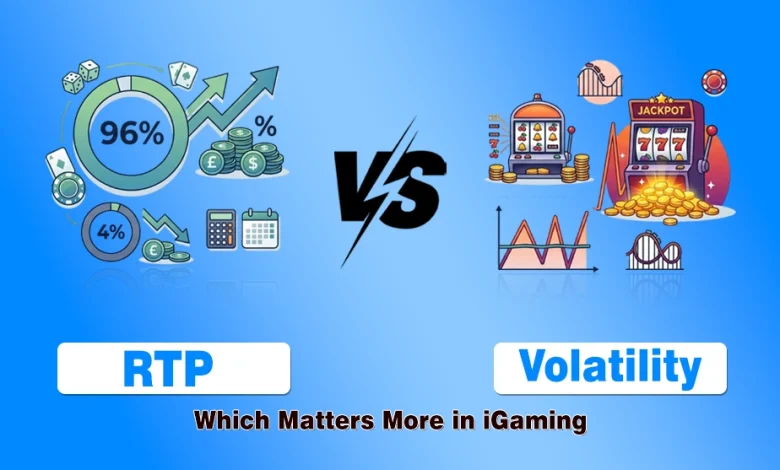
- RTP (Return to Player) shows the average payout percentage over millions of spins—not per session.
- Volatility reveals how often wins occur and how big they tend to be.
- Low volatility slots = frequent small wins, steady entertainment.
- High volatility slots = rare but larger payouts, riskier swings.
- Together, RTP + volatility define a slot’s personality and help players match games to their budget and goals.
When you fire up an online slot, it’s easy to get caught up in the flashing reels, bonus rounds, and themes. But behind the fun lies the math that shapes your experience: RTP (Return to Player) and volatility. Think of RTP as the long‑term fairness score, while volatility tells you how wild or steady the ride will feel.
Understanding both isn’t just for seasoned players, it’s the difference between knowing why your balance swings and choosing games that match your style.
In this blog post, I will explain which metric matters most in iGaming (slots): RTP or Volatility.
What Is RTP?
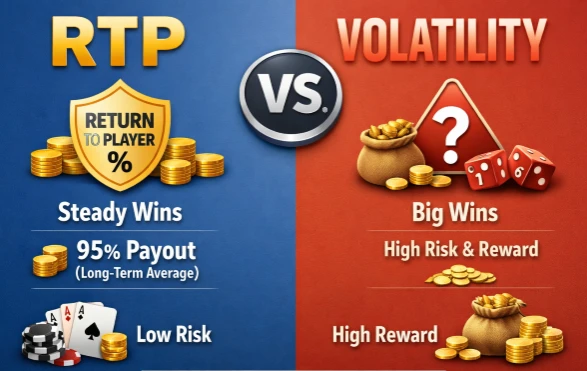
RTP stands for return to player. It’s a percentage that expresses how much will be paid back to players on average by the machine. Some players make the mistake of believing that this is exactly how much they will win on a few spins, but this is the wrong way of looking at it.
When a developer creates a new slot, the RTP is tested over a vast number of spins, usually running into millions. What this tells us is that the stated percentage only applies over a period of time and lots of spins. It’s the law of large numbers in action, letting us see that the more spins are made, the closer it gets to its theoretical value.
What does this mean for the average player?
It means that they shouldn’t rely on the RTP to understand how much they might win on an average playing session. Let’s say that a game has a 95% RTP. This slot has been tested to prove that it theoretically pays out 95% of the money gambled over millions of spins.
However, a single player who bets $10 shouldn’t expect to get exactly $9.50 back. They might win a lot more, or they could get back less.
What Is Volatility?
This is a measure of understanding how often a slot pays and how big the wins usually are. If we look at low volatility slots, these games typically pay small amounts regularly. You might not get huge wins, but you’ll probably get modest wins with fewer non-winning streaks getting in the way.
The slots shown here with high volatility let us see exactly how this works. These slots, like Caesar’s Empire, Fairy Wins, and Dragon’s Siege, all have different features and RTPs. Simply looking at their RTPs doesn’t give us that much information about how they generally play – and you can’t test every game out first-hand; you’d be trialing games for weeks.
- Low volatility: Frequent, smaller wins. Ideal for players who prefer steady entertainment and fewer losing streaks.
- High volatility: Larger prizes but longer dry spells. Perfect for risk‑takers chasing jackpots.
How to check volatility:
- Look at the paytable—big prizes usually signal higher volatility.
- Some developers list volatility levels directly.
For example, popular slots may share similar RTPs, but their volatility levels drastically change the player experience.
How Do These Parts of the Game Interact?
As we’ve seen, these are two different ways of understanding the game. How they combine is what gives each slot its unique flavor and will determine what it feels like to play it.
Let’s say that you play a 96% RTP slot, which is near the top end of this scale. If it has a low volatility, it will probably feel like the kind of game where you keep grinding out small wins to keep your budget relatively steady over time.
On the other hand, a slot with 96% RTP but high volatility is probably going to see your balance swing up and down more. This is the type of game where you might lose your budget reasonably quickly or else get a big win.
It’s always important to pair your playing preferences with your budget and to think carefully about your limits before you start playing, of course – no matter what kind of slot you pick.
- High RTP + Low Volatility: A steady grind of small wins, keeping your bankroll balanced.
- High RTP + High Volatility: Bigger swings—your balance may drop quickly, or you might hit a huge payout.
RTP tells you the long‑term fairness, while volatility tells you the short‑term feel.
How Each Type of Player Needs to Decide?
Everyone planning to play slots can use these details to decide how to play. If you’re hoping to stretch your budget over a long time and are more concerned about being entertained than winning, a lower volatility slot with a high RTP is probably ideal.
If you’re looking to quickly blast through some spins and dream of grabbing a jackpot, you might go for a higher volatility game. In this case, RTP probably isn’t as important, as you’re likely to play fewer spins either way.
Given the random nature of slots, you might simply decide to choose a theme that grabs your attention. However, once you understand RTP and volatility, you’ll have an extra way of working out which games are more suitable for your style.
Smart Play Starts with Knowing the Metrics
RTP and volatility aren’t competing metrics—they’re complementary. RTP shows the game’s fairness over time, while volatility reveals its personality in the short run. By understanding both, players can align their choices with their goals, whether that’s steady entertainment or chasing life‑changing wins.