

OpenAI Shuts Down Sora App, Triggering Disney One Billion Dollar Deal Collapse
The Wall Street Journal first reported that OpenAI is discontinuing its Sora AI video app and all associated video model efforts, simultaneously dissolving its landmark licensing and investment deal with Disney.

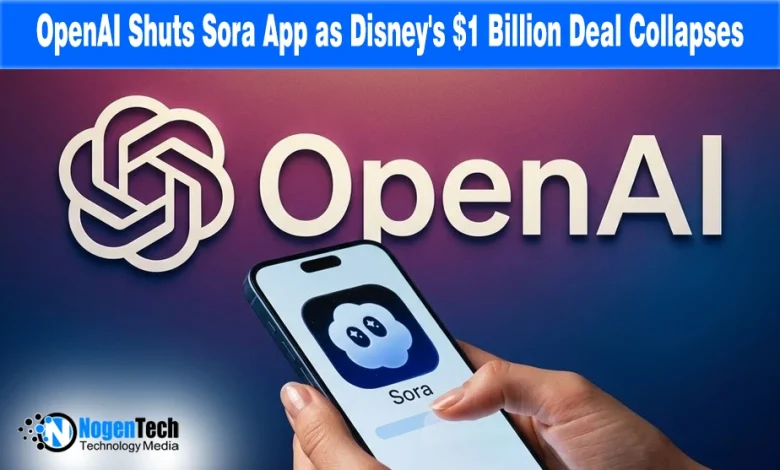
OpenAI announced on March 24, 2026, that it is shutting down Sora just six months after its September 2025 launch, as first reported by The Wall Street Journal.
The shutdown simultaneously collapses a high-profile partnership with The Walt Disney Company, under which Disney had agreed to license more than 200 of its characters and take a $1 billion stake in OpenAI.
As confirmed by the official Sora account on X, OpenAI stated: “We’re saying goodbye to the Sora app.” Reports suggest that OpenAI is discontinuing video generation entirely, refocusing compute and engineering elsewhere.
This abrupt product exit leaves Google DeepMind’s Veo 3 as the dominant AI video platform with no comparable competitor operating at scale today.
How OpenAI’s Sora App Declined
The Wall Street Journal reported that the Sora shutdown marks a broader shift, with OpenAI abandoning all video model products and developer APIs. Following this discontinuation, video functionality within ChatGPT will also no longer be supported as the company pivots resources.
TechCrunch reported that Sora surpassed 3.3 million downloads across the iOS App Store and Google Play, according to data from mobile intelligence firm Appfigures.
The app peaked in November with about 3,332,200 downloads across the iOS App Store and Google Play
By February 2026, that figure had declined to 1,128,700 downloads, as per the report. In its entire lifetime, Appfigures estimates Sora made approximately $2.1 million from in-app purchases, a figure that stands in stark contrast to ChatGPT’s 900 million weekly active users.
These reports suggest that despite topping iPhone App Store charts at launch, Sora failed to convert viral interest into sustained, monetizable engagement.
Why Sora’s Technical Ambition Hit Legal Walls
TechCrunch reported Sora functioned as an AI-first TikTok with a vertical video feed. Its flagship feature enabled users to scan faces for realistic deepfakes, originally titled “cameos” until the platform Cameo won a legal battle against OpenAI, forcing a rename to “characters.”
Mashable reported that Sora’s moderation failures led to offensive deepfakes of Martin Luther King Jr. and Robin Williams. Despite OpenAI’s policies, users bypassed guardrails to create “disrespectful” clips.
This sparked a public outcry from their daughters, Bernice King and Zelda Williams, respectively, who demanded an end to AI-generated content featuring their fathers.
Global copyright battles accelerated the project’s collapse. In November 2025, Japanese trade group CODA, representing Studio Ghibli, formally demanded that OpenAI stop training Sora 2 on their work. These legal pressures, combined with unsustainable daily compute costs, forced the platform’s rapid shutdown.
Disney and OpenAI’s $1 Billion Deal Dissolves
Bloomberg reported that the Disney deal collapsed before any cash changed hands. Disney had agreed to license over 200 characters, including Mickey Mouse, for a $1 billion stake in OpenAI. However, since the deal used stock warrants, no actual money was ever exchanged.
The original three-year agreement allowed Sora to generate user-prompted videos from over 200 characters. These reportedly included Disney, Marvel, Pixar, and Star Wars franchises, with Disney+ planning to stream a curated selection of these AI-generated videos.
With the Sora shutdown, OpenAI and Disney are winding down the partnership entirely. According to Reuters, a Disney spokesperson said in a statement, “OpenAI’s decision to exit the video generation business and to shift its priorities elsewhere.”
Who Does OpenAI’s Sora Exit Actually Affect
For content creators and independent filmmakers who had built workflows around Sora’s text-to-video capabilities, the shutdown leaves an immediate gap.
TechCrunch noted that Sora’s appearance at film festivals like Tribeca and its public adoption by actors made its closure a concrete disruption for the creative industry that had integrated it into professional pipelines.
Reuters identified Seedance 2.0 and Veo 3 as the new market leaders, with Veo 3 being the only major player pursuing Hollywood deals. CNET reported that OpenAI’s exit allows Google to dominate the creative AI space, especially in Asia and Europe, where ByteDance faces heavy regulatory scrutiny over its data handling.
What’s Next For OpenAI After Sora
The Wall Street Journal reported that OpenAI is redirecting Sora’s massive compute infrastructure toward coding and agentic AI development. This pivot aligns with the company’s urgent IPO preparations, signaling a major shift from creative media toward functional enterprise automation and financial stability.
OpenAI has not confirmed the exact date the Sora app and API will go offline. However, the official Sora X account stated that specific timelines and instructions for preserving user work will be shared in the near future.
Source: OpenAI Scraps Sora Video Platform Months After Launch



![Top Tech Stories of 5th week [2026]](https://www.nogentech.org/wp-content/uploads/2026/02/Top-Tech-Stories-of-5th-Week-2026-390x220.webp)