Google Introduces TurboQuant To Solve AI Memory Wall With Accuracy
Google Research published TurboQuant, a training-free compression algorithm that shrinks LLM memory requirements by six times and delivers an 8x speed boost on Nvidia H100 GPUs, with accuracy.


Google has just published TurboQuant, a new compression method that makes large language models use about six times less memory without reducing their accuracy.
According to the Google Research Blog, the paper was co-authored by research scientist Amir Zandieh and Vahab Mirrokni, a VP and Google Fellow, alongside collaborators at Google DeepMind, KAIST, and New York University. TurboQuant will be formally presented at ICLR 2026 in Rio de Janeiro next month.
Reports note that TurboQuant can speed up key AI processes like computing attention by up to 8 times on Nvidia H100 GPUs. Most importantly, it works without retraining or fine-tuning, meaning developers can add it directly to existing AI systems without extra setup.
How TurboQuant’s Two-Stage Architecture Works
According to the Google Research Blog, TurboQuant achieves its compression using two algorithms that work together. The first, PolarQuant, converts data from standard Cartesian coordinates into polar form, separating each vector into magnitude and angles.
Before this, it applies a random rotation to spread the data evenly across all dimensions. This makes patterns more predictable, removing the extra adjustment values that older methods need.
This makes the memory be compressed efficiently to 3 bits per value with high accuracy and no calibration required.
The second stage, Quantized Johnson-Lindenstrauss (QJL), reduces the small errors left by PolarQuant to a single sign bit per dimension.
Acting as a zero-bias estimator, QJL ensures that attention calculations, how the model decides which parts of a text are relevant, remain statistically identical to the original output.
As Tom’s Hardware notes, for a 32,000-token context, TurboQuant reduces the memory used to store key AI computations, known as the KV cache, from 12GB to 2GB, allowing models to handle the same text with far less memory.
The 4-bit version also accelerates attention calculations by up to 8x on H100 hardware compared to standard 32-bit systems.
Why TurboQuant Solves AI’s Memory Wall
According to Ars Technica, TurboQuant’s most important practical feature is that it does not require any training, which sets it apart from methods like Nvidia’s KVTC compression technique, which need a one-time calibration for each model.
Because TurboQuant is data-oblivious, it doesn’t rely on any specific dataset or examples to work. This means it can be added directly into any transformer-based model, like Claude, without extra setup or preprocessing.
This makes it useful for general-purpose AI tasks across different workloads where calibration would be difficult or impractical.
TechCrunch reported that the developer community immediately compared TurboQuant to Pied Piper, the fictional compression algorithm from the HBO series Silicon Valley. They drew parallels between the show’s idea of a mathematically elegant, lossless compression breakthrough and Google’s new peer-reviewed result.
The Google Research official X post, generated over 14 million views to date, reflecting how acutely the AI infrastructure community has been waiting for a solution to the memory bottleneck that has been limiting long-context inference at scale.
Developers and Community React to TurboQuant
VentureBeat reported that within 24 hours of Google’s publication, even without an official code release, independent developers had already created working versions of TurboQuant.
They implemented it in two popular local AI libraries: MLX, which runs on Apple Silicon, and llama.cpp, an open-source framework for running LLMs on consumer hardware.
Technical analyst Prince Canuma tested TurboQuant in MLX on the Qwen3.5-35B model and confirmed that it worked exactly as the paper claimed, with no loss in accuracy.
As Google noted, the company tested TurboQuant on five long-text benchmarks, LongBench, Needle in a Haystack, ZeroSCROLLS, RULER, and L-Eval, using open-source models like Gemma and Mistral.
TurboQuant handled all tasks perfectly, kept the 6x memory reduction, and matched or outperformed KIVI, the previous standard for managing memory in large AI models.
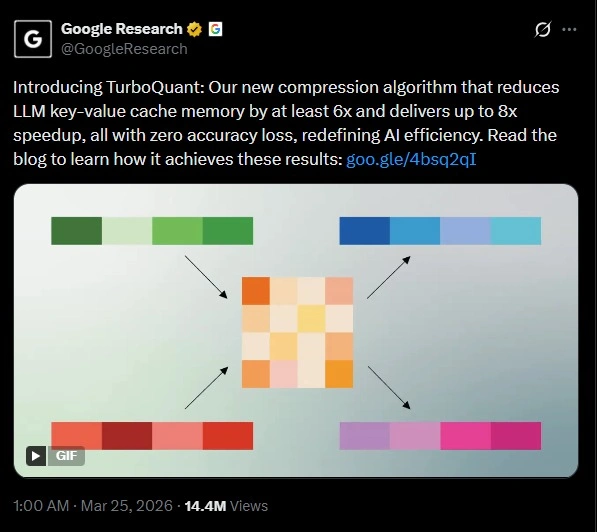
The Google Research announcement on X has generated over 14 million views, showing how urgently the AI community has been awaiting a solution to the memory bottleneck that limits long-context inference at scale.
TurboQuant Rattles Micron and Memory Stocks
Market analysis by Investing.com reported that memory stocks fell sharply in the hours following Google’s announcement, with Micron, Western Digital, and SanDisk each declining between 3% and 5%.
This reaction shows a simple market concern: if artificial intelligence companies can cut GPU memory needs by six times using just software, the demand for high-speed memory chips could grow more slowly than expected.
Wells Fargo analyst Andrew Rocha said that TurboQuant directly lowers the cost of AI memory infrastructure. He added that if many companies adopt it, it could raise questions about how much memory the industry really needs.
Rocha also cautioned that memory is just one part of data center costs, and that compression algorithms have existed before without fully slowing down the demand for hardware.
What’s Next For TurboQuant’s Deployment
Google has not released official code as of March 26, 2026, but as VentureBeat reported, community implementations are already in active development and validation. The formal paper presentations at ICLR 2026 in April and AISTATS 2026 in Tangier will provide the research community with full technical documentation.
Analysts said it is still unclear if TurboQuant’s claim of zero accuracy loss will hold for larger models. This includes models with over 70 billion parameters and advanced architectures with context windows longer than one million tokens.
Testing in real-world deployments will be needed to answer this question.