Elon Musk Unveils Terafab For Tesla, SpaceX And xAI Custom Chip Production
Musk's three-company venture aims to manufacture advanced semiconductors for AI, robotics, and space, but industry veterans are already questioning whether it can deliver on its promise.

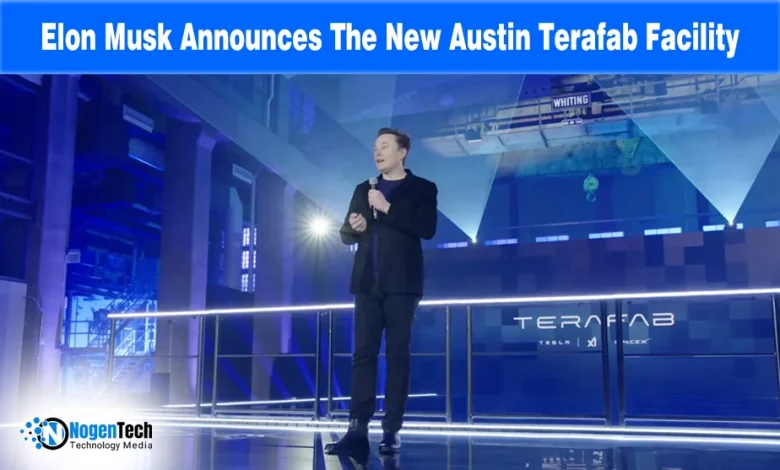
Elon Musk on Saturday night unveiled Terafab, a joint semiconductor manufacturing venture between Tesla, SpaceX, and xAI, at a dramatic live event inside the historic Seaholm Power Plant in downtown Austin, Texas.
The announcement, first reported by Bloomberg and confirmed across multiple media outlets, positions Terafab as what Musk himself called “the most epic chip-building exercise in history, by far.”
The $20 to $25 billion facility, to be built on Tesla’s Austin campus, targets 2-nanometer process technology and is designed to supply chips for Tesla’s autonomous vehicles, Optimus humanoid robots, and an ambitious network of space-based AI satellites operated by SpaceX and xAI.
Terafab: What Musk Announced at Seaholm
According to Reuters, Musk revealed Terafab as a formal joint venture between Tesla, SpaceX, and xAI, three companies Musk controls entirely, with xAI now operating as a wholly owned SpaceX subsidiary following their February merger. The facility will be constructed on Tesla’s existing campus in eastern Travis County, Austin.
According to TechCrunch, the fab will manufacture two distinct chip types: one optimized for edge computing and AI inference, destined for Tesla’s vehicles, robotaxis, and Optimus humanoid robots.
And a second high-power chip engineered specifically for space applications to serve SpaceX and xAI workloads. Musk said at the event that xAI is expected to consume the vast majority of Terafab’s total output.
The reports noted that the facility will house equipment for logic, memory, packaging, testing, and lithography mask production, all within a single building, an unusually vertically integrated approach for a first-generation fab.
Tesla is targeting 2-nanometer process technology, the most advanced semiconductor node currently entering commercial production globally, as per the report.
Why Musk Says Existing Suppliers Aren’t Enough
The clearest explanation for Terafab came from Musk himself. As reported by Fortune and Axios, Musk openly acknowledged his existing chip suppliers, naming Samsung, TSMC, and Micron, but said their expansion rate was simply too slow for what his companies require.
Even Micron’s $1.8 billion advancement at its Tongluo facility in Taiwan, while significant on paper, still falls short of the sheer capacity and speed Musk is targeting.
“There’s a maximum rate at which they’re comfortable expanding. That rate is much less than we would like… and we need the chips, so we’re going to build the Terafab,” Musk said at the Austin event, as quoted by Fortune.
Axios further reported that Musk set an extraordinarily ambitious production target: chips capable of supporting 100 to 200 gigawatts of computing power per year on Earth, alongside a full terawatt of compute deployed in space. It’s worth noting that this is a scale that has no precedent in commercial semiconductor manufacturing history.
Musk’s Space Compute Vision for xAI and SpaceX
Perhaps the most striking element of the Terafab announcement was its space dimension. Business Insider reported that Elon Musk intends to direct approximately 80% of Terafab’s total compute output toward space-based orbital AI satellites.
The reasoning is rooted in physics: solar irradiance in space is roughly five times greater than at Earth’s surface, while heat rejection in a vacuum makes thermal scaling far more practical than in terrestrial data centers.
This connects to a broader SpaceX ambition. As The Verge noted in its coverage, SpaceX had already filed a request with the Federal Communications Commission in January. The filing proposed launching one million data center satellites into Earth orbit, a move that now reads as a direct precursor to the Terafab announcement.
Industry Pushback on Terafab’s Feasibility
Not everyone in the semiconductor industry is convinced. Engadget highlighted significant skepticism from technical and industry analysts who noted that producing chips at the scale and node Musk described requires a complete manufacturing stack currently mastered by only three entities in the world: TSMC, Samsung, and Intel Foundry.
Analyst Patrick Moorhead, cited in Tom’s Hardware coverage, called Terafab “the most ambitious semiconductor manufacturing bet in history,” while noting that several critical technical foundations remain publicly undisclosed.
Separately, Nvidia CEO Jensen Huang had previously cautioned Musk, warning that reaching the engineering and scientific mastery that TSMC represents is “extraordinarily difficult”, a remark that now carries added weight following Saturday’s announcement.
What’s Next For Terafab
Tesla’s CFO has acknowledged that the full $20 to $25 billion Terafab cost is not yet incorporated into the company’s existing 2026 capital expenditure guidance of more than $20 billion, meaning investors and analysts will be closely watching Tesla’s next earnings call for financial clarity on how the venture will be funded.
On the regulatory side, SpaceX’s FCC filing for one million orbital satellites remains pending, a decision that will directly determine the viability of Musk’s space compute ambitions.
The broader semiconductor industry will be monitoring whether Terafab moves from announcement to groundbreaking and on what timeline.
Source: SpaceXAI + Tesla TERAFAB Project