AMD launches Ryzen AI 400 desktop chips for local computing
New desktop chips integrate dedicated AI acceleration, enabling local AI workloads for creators, developers, and everyday users.

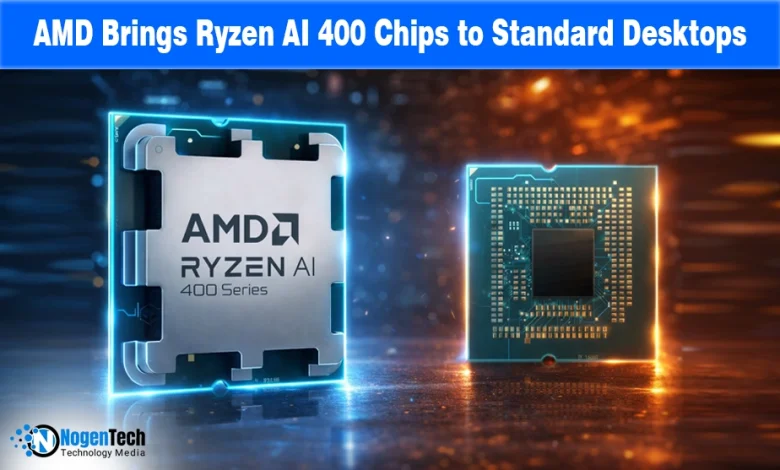
AI-powered personal computing is moving beyond laptops and entering the traditional desktop market. Advanced Micro Devices (AMD) has confirmed plans to bring Ryzen AI processors to standard desktop PCs, introducing dedicated neural processing capabilities directly into consumer and workstation systems.
The move reflects a broader shift toward AI-native computing, where devices run machine learning tasks locally instead of depending entirely on cloud infrastructure.
As AI features rapidly expand across operating systems and applications, AMD’s decision signals that desktop PCs are becoming an important platform for next-generation AI workloads.
What Happened?
AMD announced that its Ryzen AI architecture, previously deployed in mobile processors like the AMD Ryzen 7040 Series, will expand to desktop-class processors.
These chips combine traditional CPU and GPU cores with a dedicated neural processing unit (NPU) designed for AI workloads. The NPU allows PCs to handle machine learning tasks locally, improving efficiency and reducing reliance on cloud-based computation.
According to AMD’s official communications and industry coverage from major technology outlets, Ryzen AI processors can accelerate workloads such as:
- Real-time speech recognition
- Image generation and enhancement
- Video effects and background processing
- AI-powered productivity tools
Instead of sending data to remote servers, the processor performs these tasks directly on the device.
This shift aligns with AMD’s broader strategy to embed AI acceleration across its product ecosystem, including laptops, desktops, and enterprise hardware.
Why It Matters Now
The timing reflects a wider transformation in the PC industry.
Major technology platforms are rapidly integrating AI features into everyday software. For example, Microsoft has introduced AI-powered productivity tools across its ecosystem, while hardware vendors continue to explore ways to support these workloads efficiently.
Local AI processing offers several advantages:
- Lower latency: Tasks complete faster when processed locally.
- Improved privacy: Sensitive data remains on the device.
- Reduced cloud dependency: Users rely less on internet connectivity.
This transition mirrors earlier shifts in computing. When GPUs became common in PCs, they initially targeted gamers but eventually supported video editing, 3D design, and scientific computing. AI hardware could follow a similar trajectory.
Who Is Affected?
The expansion of Ryzen AI processors to desktops could impact several groups.
Consumers
Everyday users may benefit from faster AI-powered features within operating systems, creative software, and productivity tools.
Content Creators
Creators working with photo editing, video production, or generative design tools may see performance improvements when AI workloads run locally.
Developers
Developers can design applications that leverage the NPU for tasks such as machine learning inference, natural language processing, and real-time analysis.
Hardware Manufacturers
Other chipmakers, including Intel and NVIDIA, are also investing in AI hardware for personal computers, making competition in the AI PC segment increasingly intense.
Industry Context
For decades, PC innovation focused primarily on CPU performance, graphics capabilities, and energy efficiency. Now the conversation is shifting toward AI-enabled computing.
Analysts from organizations such as Gartner and IDC have noted a growing industry push toward AI-ready devices, often described as “AI PCs.” These systems include dedicated hardware that accelerates machine learning workloads locally.
The concept aligns with the broader trend of edge AI, where computation moves closer to the user rather than relying solely on centralized cloud infrastructure. AMD’s move into desktop AI processors positions the company to compete directly in this emerging category.
What’s New: Step-by-Step Breakdown
1. Integrated Neural Processing Unit (NPU)
The most important addition is the dedicated neural processing unit.
Unlike CPUs or GPUs, NPUs are optimized specifically for machine learning operations such as matrix calculations used in neural networks. This hardware allows AI workloads to run more efficiently.
2. Hybrid CPU, GPU, and AI Architecture
Ryzen AI processors combine three major compute components:
- CPU cores for general computing tasks
- Integrated graphics for visual workloads
- AI acceleration hardware for machine learning
This hybrid architecture allows applications to distribute workloads across different processing units.
3. On-Device AI Processing
Local AI processing reduces reliance on cloud services.
Applications can perform inference tasks directly on the PC, improving responsiveness while enhancing privacy.
4. AI Software Ecosystem Support
AMD has also worked to support AI development frameworks and software tools.
These integrations allow developers to build applications that leverage on-device AI acceleration effectively.
Impact Analysis
Market Impact
The move reinforces the industry’s shift toward AI-enabled personal computing.
According to industrial reports, chipmakers increasingly compete not only on raw performance but also on AI capabilities integrated into processors.
AMD’s strategy could accelerate the adoption of AI-ready desktop systems.
User Impact
Short-term
- Increased interest in AI-capable PCs
- Faster AI-assisted productivity tools
- Improved performance in creative applications
Long-term
- More software is designed specifically for local AI processing
- Smarter personal computing experiences powered by on-device AI
Developer & Enterprise Implications
For developers, the introduction of desktop NPUs opens new opportunities. Applications could integrate AI capabilities directly into workflows such as:
- Intelligent coding assistants
- Automated media editing
- Real-time data analysis
Enterprise environments may also benefit from local AI processing, particularly in industries that require privacy-sensitive workloads or offline computing capabilities.
Expert Insight & Competitive Context
Industry analysts increasingly view AI hardware as the next competitive frontier in PC processors.
Companies such as Qualcomm and Apple are developing similar strategies for AI‑enabled computing platforms, integrating dedicated neural engines and AI accelerators into their chip designs.
While AMD’s desktop AI processors represent a significant step, the broader industry race will likely determine how quickly AI hardware becomes standard in consumer PCs.
Common Misconceptions
“AI PCs Replace Traditional Computing”
AI acceleration supplements traditional computing rather than replacing it. CPUs and GPUs remain essential for most workloads.
“All AI Processing Moves to the Device”
Local AI improves certain tasks, but many large-scale AI models will still rely on cloud infrastructure.
“AI Hardware Automatically Makes Every App Smarter”
Applications must be designed to use AI acceleration effectively. Without software support, the hardware offers limited benefit.
Future Outlook
The expansion of Ryzen AI processors into desktop PCs suggests that AI hardware will become a core feature of future personal computers. Possible developments include:
- More powerful NPUs integrated into mainstream CPUs
- AI-enhanced operating system features
- Increased adoption of local generative AI tools
As the AI PC market evolves, desktop systems may play an important role in enabling advanced AI applications for developers, creators, and everyday users.
When Not to Rely on Social Media
Tech announcements often circulate rapidly on social media platforms, but short posts rarely capture the full technical context. Clips or headlines about “AI PCs” can oversimplify complex engineering developments.
For accurate information, readers should rely on:
- Official company announcements
- Coverage from established technology publications
- Industry analysis from recognized research organizations
What’s Your Take?
Would you upgrade to a desktop PC with built-in AI acceleration?
Do you see AI-powered processors becoming standard across personal computers in the next few years?
Share your thoughts and predictions.
How This News Was Verified
- Official announcements from Advanced Micro Devices
- Industry reporting from established technology media outlets
- Analyst insights from organizations such as Gartner and IDC
- Public information about Ryzen AI architecture and AI PC development trends
- Reviewed CISA guidelines for responsible tech journalism
All details were reviewed and synthesized according to responsible technology journalism practices, ensuring accuracy, transparency, and compliance with professional reporting standards.