Meta Debuts Muse Spark AI Model Redefining Personal Superintelligence
This is the first AI model from Meta Superintelligence Labs; built from a completely rebuilt AI stack under Chief AI Officer Alexandr Wang, and now powers Meta AI across apps used by more than three billion people.

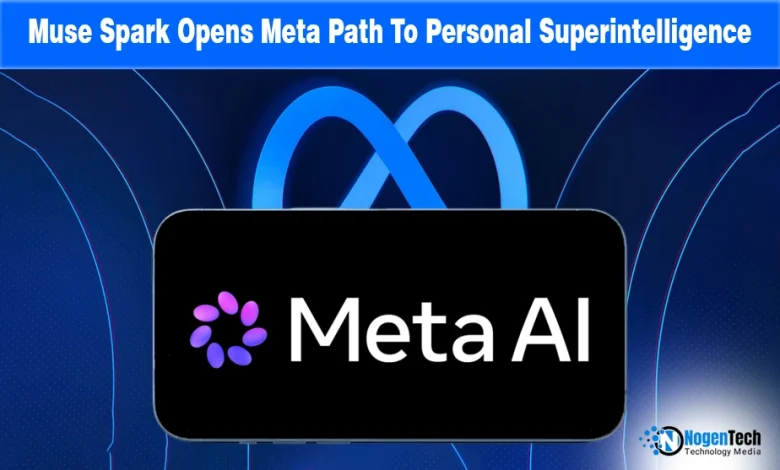
Meta launched Muse Spark on April 8, 2026. It’s the first AI model from Meta Superintelligence Labs and the company’s biggest AI move since restructuring in the summer of 2025. According to Meta’s official AI blog, Muse Spark is the first model in a new “Muse” series.
It’s built for what Meta calls “personal superintelligence”, AI that can solve complex problems in science, math, and health, not just give answers like chatbots.
The model is now live on meta.ai and the Meta AI app, with a phased rollout across Facebook, Instagram, WhatsApp, Messenger, and Meta’s Ray-Ban AI glasses planned for the weeks ahead.
Why Meta Rebuilt Its Entire AI Stack From Scratch
The technical shift behind Muse Spark is not incremental but a complete rebuild.
The model represents what Meta calls a “ground-up overhaul” of its AI infrastructure: new architecture, new data pipelines, and new training techniques. all assembled from scratch over nine months by Meta Superintelligence Labs
This was built in nine months by Meta Superintelligence Labs, as Wang confirmed on X, saying the rebuild is just the first step, with larger models already in development.
According to Meta’s AI blog, the new system allows smaller models to match the performance of older mid-sized Llama 4 models while using far less computing power. Like Mistral Forge, it activates sparingly, meaning similar results at significantly lower cost.
Muse Spark also uses multiple AI agents working at the same time to handle complex tasks. Meta says this improves speed, especially in its “Contemplating” mode, which is designed for deeper, multi-step reasoning.
What Muse Spark Can Do and Where It Falls Short
Muse Spark accepts voice, text, and image inputs, but only produces text output.
As reported by Axios, it includes a fast mode for simple queries and multiple reasoning modes. One of these is a shopping mode that combines large language model capabilities with data on user interests and behavior across Meta’s platforms
Its “Contemplating” mode uses multiple AI agents to handle complex problems. Wang says it performs at a level similar to advanced models like Gemini Deep Think and pro versions of ChatGPT.
However, Axios also reported that Muse Spark is not leading in every area. In coding, Meta says it still lags behind the most advanced models from other companies.
Meta is being transparent about that limitation, framing Muse Spark as a “powerful foundation” with larger models already in active development.
The Open-Source Reversal and What It Signals
One of the most important points about Muse Spark is that it is not open-source.
As reported by Reuters, Muse Spark is a closed, proprietary model. This is a major shift from Meta’s usual approach with the Llama series, which was released as open-source.
By early 2026, Llama models had reached 1.2 billion downloads, about 1 million per day. That open-source legacy gave Meta a developer ecosystem no other lab could match.
Choosing to keep Muse Spark closed shows a strategic shift. Meta now sees its most advanced AI as too valuable to release openly, at least until safety checks are complete.
The integration of Motlbook into Superintelligence Labs signals a move toward fully proprietary agentic ecosystems. Meta says it may open-source future versions, but has not given a concrete timeline.
Meta’s $14.3 Billion Question
Muse Spark is Meta’s first major model release since its $14.3 billion investment to acquire a 49% stake in Scale AI and hire Alexandr Wang as its first Chief AI Officer, according to CNBC.
That investment, and the broader restructuring it enabled, followed CEO Mark Zuckerberg’s dissatisfaction with Llama 4’s performance in April 2025.
Reuters called Muse Spark the first output of a “costly superintelligence team”, coming as Meta plans $115 billion to $135 billion in capital spending for 2026, nearly double its spending in 2025.
A deal with AMD worth $100 billion fuels this growth, providing the hardware capacity needed for such massive superintelligence goals.
Reports noted that Meta’s stock rose more than 9% on the day of the announcement. The company has also indicated plans to offer third-party developers access to Muse Spark’s underlying technology via a private API preview.
This shows that, while the model is not open-source, Meta is building a commercial layer that goes beyond internal use.