Have you ever wondered how a small state government delivers services to remote villages without a single missed email? If yes, then let me tell you that you are not alone. I have also been in the same position. And let me tell you that this is done using State Wide Area Networks (SWAN).
State Wide Area Networks SWAN digital governance is the primary source behind efficient e-services, secure data sharing, and faster decisions.
From connecting district offices to enabling video calls with citizens, SWAN turns fragmented systems into seamless networks. I came to know that there are a alot of people who are unaware of what a State Wide Area Network SWAN is, as they are aware of LAN, MAN, and WAN.
In this blog post, I will discuss what a State Wide Area Network SWAN) is. This will also include how State-Wide Area Networks (SWAN) power digital governance.
What is State Wide Area Networks (SWAN)?
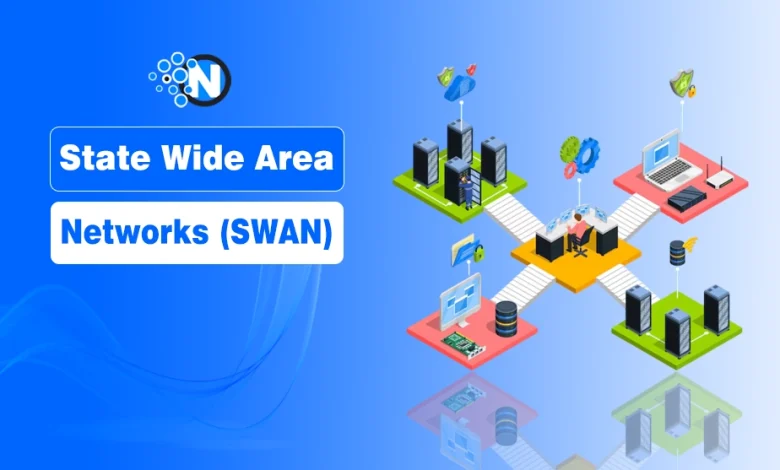
The State Wide Area Network (SWAN) is a secure, dedicated communication infrastructure launched under the National e-Governance Plan (NeGP) of India.
It serves as the Internet backbone to link the government offices between the State Headquarters and all the other District and Block government offices on a stable, high-speed network. SWAN is designed to support data, voice, and video traffic easily. This helps in contributing to efficient Government-to-Government (G2G) and Government-to-Citizen (G2C) services.
The network is meant to enhance administrative efficiency, improve transparency, and facilitate smooth communication among different government units. This will be a key pillar of overall national development in the digital sector. Frequent third-party audits ensure the quality and reliability of the services in the various states.
Key Features of State Wide Area Network (SWAN)
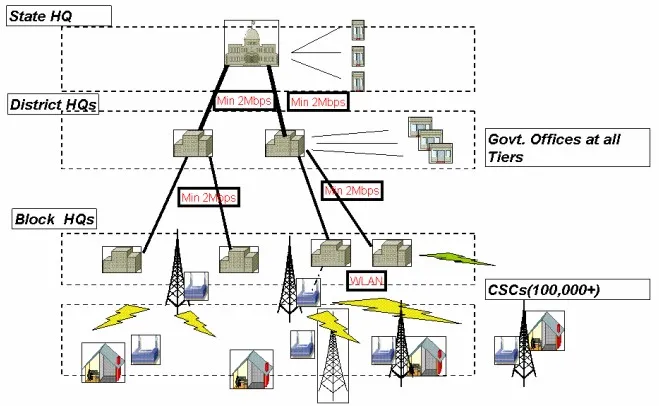
- Hierarchical Architecture: Typically structured with Points of Presence (PoPs) at three levels: State Headquarters (SHQ), District Headquarters (DHQ), and Block Headquarters (BHQ), enabling tiered connectivity across administrative layers.
- High-Speed Connectivity: Designed to support fast data transmission for voice, video, and digital services, SWANs enable real-time communication and service delivery.
- Secure Communication Backbone: SWANs use encryption and controlled access protocols to ensure data integrity and protect sensitive government information.
- Support for E-Governance Applications: SWANs facilitate the deployment of digital services like citizen portals, government databases, and online grievance systems by providing reliable infrastructure.
- Scalability and Integration: Built to accommodate growing digital demands, SWANs can integrate with cloud platforms, mobile networks, and other IT systems for expanded functionality.
- Voice, Video, and Data Convergence: SWANs support unified communication, allowing government departments to collaborate seamlessly across formats.
- Improved Service Delivery: By connecting remote offices and reducing response times, SWANs enhance the efficiency and transparency of public service delivery.
How State Wide Area Network SWAN Powers Digital Governance?
State Wide Area Network (SWAN) is the driver of the digital governance system. It offers the necessary highly secured and fast communication system that makes the provision of the e-governance services effective and efficient throughout the state.
Here is how SWAN powers the digital governance all over the nation:
G2G (Government-to-Government)
SWAN allows connecting the offices of the government between the State Headquarters and the District and Block Governments. It creates the conditions of inseparable communication between different government sectors and the mutual flow of information.
This integrated administration gives officials space to work efficiently and review processes more easily. It also makes the right choices without travelling long distances.
Ensuring G2C (Government-to-Citizen) Service Delivery
The network makes up the system around which citizen services are provided online. Citizens can receive services related to application forms, certificate issuance, and utility bill payments through Common Service Centres (CSCs).
Increasing Efficiency and Accountability
SWAN increases the efficiency and accountability of government functions. This is done by automating workflows and simplifying processes. This is also achieved by ensuring the government has a reliable network for sharing information.
This not only reduces administrative costs but also the time and effort citizens need to use the services, thereby reducing corruption.
Technical Performance and Reliability
Technical performance and reliability on the State Wide Area Network (SWAN) is controlled by a set of technical specifications and Service Level Agreements (SLAs). In reality, performance depends on the state and is affected by pressure.
Architecture and Speed
A three-level hierarchical structure, comprising state, district, and block headquarters, is used in SWAN.
All of them are linked through dedicated leased lines with bandwidths of about 2 Mbps or more, and in uncommon cases, 40-50 Mbps at the DHQ level. This is done through a combination of fibre-optic cable and wireless technologies.
Convergence
It is a converged network to serve data, voice, and video services. This allows management to use such video conferencing applications.
Security
The network is a secure, Closed-User-Group (CUG) intranet. A set of security policy guidelines is advocated and used to ensure internal and external security threats.
Scalability
The design is scaled to accommodate more government offices horizontally and vertically as e-governance projects are increased.
Service Level Agreements
The Department of Information Technology (DIT) guidelines provide specific SLAs for network availability.
For core links such as State HQ to District HQ, availability must be at least 99.5% during peak business hours, and at least 99% must be maintained during core links.
Redundancy
This is done to promote and maintain constant, dependable connectivity, where most states install redundant links. This is often done through a combination of fibre and wireless technologies to reduce downtime in the event of a connection failure.
Challenges in SWAN Implementation
Now I’ll give you the modern-day challenges that are getting in the way while working with SWAN implementation:
Security Concerns
This system interconnects many government agencies, creating a vast attack surface. Maintaining strong cybersecurity standards, access controls, threat monitoring, and applying effective security policies across the entire network architecture are significant challenges and a continuous endeavour.
Operational and Maintenance Problems
Network monitoring and maintenance are effective in different states. It is not always consistent to ensure that faults are resolved on time and that network operators comply with Service Level Agreement requirements.
Human Resources and Expertise
Qualified personnel, engineers, and managers often lack the skills and expertise that are needed to maintain the complex network infrastructures. Moreover, general personnel might not have the required knowledge on security awareness.
Final Thoughts
State Wide Area Network (SWAN) is the foundation of modern e-governance, connecting government offices and improving digital service delivery even in remote areas.
Personally, as someone interested in technology and governance, I truly appreciate how SWAN makes government services faster, more transparent, and easily available to everyone. With strong architecture, strong security, and high reliability, SWAN simplifies communication and decision-making for both citizens and officials.
As digital demands grow, the scalability and efficiency of SWAN will keep supporting smart governance in the future, making everyday lives better for citizens like you and me.