Nvidia Leads $4B Optical Networking Expansion with Lumentum, Coherent
Strategic partnerships with Lumentum and Coherent highlight Nvidia’s photonics strategy to scale next-generation AI data centers.

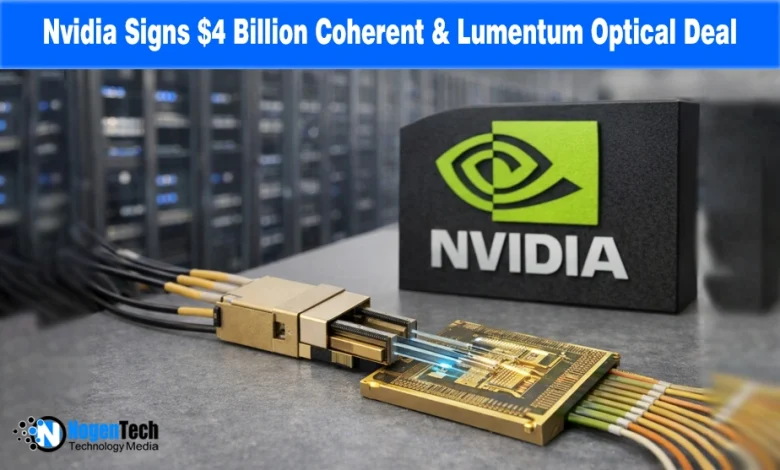
Nvidia has announced a major move to strengthen the infrastructure behind artificial intelligence: a Nvidia $4 Billion optics Investment aimed at accelerating next-generation data-center networking.
The company committed about $2 billion each to Lumentum (LITE) and Coherent Corp (COHR) through multiyear partnerships aimed at expanding optical component manufacturing capacity and advancing photonics technologies used in large-scale AI clusters.
The announcement highlights a growing industry realization: scaling generative AI and advanced machine learning systems requires far faster data-center networking than traditional copper infrastructure can provide.
What Happened?
Nvidia revealed plans to deepen collaboration with optical component manufacturers, including Lumentum Holdings and Coherent Corp, to develop advanced optical connectivity for AI supercomputing clusters.
The effort centers on expanding optical interconnect technologies used in AI data centers, where optical technologies, such as fiber wavelength systems, are increasingly deployed to move large volumes of data between GPUs more efficiently than traditional copper-based transmission.
The partnerships aim to:
- Expand advanced optical component manufacturing capacity
- Accelerate the development of high-bandwidth photonics technologies
- Support large-scale AI clusters requiring faster and more energy-efficient interconnects
The move aligns with public statements by Nvidia CEO Jensen Huang emphasizing optical networking as a critical foundation for scaling next-generation AI supercomputers.
Why It Matters Now
The announcement comes amid an AI Reality Check, as investors increasingly focus on the physical infrastructure required to support large-scale AI models.
Training advanced AI systems requires massive data transfer between GPUs, and a growing portion of AI infrastructure investment is focused on high-bandwidth networking and data-movement technologies in addition to compute resources.
This helps explain why Nvidia is investing heavily in optical networking.
The shift also aligns with strategies pursued by major technology players. As cited by The Wall Street Journal, companies such as Microsoft, Google, and Meta are building massive AI clusters that depend on faster networking layers to keep thousands of GPUs synchronized.
In that environment, optical technologies are rapidly replacing copper connections.
Who Is Affected?
Developers
Developers building large-scale AI models benefit from faster GPU communication, which shortens model training cycles.
Enterprises
Enterprises investing in private AI infrastructure benefit from scalable, high-bandwidth networking architectures that support more efficient AI workloads.
Consumers
Faster AI infrastructure ultimately improves consumer AI applications such as voice assistants, search, and generative tools.
Investors
Investors are closely monitoring Nvidia’s optical investments and their implications for Lumentum and other AI infrastructure suppliers.
Industry Sectors
Cloud providers, semiconductor suppliers, and telecommunications infrastructure companies are affected as Nvidia’s optical investments increase focus on AI networking technologies.
Industry Context
The partnerships reflect several major industry trends shaping AI infrastructure.
Silicon Photonics Adoption
According to industry research, hyperscale data centers are increasingly adopting silicon photonics and other optical networking technologies to overcome the bandwidth and power limitations of traditional copper interconnects.
Optical Interconnect Shift
As GPU clusters grow larger, the industry is increasingly adopting optical interconnects over traditional copper connections.
Copper connections struggle with:
- signal loss over distance
- heat generation
- power inefficiency
Optical technologies enable higher bandwidth, lower latency, and energy-efficient data transmission in large-scale AI.
Infrastructure Bottlenecks
The industry is facing next‑generation AI training infrastructure scarcity as demand for compute clusters grows faster than networking capacity.
Industry reporting form Seeking Alpha shows that as GPU clusters expand, demand for high‑bandwidth optical networking components is rising, reflecting networking capacity constraints.
What’s New: Step-by-Step Breakdown
1. Core Technology
The partnerships focus on silicon photonics technologies for AI data centers, which enable optical data transmission between GPUs and network switches.
This reduces latency and increases bandwidth dramatically.
2. System Architecture
According to Reuters, Nvidia is exploring the co-packaged optics (CPO) technology, which integrates optical components directly into network switches.
This design minimizes signal loss and improves efficiency compared to traditional pluggable optical modules.
3. Optical Circuit Switching
Optical Circuit Switching (OCS) technologies are being introduced for AI data centers, enabling data to remain in the optical domain through network switches rather than requiring repeated electrical conversions.
This architecture can improve networking efficiency as compared with traditional electrical switching.
4. Manufacturing Expansion
As announced by Nvidia, the U.S.-based semiconductor fabs of Lumentum and Coherent are expanding production capacity for optical components as part of partnerships with Nvidia.
This expansion includes scaling Indium Phosphide manufacturing, a material widely used in high-performance photonic devices.”
Impact Analysis
Market Impact
The initiative could influence Nvidia’s data center networking segment, which analysts view as a key driver of long-term growth.
Optical networking vendors such as Lumentum and Coherent are expected to benefit from long-term supply agreements with Nvidia.
User Impact
Short-Term
- AI infrastructure operators may see improvements in network performance within new GPU clusters.
- Faster data transfer between GPUs could increase training efficiency for current AI workloads.
Long-Term
- Photonic networking could enable dramatically larger AI models and faster training times.
- Advanced optical interconnects may allow significantly faster training times for next-generation AI systems.
Developer & Enterprise Implications
Developers and infrastructure architects may need to strategically adapt their system architectures to fully leverage photonic networking environments.
Moreover, enterprises building AI infrastructure may also need to redesign and optimize their data-center networking layers to effectively accommodate emerging optical switching technologies.
Expert Insight & Competitive Context
Analysts say the shift toward photonic networking is inevitable as AI clusters scale. According to analysis cited by McKinsey & Company, future AI data centers will require significantly faster interconnects to support distributed model training.
Industry reporting from Forbes notes that Nvidia has significantly expanded its venture investment activity, participating in more than 50 startup funding deals in 2025 as part of a broader strategy to support AI ecosystem growth, including infrastructure and hardware technologies.
Together, these initiatives reinforce Nvidia’s goal of controlling the full AI infrastructure stack, from GPUs to networking.
Common Misconceptions
“This is just another semiconductor deal”
In reality, the partnerships focus on optical networking infrastructure rather than traditional chip manufacturing.
“AI scaling is limited only by GPUs”
Many experts note that networking bandwidth and data movement are now just as critical as compute performance in AI data centers, where high‑bandwidth, low‑latency interconnects are essential to prevent bottlenecks that negate GPU advantages.
Future Outlook
If Nvidia’s photonics strategy succeeds, optical networking could become a standard architecture in AI data centers.
The combination of co-packaged optics market growth, expanded photonics manufacturing, and optical switching technologies may define the next generation of AI infrastructure.
In that scenario, Nvidia’s optics investments could prove as strategic as its earlier GPU breakthroughs.
When Not to Rely on Social Media
Technology announcements are often oversimplified or exaggerated on social media platforms.
Complex developments such as optical networking, photonics manufacturing, and AI infrastructure scaling require careful technical analysis and verified reporting.
Relying solely on social media can lead to misunderstandings about what the technology actually enables.
What’s Your Take?
Do you think photonic networking will become the standard architecture for AI data centers?
Or will new chip architectures reduce the need for optical networking infrastructure?
Share your thoughts and predictions.
How This News Was Verified
- Official company announcement from Nvidia Newsroom
- Lumentum official News Release
- Industry reporting from major technology publications, including Reuters, Seeking Alpha, and credible reporting outlets
- Analyst insights from established firms like the Wall Street Journal and McKinsey & Company
- Reviewed CISA guidelines for responsible tech journalism


![Top Tech Stories of 6th week [2026]](https://www.nogentech.org/wp-content/uploads/2026/02/Top-Tech-Stories-of-7th-Week-2026-390x220.webp)