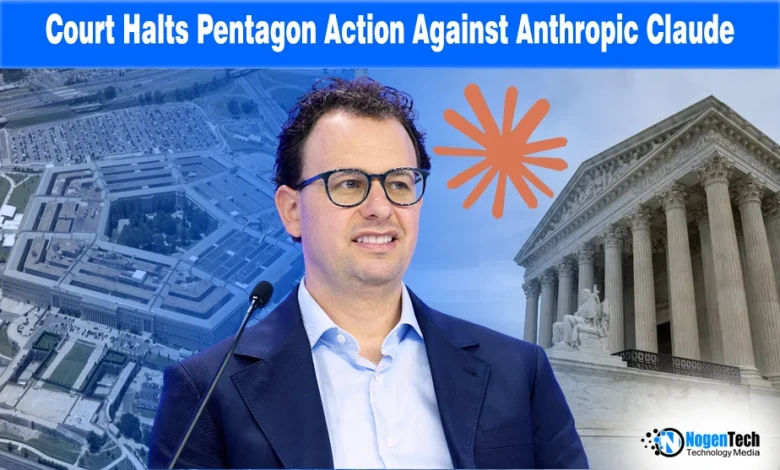
U.S. Federal Judge Rita Lin of the Northern District of California issued a preliminary injunction on March 26, 2026, temporarily suspending the Pentagon’s designation of Anthropic, the San Francisco-based AI safety company behind Claude, as a supply chain risk to national security.
As Reuters reported, Lin also blocked Donald Trump’s directive ordering all federal agencies to cease using Anthropic’s products.
The 43-page ruling found the government’s actions were likely unconstitutional and legally arbitrary, giving Anthropic a temporary victory in a case that places AI safety guardrails versus government authority at the center of a federal courtroom.
How Claude’s Guardrails Triggered Pentagon’s Blacklist
The Anthropic-Pentagon conflict began in late February 2026 when contract negotiations between Anthropic and the Department of Defense broke down over two limitations embedded in Claude: it would not support fully autonomous lethal weapons systems and would not be used for domestic mass surveillance of American citizens.
The Pentagon argued it needed unrestricted access to Claude for all lawful purposes, particularly in wartime scenarios.
Defense Secretary Pete Hegseth then posted on X, declaring Anthropic a supply chain risk, making it the first American company to receive a designation historically reserved for foreign adversaries and terrorist linked entities.
The practical consequence was immediate: the label required defense contractors, including Amazon, Microsoft, and Palantir, to certify that they do not use Claude in any work performed for the military.
This effectively forced Anthropic’s technology to be scrubbed from the entire defense contractor supply chain, not just the Pentagon itself.
Why Judge Lin Ruled Against the Pentagon
In her 43-page opinion, Judge Rita Lin said the law does not support the idea that an American company can be labeled a potential adversary just for disagreeing with the government.
She found the designation was not based on real national security concerns but on Anthropic’s public stance on how its AI systems should be used.
Lin noted that the Pentagon’s own records showed it designated Anthropic as a supply chain risk because of its “hostile manner through the press”, not because of any technical vulnerability to government systems.
Bloomberg reported internal communications showing Pete Hegseth called Dario Amodei a liar with a God complex and gave a 5:01 PM deadline to accept Pentagon terms before blacklisting.
Lin was direct in her assessment: “Punishing Anthropic for bringing public scrutiny to the government’s contracting position is classic illegal First Amendment retaliation,” as NPR reports.
She paused the ruling for seven days to allow the Justice Department to seek emergency relief from the U.S. Court of Appeals for the 9th Circuit before the injunction takes full effect.
Anthropic’s Constitutional AI at the Core
Wired reported that the dispute centers on Anthropic’s Constitutional AI, an alignment system that embeds safety constraints directly into Claude’s training. The Pentagon argued that once it procures an AI system, it should have full operational control, including overriding the model’s built-in restrictions.
Anthropic countered that Constitutional AI cannot be disabled. As CNBC reported, the company stated it had already deployed its systems across Pentagon networks after national security vetting.
Removing the safety architecture, Anthropic argued, would not produce a more capable military tool; it would produce an unreliable one.
Who the Anthropic Ruling Actually Affects
As the BBC reported, several third parties filed legal briefs supporting Anthropic’s case, including Microsoft, industry groups, tech workers, retired U.S. military leaders, and Catholic theologians.
This broad coalition shows the case has been understood as setting a precedent for every AI company working with or seeking federal contracts.
TechCrunch reported the case has unsettled the AI startup ecosystem, with investors reassessing risks tied to defense contracts. Axios noted a parallel legal challenge to separate authorities used in the designation is ongoing in Washington, D.C., meaning the broader dispute remains unresolved.
Reports note that a parallel case challenging separate legal authorities Hegseth invoked to make the supply chain risk designation is still proceeding before a federal court in Washington, D.C., meaning the legal battle is not resolved by Thursday’s injunction.
What’s Next For Anthropic Versus Pentagon
As CNBC reported, a final ruling could take months. The Justice Department has seven days from March 26 to seek an emergency stay from the 9th Circuit. If it does not, the injunction will allow Anthropic to resume business with federal agencies and contractors while the case proceeds.
Reuters reported the Pentagon has not commented on the ruling. Whether the Trump administration appeals or negotiates a revised contract framework with Anthropic will shape the next phase of what has become a defining case for AI governance in U.S. federal courts.
Source: Federal judge sides with Anthropic in first round of standoff with Pentagon