Jeff Bezos Seeks $100 Billion to Transform Legacy Manufacturing With AI
The Wall Street Journal reported on March 19, 2026, that Bezos is in early talks with sovereign wealth funds and major asset managers to raise the largest AI-focused industrial transformation fund ever attempted.

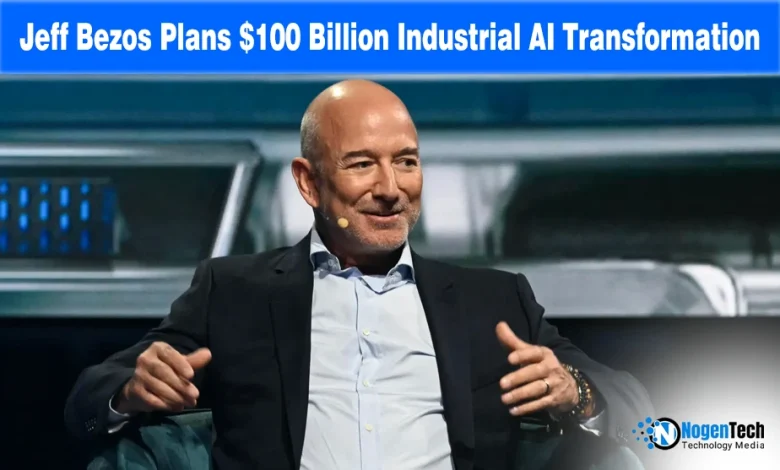
Amazon founder Jeff Bezos is in early talks to raise $100 billion for a new fund that would acquire legacy manufacturing companies across aerospace, semiconductors, and defense and rebuild them from the inside using artificial intelligence, The Wall Street Journal first reported on March 19, 2026.
The fund is directly tied to Bezos’s stealth AI startup, where he serves as co-CEO alongside former Google executive Vik Bajaj.
As Reuters confirmed, Bezos has already been meeting with the heads of sovereign wealth funds in the Middle East and recently traveled to Singapore as part of the fundraising effort. This marks the most ambitious private capital push into AI-driven industrial transformation on record.
How Project Prometheus Powers the $100B Plan
The Wall Street Journal reported that the proposed fund is not a standalone financial vehicle; it is the commercial arm of Project Prometheus, the AI startup Bezos co-founded in late 2025.
Project Prometheus launched with $6.2 billion in funding, with a stated goal to transform the engineering and manufacturing industries with AI and automation, and currently has around 120 employees with offices in San Francisco, London, and Zurich, according to Silicon Angle.
Prometheus develops engineering simulation software predicting material stress and airflow via “physical AI” or digital twins.
This tech models industrial environments like factories and supply chains with high precision. It allows engineers to virtually test changes before applying them to physical components on the factory floor.
The new $100 billion manufacturing fund would support that mission directly by buying up companies that would ultimately use Prometheus’s AI models, TechCrunch reported.
Acquisition targets confirmed by the WSJ include companies in the aerospace, chipmaking, and defense sectors, where legacy infrastructure is deeply entrenched, but AI integration remains minimal.
Why Bezos Is Targeting Old Industrial Sectors
Forbes reports the fund targets legacy manufacturing firms with established infrastructure but lacking AI expertise. Instead of building anew, the Prometheus-linked fund acquires these companies to deploy AI directly into existing operations.
Robert Nelsen, ARCH Venture Partners co-founder and Prometheus director, noted the challenge of reinventing the physical world amidst rapid AI innovation.
The New York Times highlighted Bezos’s belief that manufacturing is on the cusp of AI-driven automation, a conviction fueled by his largest post-Amazon fundraising effort.
The Information noted that the strategy mirrors private equity approaches in sectors like real estate, but with greater technical depth.
By using Prometheus simulation models, the fund aims to unlock productivity gains that conventional financial engineering cannot achieve, marking a shift toward high-precision industrial transformation.
The Prometheus Coalition and Global Investor Response
Bezos serves as co-CEO of Project Prometheus alongside Vik Bajaj, a physicist and former Google X executive. The team includes talent recruited from OpenAI, DeepMind, and Meta, and Blue Origin CEO David Limp recently joined the board.
Bloomberg noted that this marks the first time Bezos has taken a formal operational role at a company since stepping down as Amazon’s CEO in 2021, a signal of how seriously he is treating the Prometheus mission.
The Wall Street Journal reports JPMorgan Chase is in talks to back the effort via its $10 billion Security and Resilience Initiative, led by Todd Combs. To meet the $100 billion target, Bezos engaged sovereign wealth funds in the Middle East and institutional investors in Asia.
TechCrunch noted this capital pool necessitates a global financial coalition, marking a shift where AI dictates industrial capital flow.
Who Does This Fund Actually Affects
For the developer and engineering community, Prometheus’s focus on physical AI represents a meaningful expansion of where frontier AI is being applied, moving beyond language and code generation into simulation, materials science, and industrial process modeling.
Reaching the $100 billion target would trigger industrial AI integration at an unprecedented scale, according to Investing.com. This would dwarf any previous private sector effort to modernize global manufacturing systems.
For workers in aerospace, chipmaking, and defense, the implications are significant. The fund’s explicit goal is to accelerate automation inside acquired companies. Reuters noted this process faces intense regulatory scrutiny, particularly where national security governs foreign ownership and technology transfer.
What’s Next For Bezos and Project Prometheus
The Wall Street Journal reports that fundraising remains in its early stages with no confirmed closing date for the $100 billion vehicle.
Simultaneously, Project Prometheus is discussing a separate $6 billion funding round to accelerate AI model development ahead of any initial acquisitions.
While Jeff Bezos has not made a public statement and spokespeople have declined to comment, the full scope of the plan is still emerging.
Ultimately, the scale of this initiative signals a historic pivot toward a fully automated and AI-integrated industrial future.